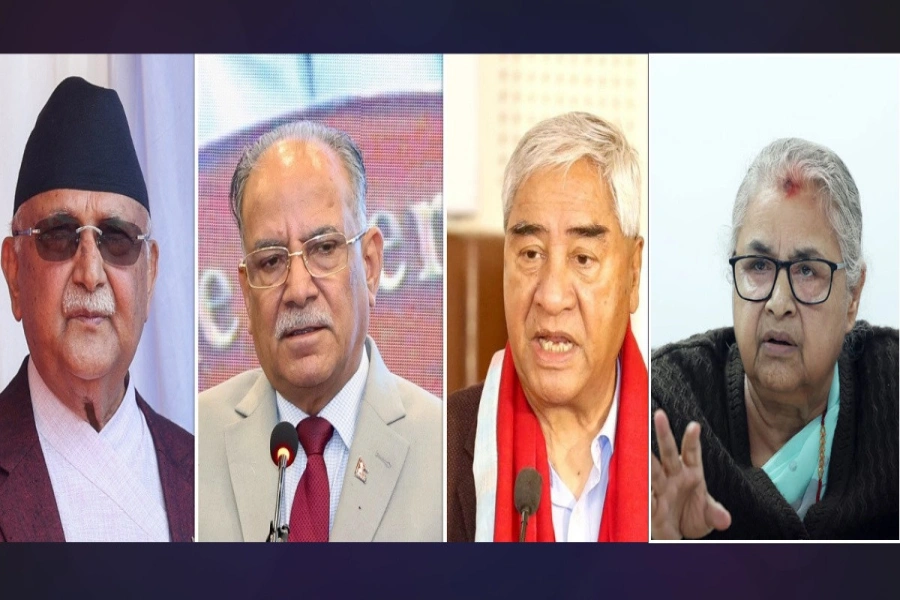
Addressing a public event on December 25th, Prime Minister KP Oli admitted to the failure of his government to live up to people's expectations. If he had it his way, said the sexagenarian prime minister, he would have formed a much smaller cabinet—not the 40-member (and expanding) behemoth it is today—so that his government could quickly ease people's hardships. But, alas, "time was not conducive," the CPN-UML chairman lamented. This is a shameful excuse. During his 20 months in power his immediate predecessor as prime minister, Sushil Koirala, was rightly blamed for prevarication. Koirala had neither been able to take the protesting Madheshi forces into confidence nor was his government able to push through a constitution through the Constituent Assembly. So when Oli replaced Koirala at the top back in October there was a hope that the straight-talking and decisive Oli would give new impetus to the stall constitutional process. And he did. It was due to his steadfast resolve not to bow down before foreign forces, however strong, that the new constitution became possible on September 20th. It would have been better still had he been able to garner the support of Madheshi parties. But even without them, the new constitution, with the support of over 85 percent lawmakers, was, undoubtedly, a feather in Oli's cap.But the enormous political capital Oli was able to earn in the process, almost overnight, especially among non-Madheshis, is being frittered away just as quickly. First, some members of his government were implicated in the black-marketing of fuel and cooking gas. But instead of punishing them, Oli chose to look the other way. Now to please the smaller parties on whose support his majority government stands, he is in the process of fashioning the biggest cabinet in the democratic history of Nepal. Existing ministries are being broken up to create new ones. Already, his unwieldy cabinet has an astonishing six deputy prime ministers. The creation of three new ministries on Thursday, from the existing 26, is estimated to cost the national exchequer an additional 600 million rupees a year. For the prime minister to try to justify such an open abuse of his power by implying that he had to do so to keep his governing coalition intact indicates that Oli is far from the 'man of action' as he likes to portray himself.
It also shows what a weak prime minister he is, his vision for the country easily warped by compulsions of leading a fractious coalition. But more than anything else it suggests that Prime Minister Oli is these days more concerned about hanging on to his post at any cost than in properly governing the country and addressing people's concerns. To give continuity to his reign Oli is apparently ready to ignore blatant corruption and to misuse state resources. Another of his signature failure has to be his inability, for whatever reason, to seriously engage the Madheshi parties and end the prolonged economic blockade. Consequently, even Oli's one-time hardcore supporters are these days struggling to justify the continuity of his government.
Related story
Debased polity