

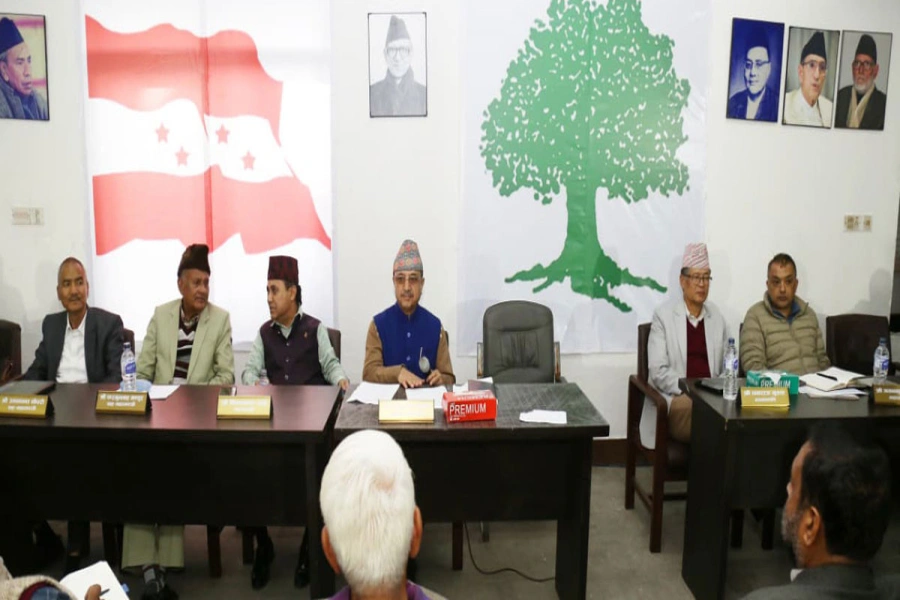
KATHMANDU, Dec 26: With just 15 days remaining before the Nepali Congress (NC)'s 15th General Convention, as per the party’s announced schedule, the country’s oldest democratic party appears stuck at the starting line. At a moment when it should be racing through final preparations, the NC finds itself bogged down in a basic question: whether to form one of its most powerful bodies—the Parliamentary Committee.
The issue surfaced during the ongoing meeting of the party’s Work Execution Committee (WEC), which began on Wednesday to deliberate on matters including the preparation of the proportional representation list for the House of Representatives (HoR) election scheduled for March 5. According to the party statute, the Parliamentary Committee plays a central role in selecting candidates for local, provincial and federal elections, as well as deciding which leaders will represent the party in the federal cabinet.
Clause 31 of the NC statute states that party office bearers and the parliamentary party leader are ex officio members of the committee. In addition, the party president is required to propose 11 central committee members, whose names must then be endorsed by the central committee.
Yet it is only now—four years after the 14th General Convention—that the question of forming the Parliamentary Committee has formally arisen. “There is an argument that since candidates were previously finalized through the Work Execution Committee, we should continue the same practice,” a leader said, referring to discussions in the meeting. “No decision has been made.”
Kargil runner wins 'Mount Everest Marathon Goodwill Prize'

In the intervening years, the party has contested local, provincial, HoR and National Assembly elections, as well as by-elections. Still, the leadership felt no urgency to form the committee mandated by its own statute. During this period, the NC also joined the government multiple times, but the selection of ministers was not routed through the Parliamentary Committee. Instead, names were forwarded at the discretion of individual leaders.
When the 14th General Convention elected Sher Bahadur Deuba from the senior generation as party president and Gagan Kumar Thapa and Bishwa Prakash Sharma from the younger generation as general secretaries, expectations were high. Party workers and the wider public alike believed the NC would finally operate in line with its statute and institutional procedures. Four years on, however, the party has neither adhered to its own rules nor managed to regain public confidence. Weakened by factionalism and ad-hoc decision-making, the NC now finds itself belatedly debating the formation of the Parliamentary Committee.
Clause 60 of the statute requires all party bodies to be fully constituted within six months of a general convention. Yet even today, the WEC and several key departments and bodies remain incomplete. Leaders say factional disputes—from the center down to the ward level—have prevented even routine meetings of some party structures.
Although the statute mandates central committee meetings at least once every two months, such meetings have been held only sporadically, mostly in times of crisis. The party’s publicly announced action plan has also failed to move beyond paper.
The statute also envisions a General Council meeting every year except in convention years. Since the 14th General Convention, however, the NC has convened the Mahasamiti meeting only once. Although that meeting passed several proposals with recommendations, it took six months to finalize them, and they were never forwarded to the lower bodies for implementation.
Questions over procedural compliance have surfaced elsewhere as well. On November 24, 2024, party president Deuba nominated central committee member Umesh Shrestha as treasurer. Clause 21(4) of the statute requires the president to propose the treasurer from among elected central committee members, with the nomination subject to endorsement by the central committee. That endorsement has yet to happen. Despite the apparent procedural lapse, neither of the two general secretaries nor other senior leaders formally raised objections.
The party’s preference for ad-hoc management has also stalled the renewal of its major sister organizations. Although President Deuba formed three directive committees—each led by a joint general secretary and supported by two central committee members—to oversee their conventions, the Nepal Students’ Union, Nepal Tarun Dal and Nepal Women’s Association have not held general conventions even after a decade. Notably, on February 15, 2022, the WEC dissolved the central committees of 10 sister organizations for failing to hold regular conventions. The NSU, Tarun Dal and Women’s Association have not held conventions since 2016.
Meanwhile, a leader said Thursday’s WEC meeting also discussed setting criteria for selecting proportional representation candidates. “The general convention date will certainly be postponed,” the leader said, “but there has been no discussion on when.”
Party spokesperson Prakash Sharan Mahat attributed the likely delay to complications in managing active membership. Noting that the general secretary chairs the Active Membership Management Committee under the statute, Mahat told journalists, “Despite sustained efforts at the district level, the work could not be completed uniformly.”
Central committee member Pradeep Paudel, however, accused the party leadership of lacking the will to hold the general convention. “For the Congress to win elections, holding a general convention is the first condition,” he said. “Party workers across the country should not be kept in such uncertainty.”
Leaders at the lower levels have long accused the leadership of attempting to secure their own positions and political futures by limiting conventions to just two tiers ahead of the general convention. Paudel said that if it is not possible to hold conventions at all levels before the general election, the party should at least conduct conventions at three levels, change both policy and leadership, and then head into the polls.





