What were you doing when you were a teenager?
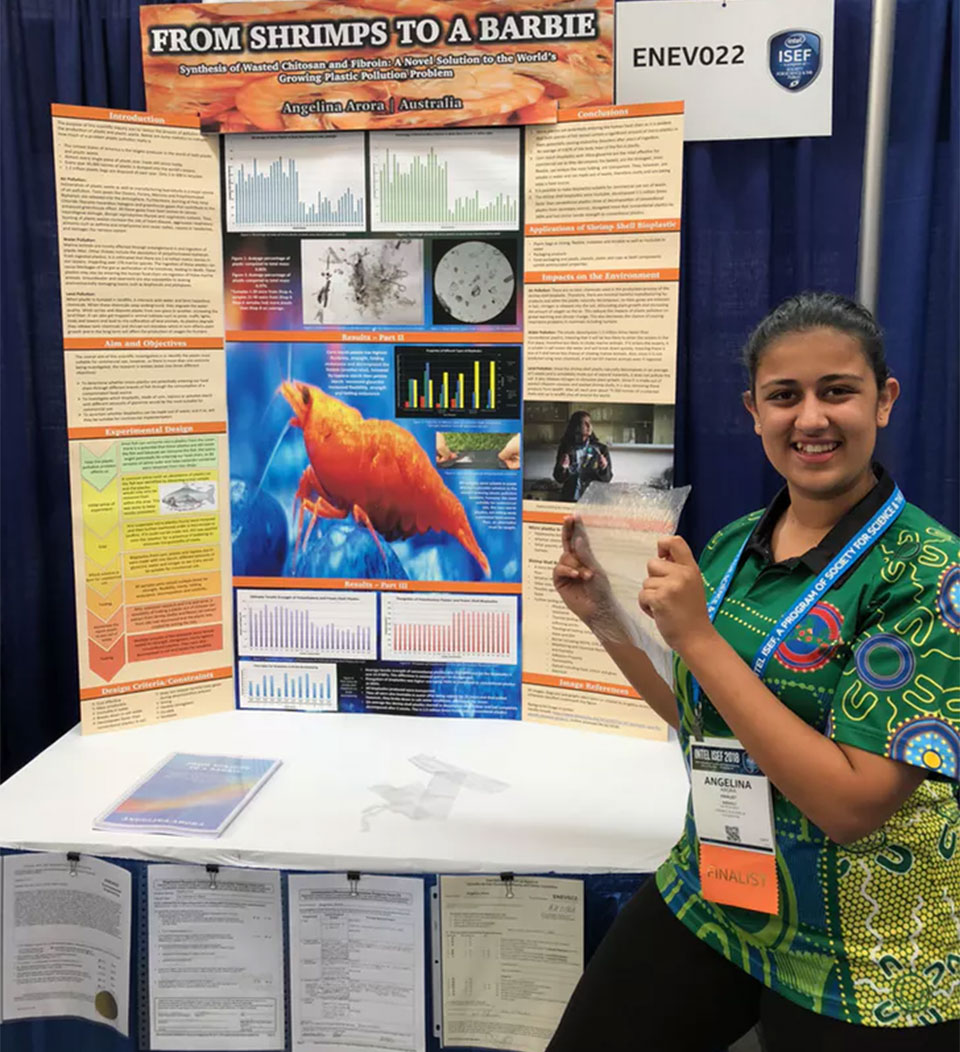
Riding bikes, watching movies, learning trigonometry perhaps? Angelina Arora, from Sydney Girls High School, is doing all these things, but Angelina Arora is not your average teenager.
Arora explained to National Geographic the moment when she first understood the impact plastic was having on the environment. One day when she was a young girl, she went out shopping to the local supermarket with her mother when she noticed that her mother paid for plastic bags, curious, she asked the cashier why. The cashier responded that it was to deter people from using plastic bags and therefore help save the planet.
This idea, and Arora’s strong love of science is what guided her to create an extremely sophisticated biodegradable plastic at age 16. However, the journey was not an easy one. After experimenting and failing with different kinds of organic waste such as banana peels, Arora turned to prawns after noticing the similarities between their shells and plastic.
HIV/Aids and Stigma

“I looked at prawns and thought what makes their shells look like plastic? Maybe I can take that out and use it someway and bind it to make a plastic-like material, “Arora explained to National Geographic in an interview.
“I extracted a carbohydrate called chitin and chemically converted it into chitosan and mixed it with fibroin which is a protein in silk cocoons.”
She found that the combination of the two organic products created a plastic-like material that decomposed 1.5 million times faster than commercial plastics, completely breaking down within 33 days.
Her invention won her the Innovator to Market Award in the 2018 BHP Billiton Foundation Science and Engineering Awards and international recognition at the Intel International Science and Engineering Fair where she won 4th in the world as well as a comprehensive scholarship to a prestigious US university against students from over 81 countries.
"The world is changing faster than many of us can keep up with, but science, technology, engineering, and maths can guide that future through innovation," CSIRO’s Chief Executive Dr. Larry Marshall explained in a press release.
"We know that the achievements of the winners and finalists will inspire other students to become innovators in solving the big challenges that face our world."
However, Arora’s sights are set on the bigger picture.
“Everyone should do whatever they can, so I’m just trying to play my part,” she urges.
“Eliminate the things you don’t need, plastic straws for example, and just drink from the cup.”
At just 16, Arora has a bright scientific future ahead of her, one that will no doubt affect positive change within our society in the coming years.
“Every time I fail or things don’t work out in the lab, I always think back to why I started doing it and that is to change the world and make a difference, make oceans plastic-free and continue striving to achieve what I’ve always wanted to do as well as encourage other young people, especially young girls, to make a difference to the world, in whatever domain their passion lies.”