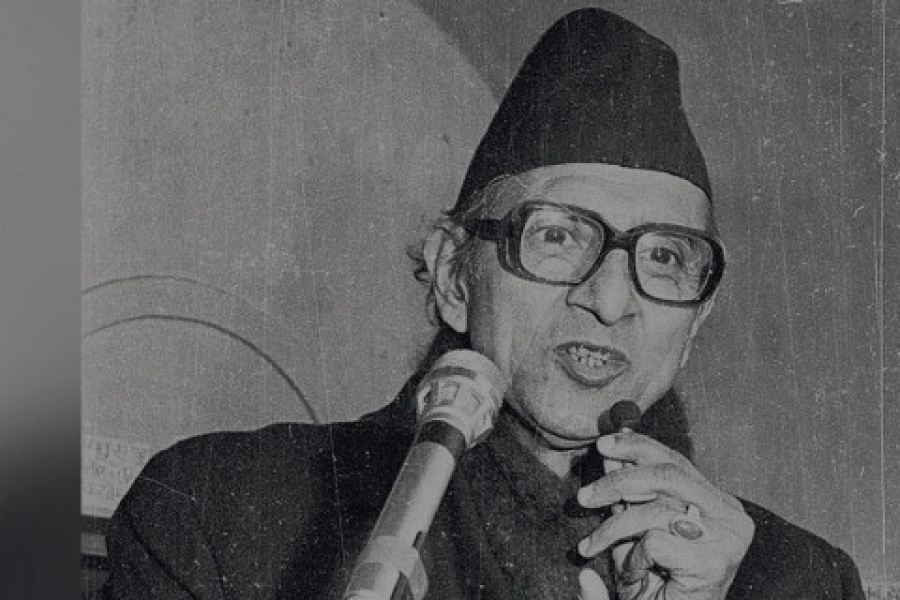
KATHMANDU, Dec 31: When the founder of Nepali Congress (NC) BP Koirala returned to Nepal on December 30, 1976, embracing the policy of national unity and reconciliation, he warned that the country was increasingly being driven by self-interest, sectarianism, individualism, and an outward-looking political mindset. Nearly five decades on, those very tendencies continue to shape Nepal’s political landscape—this time within the party he founded.
BP Koirala and other leaders returned home from exile in India 49 years ago, placing national interest above all else in their quest to restore democracy. While Nepal today has a democratic system, the challenges BP had cautioned against remain deeply entrenched in politics.
The constitution promulgated by the Constituent Assembly appears, in effect, to be in a “coma.” Parliament—the supreme representative body of the people—has been dissolved. An elected government has been replaced by an interim administration, and the Sushila Karki-led interim government has announced elections, pledging to return power to an elected leadership.
The election date has been set for March 5, 2026, and political parties have already submitted their closed proportional representation lists to the Election Commission. In many ways, the electoral process has crossed its midpoint. Yet skepticism and uncertainty surrounding the polls refuse to fade.
If elections are held on schedule, the country could return to the democratic track. But BP Koirala’s words from 1976 resonate sharply today: “We emphasized democracy alone. Now a new dimension has been added—the protection of the nation’s very existence.”
His belief that “if the nation does not survive, neither will we,” appears to echo in current political discourse. Conversations with leaders across parties reflect a growing anxiety that Nepal’s sovereignty itself may be at risk.
National Unity and Reconciliation Day being observed today

At a time when political unity is most needed, the NC finds itself adrift. Even after the September 8 crackdown and the destruction that followed on September 9, party leaders have failed to rise above power struggles and personal ambitions to stand decisively for the nation and the people.
Internal unity and fraternity within the party continue to erode as leaders remain surrounded by interest groups. The party has been unable to settle even on the timing of its general convention. Although the NC had earlier decided to hold its 15th general convention from January 10, it is now almost certain that the deadline will be missed.
General Secretaries Gagan Kumar Thapa and Bishwa Prakash Sharma have warned that if the convention is not held on time, a special convention could be convened based on previously registered applications. Party President Sher Bahadur Deuba, however, ruled out that possibility, stating unequivocally that a special convention would not take place under any circumstances.
Deuba reiterated that only a regular general convention would be held—a stance likely to deepen internal bitterness. Much like the fears during the Panchayat era, when party cadres were allegedly used against their own leaders, Congress leaders today are not only trading accusations but also operating amid suspicion and mistrust.
Factionalism has left the party unable to fully constitute its committees from the central to the grassroots level between conventions. Across all tiers, leaders and cadres remain locked in a contest to weaken one another in pursuit of power.
As unity and reconciliation within the party falter, the NC has become largely irrelevant in the political crisis that unfolded after September 9. “Neither beating nor being beaten, Congress appears to be standing on no one’s side,” said Lalitpur-based NC leader Laos Rai. “Broad unity within Congress is the need of the hour. Leaders focusing only on themselves is a serious mistake.”
Dhading NC leader Bikash Shrestha echoed the concern, urging leaders to rise above factional interests. “Congress must take the lead in uniting other political forces and steering the country out of this crisis,” he said, warning that constant power calculations have weakened not just the party, but the nation itself.
As criticism mounts that the NC resembles a traveler stranded at a crossroads, Nuwakot NC leader Jayaram Dahal called for clarity. “The party must clearly define its policies and programs, including the general convention. Prolonged confusion is raising serious questions about Congress,” he said.
BP Koirala had long argued that national unity rests on the foundation of democracy—and that democracy, in turn, enables economic development and justice. Dang NC leader Bipul Pokharel said nationalism, democracy, development, and progress are inseparable, and that only broad internal unity can help Nepal overcome its current crisis. He stressed that elections remain the sole path forward and that the NC must reassure both its own ranks and other political forces.
No alternative to complete unity within NC: Shekhar
NC leader Dr Shekhar Koirala has also called for unity beyond power politics. Marking Reconciliation Day, he said that even after five decades, Nepal is once again facing pressure from competing global powers.
“The relevance of national reconciliation today is not limited to Congress alone,” he said in a message issued Tuesday. “It requires collective unity of all sovereign Nepalis, rising above power politics with vigilance and awareness.”
Recalling BP Koirala’s return from eight years of exile in India, Shekhar said BP had made it clear that there was no alternative to national unity and reconciliation to safeguard the sovereignty and independence of a small, geopolitically sensitive country like Nepal.
“In this moment, we must once again reflect on BP’s ideas in thought, word, and action,” he said.
Shekhar said it was NC’s responsibility to transform BP’s message—of unity as the guarantor of sovereignty and independence—into a shared national commitment.
“To protect democracy and hand over a peaceful and prosperous Nepal to future generations, we must set aside disputes, differences, and personal ambitions and move toward the upcoming national elections,” he said.
Warning that public trust alone ensures political relevance, Shekhar added, “If we fail to recognize this reality, we risk becoming irrelevant. To confront emerging challenges, there is no alternative to complete unity.”