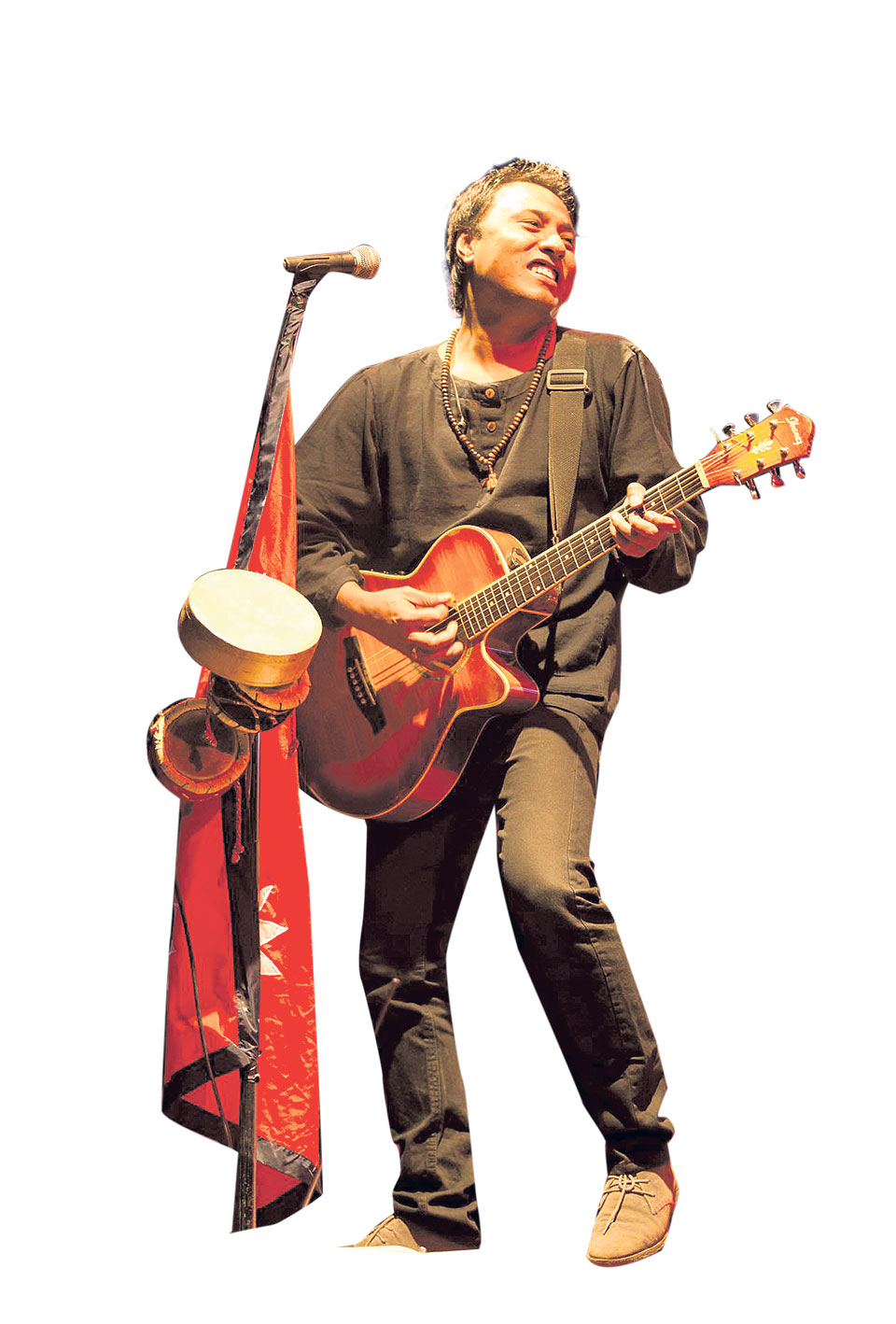
For him tomorrow is going to be the biggest day as he is all set to celebrate his 25 years of musical journey with some of the renowned singers amidst a huge crowd at his live concert to be held at the Academy Hall, Kamladi.
On Thursday afternoon, Republica met Bajracharya at his music school “Doremi” where he along with other prominent singers like Ani Choying Dolma, Nima Rumba, Satya Raj Acharya, Swaroop Raj Acharya and Ciney Gurung were rehearsing for tomorrow’s musical extravaganza.

In a tête-à-tête, Bajracharya recalled how his musical journey started, what changes he witnessed and how he evaluated the entire music composition scenario in Nepal and what in store for the concert is.
“I don’t know if this is the right moment to reveal. However, allow me to inform Republica’s readers that Saturday’s concert is not only about my composition. I’ll even be lending my voice to them,” Bajracharya said. “I’ll be singing some of my popular numbers like Orali Lageko, Jindagi Utsav Bho, Kya Bore Bhayo and of course some rock and blue numbers.”
After persistent requests from his colleagues to sing, he has finally decided to come ahead as a singer too though he still likes to be known as “a music composer who by default sings” too.
Talking about his silver jubilee celebration, it’s his friends from the music circle who have taken the initiative to pay him and his profession a tribute. After all, Nhyoo Bajracharya has worked with almost all the sought-after singers of Nepal.
Bajracharya formally started composing music when he was just 20. He was associated with the band called “Blue Moon” during his college days which later disbanded. But for Bajracharya, it wasn’t the end. He was rather drawn into the notations. He wanted to start it all over, listened to the composition of international artistes and started trying his hands with any instrument he came across.
“When I started, there was only Radio Nepal that aired songs. Today, there are dozens of FM stations in the country and the growth in technology has changed the whole scenario. It’s really a great feeling to see music industry of Nepal being more into stereo generation from mono,” Bajaracharya said.
Unlike other composers who often make comments that Nepali music industry has lost its steam in comparison to the 1970s, Bajracharya believes the whole industry has in fact shown a phenomenal growth. Today, it has succeeded in creating a unique appeal.
“Every era has its own variety to offer,” he said and elaborated: “There are, no doubt, maestros like Gopal Yonjan, Narayan Gopal and Amber Gurung, who have given Nepali music a complete new course and their legacy will remain forever. But, that doesn’t mean that music composers and singers we have now are not competent enough. For instance, in the earlier days, only a few got a chance to sing who knew all the seven notes of music. Today, any one can attempt to sing no matter how good he or she is. See, if I want to do some painting, what’s wrong with it? It’s not necessary that one has to be like that of Kiran Manandhar.”
What Bajracharya hates to see is people classifying music between good and bad. For him all compositions are equally good and he tells people not to judge music in terms of likes and dislikes.
Bajracharya makes things quite clear. He says: “When I started my career as a music composer I didn’t like the compositions of veteran musicians like Mozart, Ludwig van Beethoven, Antonio Vivaldi and Sopan. I didn’t like them because their composition was beyond my reach. But did that mean that their compositions were really bad? After 25 years into the journey, listening to their compositions, I find them masterpieces. So, please keep your personal opinion to yourself.”
Today, what he finds disturbing is the way media are projecting singers, overlooking the composers, “the soul” of any song in his words. “At times, it seems like lyricists and music composers don’t exist in this world and it’s the singers who hold the magic wand. Trust me; it’s not an easy job to pick up music from the air”, he said.
When asked whether he lost anything while pursuing to achieve his dream of becoming a music composer, his spontaneous answer was “no”. He says he loves his profession every single day. The song that he loved composing the most was Laija Chari which was voiced by Yogeshwar Amatya. He was lucky with another composition Phulko Ankhama Phulai Sansara.
“Believe it or not, this song became popular out of a fluke. There was nothing as such that my composition was superb. Neither the lyrics was exceptionally written, nor was the voice that powerful. I still wonder why people like it so much. I was surprised to see how people even in Canada, Australia, Hong Kong and Japan hummed the lines of this song,” he laughed.
Being geared up to make his silver jubilee celebration a day to remember, Nhyoo Bajracharya concludes, “People will soon get to see me singing too.” And then, he went back to his studio for another round of rehearsal for his concert tomorrow.
Related story
Krishna Devi, mother of musician Nhyoo and Pavitra passes away