

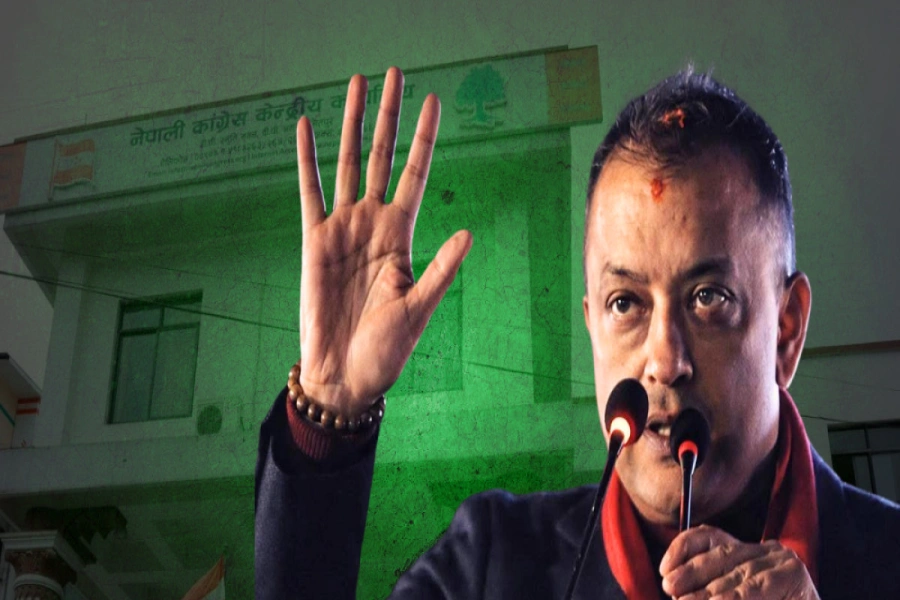
KATHMANDU, March 21: Nepali Congress (NC) has conducted a preliminary review to understand the reasons behind its disappointing performance in the House of Representatives (HoR) election held on March 5.
At a central committee meeting on Friday, Vice-President Bishwa Prakash Sharma presented a 13-page report analyzing the party’s poor showing, highlighting internal challenges, leadership issues, and public dissatisfaction as key factors.
The election left NC with only 38 seats across 275 direct and proportional representation seats, far below expectations. Party leaders described the outcome as a serious setback, stressing the need for reflection and strategic corrective measures.
Govt identifies 10 reasons behind shortfall in public expenditu...

According to the report, one of the core reasons for the loss was the party’s failure to implement meaningful reforms following the 2015 constitution. Citizens had expected new approaches and innovative leadership, but NC did not seriously pursue internal reforms, leaving it ill-prepared to adapt to the changing political landscape. This lack of renewal, the report noted, contributed to the broader decline of mainstream parties in the election.
Persistent instability in governance also played a major role in eroding public trust. Nepal has rarely seen a prime minister complete a full five-year term, frustrating citizens who longed for consistent leadership. Decades of inability to provide stable governance pushed voters to seek alternatives, further weakening NC’s position. Adding to this frustration was the repetition of familiar leadership figures. Even when new governments were formed, citizens were repeatedly confronted with the same faces in power, which heightened dissatisfaction and reinforced negative perceptions of mainstream parties.
The report also highlighted inconsistencies in policy and governance as another critical factor. Frequent changes in government disrupted policy continuity, weakened administrative effectiveness and undermined development efforts, leaving citizens disillusioned and skeptical about the party’s competence. This disillusionment had deeper roots, the review noted, stretching back to the post-2017 period. After the two-thirds majority government was formed following the 2015 constitution, the party had an opportunity to drive institutional and developmental progress, but failure to capitalize on this momentum disappointed citizens and intensified frustration over subsequent years.
Coalition politics, while strategically necessary to safeguard the dissolved parliament, further complicated NC’s standing. The report notes that repeated reliance on coalitions created internal dissent and public resentment, which, combined with the party’s inability to address long-standing voter dissatisfaction, amplified negative perceptions. The review traced this dissatisfaction through three phases: initially during the 2022 local elections, then in subsequent federal elections, and finally erupting during the September 8–9 Gen-Z protests in 2025. NC’s failure to respond effectively to these signals allowed frustration to accumulate and ultimately translate into electoral rejection.
The report also underscored contradictions in NC’s pragmatic strategies. Despite emerging as the largest party in 2022, it neither governed effectively nor positioned itself as a consistent opposition. This created internal contradictions, alienating party members and voters alike, and undermined the party’s credibility. Finally, the party’s weak parliamentary voice contributed to its downfall. By failing to convert public grievances into effective representation in parliament, NC allowed dissatisfaction to spill over into streets and social media, creating a vacuum that fuelled the Gen-Z revolt and drove voters away.
The review concludes that the party’s electoral setback was a result of failures in reform, governance, coalition management, and effective opposition. It calls for urgent reflection, strategic restructuring, and mechanisms to restore public trust in order to perform better in future elections.





