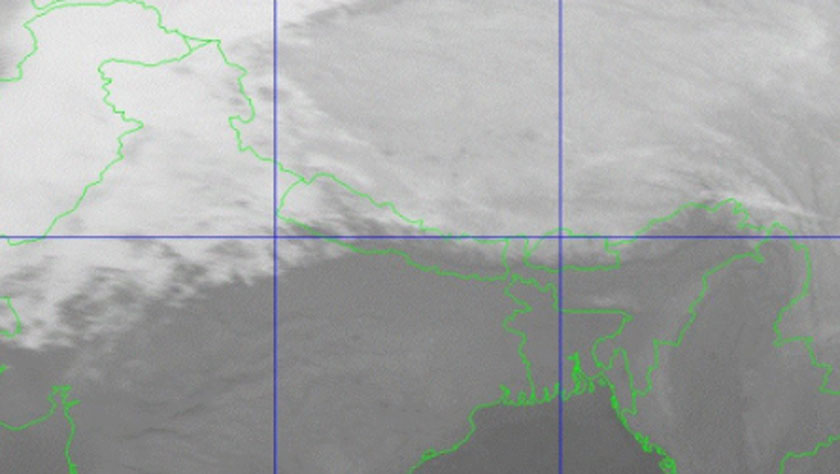
On August 18, 2008, the Koshi abruptly changed its course and breached its embankments at Kusaha, inundating densely populated swathe of land in southeastern Nepal and north Bihar in India. An estimated 50,000 people were displaced in Nepal and more than three million in India. That afternoon, as in the days before, hundreds of people had gathered near the embankments as news and rumors swirled around about the impending breach on the Koshi.
From the chaos of embankment, Masuri, the patriarch of a family of 14, including a daughter in her mid-20s and a five-year-old son, drove almost parallel to the tidal wave that submerged everything including his two-story cement home on its way, leaving behind a trail of devastation. His fears subsided only after he made it to Laukahi, where his family members had been sheltered a day before.
Tens of thousands of stranded people needed rescue efforts, food and medical care. A couple of days later, helicopters buzzed overhead. Masuri says the boatmen did a brisk business in the wake of the calamity: they charged up to 5,000 rupees to ferry goods from people's homes to safer places. The waters of the Koshi have long receded, but the memory of the mayhem hasn't.
Six years later, as he stood amid the ruins of the devastation, Masuri lamented lack of rehabilitation efforts on the part of the government. "We cannot grow crops here, it's covered with sands. There are no alternatives, so we are left on our own," says Masuri, a contractor.
This was a major flood in the Koshi in decades. It saw an unprecedented pouring in of aid. Nepal government and dozens of international aid agencies rushed to provide relief to the flood victims.
A local social activist, however, claimed a sort of disaster economy evolved after the floods. "Lack of coordination among the donors led to unnecessary expenses. In some cases, more amount of money was spent on transportation and daily allowance for the relief workers than the cost of relief materials," says Rabindra Ghimire, an environmental activist who is also with the Nepal Red Cross Society, Sunsari.
"This also led to the donor dependency among the survivors," Ghimire says, adding that most received compensation for the loss of crops and other hand-outs. He pointed out that even now survivors haven't switched to other forms of farming such as watermelon that can be grown in such places.
About 300 km downstream in the village of Sunder Virajit in Madhubani district in Bihar, Deonath Deo, 60, grapples with a different sort of agrarian crisis due to the embankments on the Koshi River. After the floods of 1954 which prompted the construction of the Koshi Barrage and embankments, Deo's father had migrated to the village of Sripur in Supaul district beyond the Koshi's eastern embankments. But since then, the region didn't experience floods.
Each monsoon, the Koshi brought one hundred million cubic meters of gravel, sand and mud and deposited it on the alluvial plains. "But the embankments robbed of the nutrients for the arable land," Deo says, adding that another embankment on the Kamala River blocked the river's drainage system. "Since then we have been forced to live in waterlogged areas. This used to be a fertile land, which was nourished by the silt brought by the floods. But the embankments prevented it, making us poor," Deo says.
Many farmers migrated to big cities because agriculture, whose yield was once very high, saw a steady decline, according to Kameshwar Kamati, 60, a local social activist with Barh Mukti Abhiyan in the district of Madhubani, Bihar.
For centuries, the Koshi River, which flows through about 200 kilometers of the northern Bihar plains, symbolized prosperity. The farmers had not only learned to live with the floods, they welcomed it with open arms, for it brought the nutrients for the soil, contributing to rich harvest. But ever since the politicians and bureaucrats attempted to control the river through embankments—raised mud and sand structures that double as road along the river, it has become a metaphor for Bihar's backwardness.
"Koshi used to inundate this region before the embankments were built. But farmers coped with it. After the construction of embankments, floods have occurred due to breach. But the breach of embankment doesn't depend on rain, it occurs due to bad governance," Kamati says. "Those who benefit from the project, [...] they are very powerful both in bureaucracy and in public life. Any dissent was swiftly suppressed. Only a small fraction of people are against embankments. There's no organized movement [against the embankment]," he says. The embankments of the Koshi are home to around one million people living in 386 sprawling villages.
While those living outside the embankments suffer from water-logging and infertility of the soil, living within it is courting danger. There are schools, buildings and temples inside the embankments. The embankments themselves have become sites of commerce and transport, with small, bustling bazaars set up to cash in on people's flow.
People living inside the embankments have developed several coping mechanisms. "I live inside it because farming is better," says 50-year-old farmer Kamal Yadav. He fears the flood but says he would rush to higher ground. Fleeing from floods doesn't mean much in the plains: you either rush to the embankments or to the government-built flood centers, which can protect up to 200 people. Santalal Mandal, a village headman, offers a more straightforward answer: "Those who live outside the embankment fear the most, not us."
Embankments give a false sense of security, according to the social activist Kamati. "When the Koshi breached its embankments in 2008, it returned to its old channel. But the area in its old channel had not experienced flooding for many years. The people had developed adaptation methods before the embankments were built. But the embankments had given a false sense of security; people even didn't know how to swim. They had no idea about the floodwaters, its magnitude et cetera," he says.
The author is a freelance journalist
Related story
Nine bodies found across various locations in Nepal as monsoon...