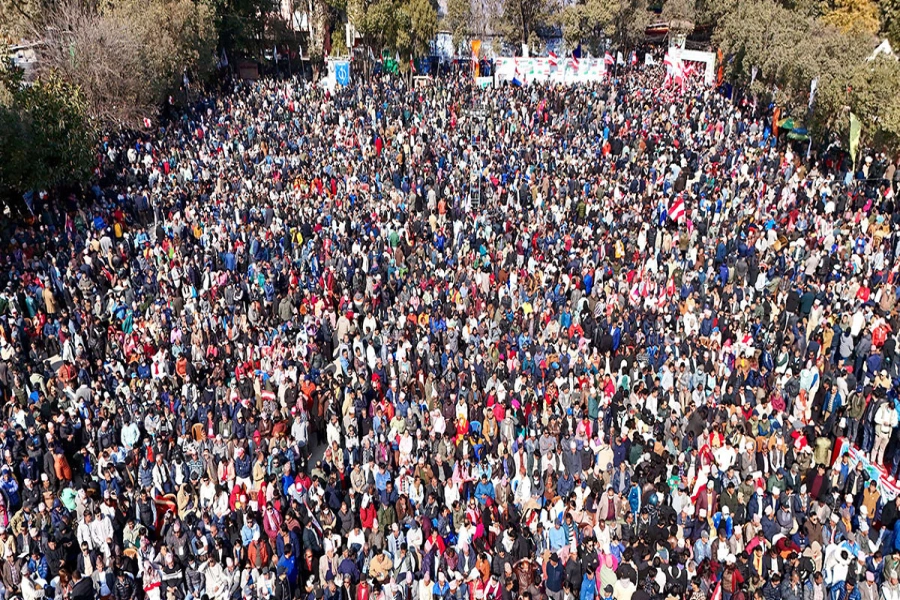
BUTWAL, Feb 17: Outgoing General Secretary of the Communist Party of Nepal (Unified Marxist-Leninist) Jhala Nath Khanal on Tuesday afternoon announced dissolution of the party’s 68-member central committee (CC) that was elected six years ago.
Opening the closed-door session of the eighth national convention of the party that was three-and-half hours behind the schedule, Khanal announced the dissolution of the committee that was elected by the seventh national convention in Janakpur and all other committees nominated by the erstwhile central committee. [break]

Khanal announces formation of interim presidium.
Tilak Pathak
Related story
Rawal’s refusal to withdraw his candidacy leaves UML's closed s...

The outgoing UML head also announced an 11-member interim presidium led by leader Amrit Bohara to carry out tasks as the party’s executive body during the 6-day convention that opened Monday. Other members in the committee are Bharat Mohan Adhikari, Modanath Prashrit, Sahana Pradhan, Ashok Rai, Prithvi Subba Gurung, Ram Chandra Jha, Bidya Bhandari, Ramprit Paswan, Mohan Singh Rathore and Mahesh Chaudhary.
Khanal also announced formation of four other committees to carry out various tasks during the convention. They are Steering Committee (to manage the views expressed in the convention) led by Ishwar Pokharel, Discussion Note Committee (to do the rapporteuring job) led by Govinda Koirala, Minute Committee led by Yubaraj Karki and Election Committee led by Agni Kharel. The election committee will hold the election of the new leadership, following endorsement of the political paper and statute amendment proposal. The 1,816 party delegates approved Khanal’s proposal with applause.
“CPN-UML has been in the center of Nepali revolutions.”
- Khanal
- Khanal
Prior to dissolving the central committee, Khanal, who became the party chief after the then General Secretary Madhav Kumar Nepal announced his resignation in the wake of the party’s election debacle last year, listed out a number of “good works” of the outgoing CC. He credited his party for almost all the “good works” that had happened in Nepal in the last six years: from leading the Janaandolan to bringing Maoists to the mainstream politics to the abolition of monarchy. “CPN-UML has been in the center of Nepali revolutions,” he claimed.
In his bid to woo more delegates in his favor, Khanal, who has in the past advocated for a review of the People’s Multiparty Democracy (PMD) propounded by late UML chief Madan Bhandari in 1993, also lauded the important role of PMD in the UML’s journey. “PMD has become extremely important guiding principle for the UML,” said Khanal, urging the delegates to use their rights “responsibly” during the convention.
Though no other paper will be presented challenging Khanal’s, two groups are going to table “supplementary papers” – one on intra-party democratization (by 18 leaders including Pradip Gyawali and Shankar Pokharel, among others) and the other on analysis of the Nepali class struggle (by 55 young leaders including Yogesh Bhattarai and Ghanashyam Bhusal).