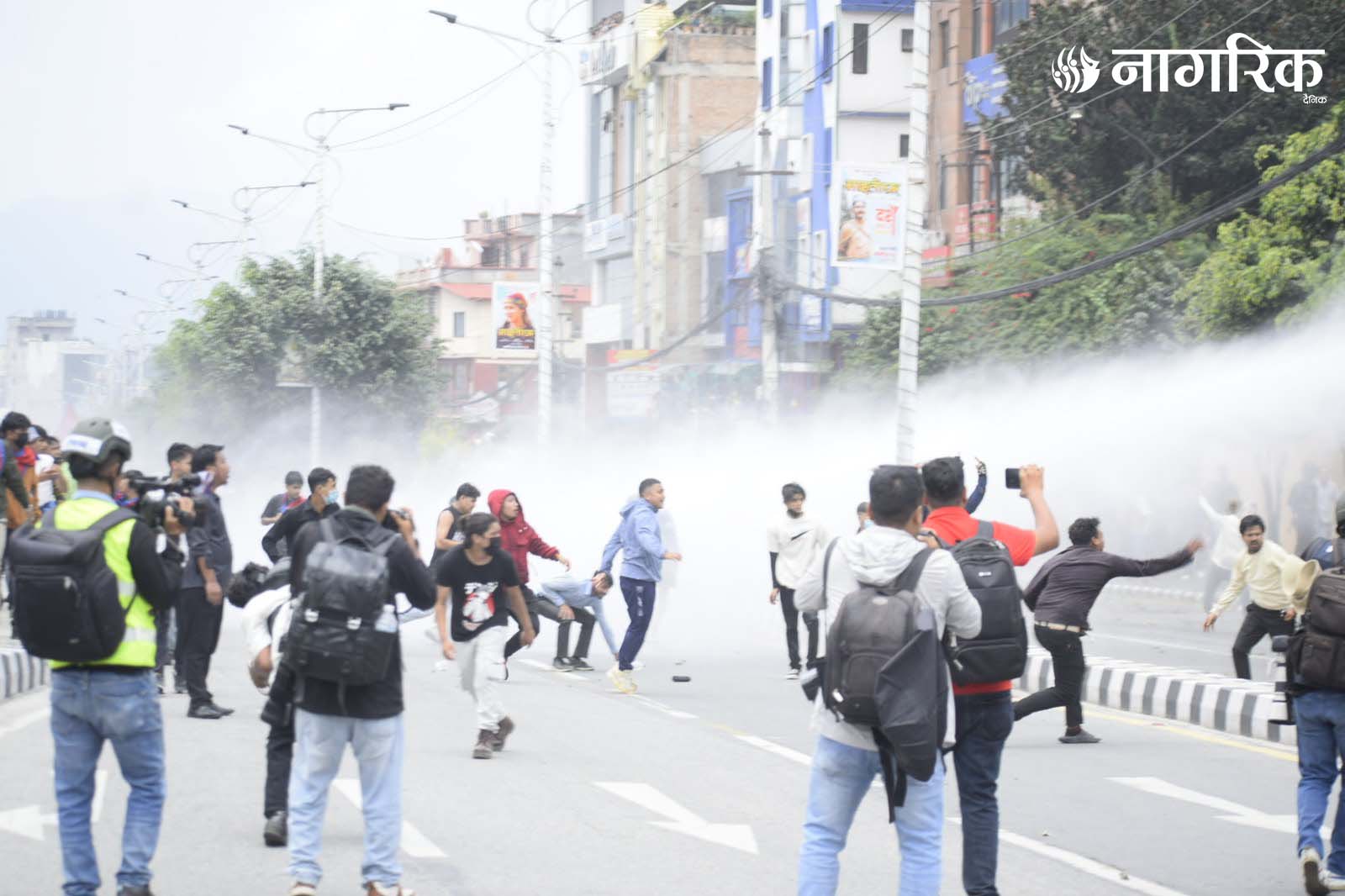
The “charm” might certainly be gone for the travelers seeking Shangri-La, but for those living in Kathmandu, the air pollution is turning the air they breathe into a serious health hazard.
A 2004 report published by the Ministry of Environment put the number of deaths due to air pollution that year at 1,600.
Air pollution in the city hasn’t lessened since, but it hasn’t increased either, according to official records, thanks largely to the increase in average rainfall in the past years.
Nonetheless, experts say automobile exhaust and dust on the Valley’s streets create a lethal mix that contains various elements that harm the human body.

Major health hazards
Surface-level ozone, not be confused with the ozone layer present in the earth’s stratosphere, is one major pollutant in the Kathmandu air, which is formed when sunlight reacts with hydrocarbons and nitrogen oxide, both of which exist in car exhaust.
“Ozone is what is responsible for irritation in the eyes,” says Professor Balkrishna Sapkota, coordinator of the Solar Radiation and Aerosol in the Himalayan Region, an environmental research division of the Tribhuvan University.
Ozone also can be harmful to the lungs causing bronchitis and even heart attack, apart from other chronic diseases.
Various reports cite benzene as another pollutant abundant in the Kathmandu air.
While WHO standard for benzene is up to 20 parts per million (ppm), the benzene concentration in Kathmandu reaches upto 67 ppm. Benzene, which is also found in automobile exhaust, causes leukemia and other blood related diseases.
It is therefore not surprising that Kathmandu was labeled the second most polluted city in Asia in 2006. Adulterated fuel, bad roads and old engines are the perfect recipe for air pollution.
While percentage of automobile and industrial exhaust in the atmosphere may still be more in other big cities around the world, Kathmandu owes its pollution status also to its topography.
The bowl like structure of the Kathmandu Valley causes a phenomenon called inversion, whereby, during winter, the temperature rises along with the altitude within the valley rather than decreasing.
Inversion doesn’t let the pollutants rise and leave the valley atmosphere and rather traps it there, causing dense smog of pollutants.
Joggers beware
“People who jog or go for morning walks in winter should know that they are not inhaling fresh air in the morning, rather they are exposed to the cumulative pollution of the past day,” warns Professor Sapkota.
There have been a few major steps taken by the government to curtail pollution of the Kathmandu Valley in the past few years. One of these includes the banning of brick kilns in the cities of Kathmandu and Lalitpur since 2004.

Another step is the emission standards, which currently include the implementation of the Nepal Vehicle Mass Emission Standard that banned heavily polluting vehicles from entering the Valley. The green stickers and regular pollution checks also control the pollution to a certain level but even if all vehicles sport a verified green sticker, the exhaust of many vehicles looks more like pre-industrial era factory soot than the EURO – II it is supposed to be.
According to Laxman Prasad Mainali, spokesperson of the Ministry of Environment, Science and Technology, there isn’t any specific Act in the current Interim Constitution to regulate the current levels of pollution. And he is rather gloomy about the incapacity of the enforcing agents.
“There is no point in just setting high standards of air quality because the implementation of regulations needs an inter-ministerial coordination which is utterly lacking at the moment,” says Mainali.
At a time when five out of the six pollution-monitoring centers of the Valley are defunct, pollution control seems to be a far consideration for enforcing agencies. As for the residents of the Valley, there is only one suggestion to reduce the risk of air pollution to your health, before you leave home: wear a mask!
kushal@myrepublica.com
Related story
Over 90% of world breathing bad air: WHO