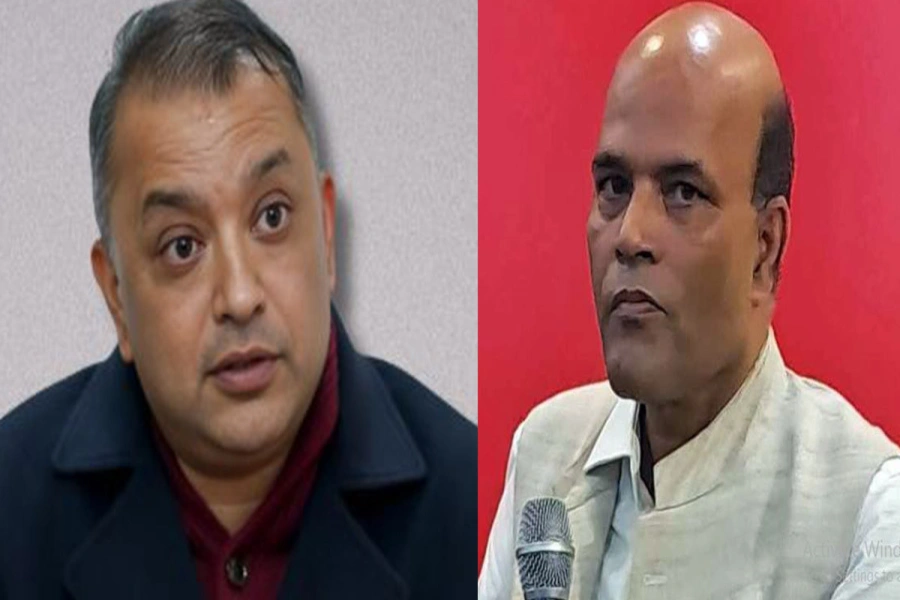
KATHMANDU, Aug. 17: Nepali Congress (NC) President Gagan Thapa is facing mounting criticism from within his own party. A three-day gathering of the party's non-establishment faction expressed strong dissatisfaction with his leadership, prompting Thapa himself to publicly acknowledge the backlash.
Speaking at the launch of Dharma Gautam's book 'BP Ra Bidrohaka Ti Din,' in Kathmandu on Sunday, Thapa said he had faced unprecedented criticism over the past three days.
“Since I was born, I may have faced criticism at various times, but I have never experienced the kind of criticism I have faced over the past three days, whether knowingly or unknowingly,” Thapa said.
He also complained that even media headlines were dominated by criticism of him. However, he declined to respond in detail immediately, saying he would present his views from the party's central office in Sanepa in Lalitpur on Monday.
During the three-day gathering of the NC's non-establishment faction, most speakers questioned Thapa's working style, leadership and approach to running the party. The criticism was not merely directed at an individual; it reflected a deeper discontent within the NC over leadership, power and the party's future political direction.
Book by Ujwal Thapa ‘Why Nepal?’ released

Since becoming party president, Thapa has repeatedly pledged to take the NC in a new direction, break away from the old political culture and restore the party as a major national force. But dissatisfaction appears to be growing within the party over his inability to deliver the pace of change and results that many had expected after he assumed the leadership.
For Thapa, the irony of the current situation is hard to miss: a leader who rose to prominence on the promise of change now finds himself at the center of the same old power struggle.
In NC politics, factions are not merely organizational structures; they are also mechanisms for distributing power. Following Thapa's election as party president, many leaders who had previously belonged to the non-establishment camp began reassessing their political position, role and influence.
Meanwhile, a national gathering organized by leaders close to former NC President Sher Bahadur Deuba's faction also created an environment for questioning Thapa's leadership. This suggests that discontent within the NC has now moved beyond individual grievances and into a broader institutional debate.
Thapa, however, has framed the issue from a different perspective. He described Nepal's political parties as “factories of disappointment.” According to him, Nepali politics is plagued by a tendency among leaders who have once held power to seek leadership repeatedly, while those who have already served as prime minister five times become frustrated when they are unable to secure a sixth term.
His comment is significant in itself. The political culture Thapa is criticizing is also reflected in the controversy surrounding his own leadership within the NC. Opposing the tendency to measure success solely in terms of power and position, he said, “Success should not be measured only by how much power someone has acquired.”
Citing the political life of Dharma Gautam as an example, Thapa argued that moral authority is greater than political office. But the question of how a leader who speaks of morality and ideals in politics responds to growing dissatisfaction within his own party is equally important. Leadership is not tested when there is no criticism; it is tested when criticism comes.
The “abuse” Gagan Thapa says he has endured over the past three days cannot simply be viewed as a matter of personal pain. It is a political expression of growing dissatisfaction with his leadership within the NC.
When Thapa rose to the leadership of the NC, many saw him as a representative of change. Today, the same Thapa is facing a question from within his own party: Where is the change?
A leader does not necessarily become exhausted because of criticism; what makes a leader appear to be faltering is the inability to understand the reasons behind that criticism.
For NC leaders and cadres, the time has come not to ask how much criticism Gagan has endured, but why the NC has reached a point where its own leaders feel compelled to criticize him so fiercely.
The party president who has pledged to prevent the NC from becoming a “factory of disappointment” must first identify the causes of growing disappointment within his own party. Otherwise, there is an equally real risk that a leader who rose on the language of change will himself become worn down by the very factional politics he once sought to change.