American transcendentalist Henry David Thoreau first published his landmark essay Civil Disobedience in 1849. In it, he argued that individuals should prioritize their conscience over compliance with unjust laws, asserting that passive submission to government authority enables injustice. Thoreau was motivated by his opposition to slavery and the Mexican-American War (1846–1848), both of which he regarded as morally and politically objectionable. His essay has had a profound influence on political thought and activism. It inspired leaders such as Mahatma Gandhi, who adopted its principles during India's struggle for independence, and Martin Luther King Jr., who cited it as a major influence on the American civil rights movement. Its themes of individual responsibility and resistance to injustice have made it a foundational text in the philosophy of nonviolent protest.
The word "civil" has several meanings, one of which is "relating to citizens and their relations with one another or with the state." Civil disobedience refers to the deliberate refusal to obey laws or policies considered unjust, particularly when democratic institutions fail to protect citizens' rights. Nonviolence lies at the heart of civil disobedience. However, peaceful protests can turn violent because of excessive use of force by security agencies, poor organization, the presence of provocateurs or heightened public anger. Heavy-handed policing can provoke retaliation, while poorly organized demonstrations without effective leadership may allow disruptive elements to incite violence. In such circumstances, the government has a crucial responsibility to maintain law and order while safeguarding citizens' constitutional right to peaceful protest.
Political grievances, economic inequality, environmental degradation, social discord, religious tensions, racial oppression and discrimination often drive people to engage in civil disobedience. Such protests may range from small demonstrations to large-scale mass movements. Some are organized by political parties or civic groups, while others emerge spontaneously in response to controversial government decisions or perceived injustice.
The recent communal clashes between Hindu and Muslim groups in Sunsari district illustrate how quickly peaceful situations can spiral into violence. The clashes, which began on July 26, 2026, reportedly stemmed from a dispute over loud music and religious flags during a Bolbam procession. The violence claimed three lives, injured many others and spread to neighboring districts, prompting local administrations to impose curfews and prohibitory orders. National leaders appealed for calm, communal harmony and social unity.
Motorists' civil disobedience against VIP motorcade

Communal violence often leaves deeper and longer-lasting scars than other forms of protest. It destroys lives and property, fractures communities and erodes trust among neighbors who once lived peacefully together. Economic activity suffers, social interaction declines and fear replaces cooperation. Worse, the resentment generated by communal violence can be passed from one generation to the next, prolonging divisions for years.
The outcome of any protest depends largely on the conduct of organizers, leaders, participants, security forces and even external actors seeking to exploit unrest. Nepal has witnessed several examples of peaceful civil disobedience producing positive outcomes. In 2019, the Newar community organized massive rallies across the Kathmandu Valley demanding the withdrawal of a bill that threatened the traditional guthi system, an institution central to Newar cultural heritage. Following sustained public protests, the government withdrew the bill—the first time a sitting Nepali government had withdrawn legislation it had introduced in Parliament—marking a significant moral victory for the protesters.
Likewise, the protests led by victims of loan sharks remained largely peaceful despite lasting for months. Thousands of victims from different parts of Nepal travelled to Kathmandu to seek justice from the federal government. Many walked barefoot for weeks to draw attention to their suffering. Although the government has taken some measures, many of their demands remain unresolved. Similarly, victims of multibillion-rupee cooperative frauds have repeatedly organized peaceful demonstrations in Kathmandu demanding justice and accountability.
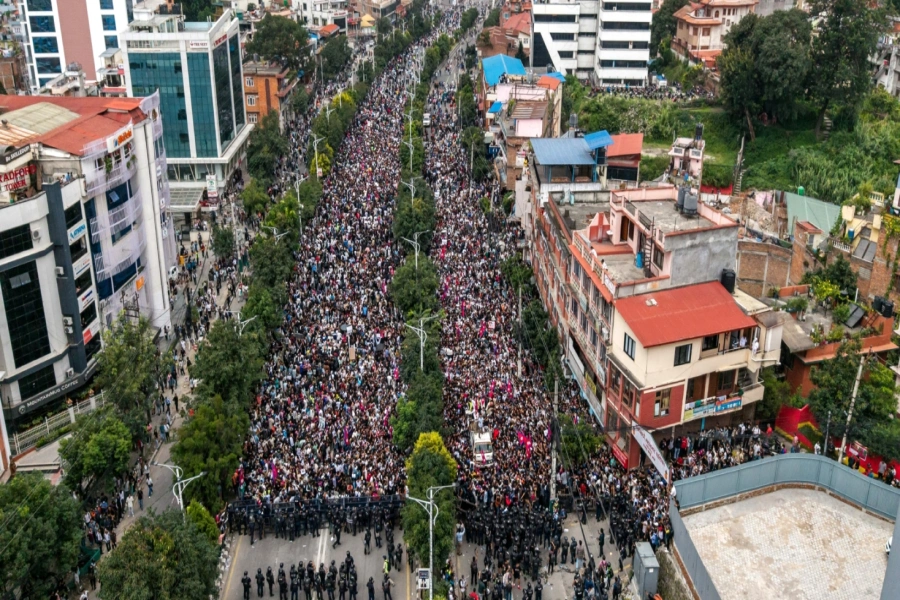
However, when civil disobedience turns violent, nobody benefits. Violence results in the loss of life, economic destruction and deep social trauma. One example was the youth-led uprising of September 2025, triggered by a sweeping social media ban, widespread political corruption and high unemployment. What began as a peaceful movement escalated into violent confrontation, and several young demonstrators lost their lives after security forces used lethal force. The movement eventually led to the collapse of Prime Minister KP Sharma Oli's government and the formation of an interim administration.
Another example occurred during protests against certain provisions of Nepal's 2015 Constitution. In Kailali district, eight police officers were killed by protesters armed with spears and axes during escalating violence. The protests were led by members of the historically marginalized Tharu community, who demanded an undivided Tharu province. The incident also exposed weaknesses in intelligence gathering and the preparedness of security forces.
The role of Nepal's security agencies has often come under scrutiny because of the country's relatively high number of protest-related fatalities, many linked to the excessive use of force and intelligence failures. Security personnel require better equipment, specialized training and modern crowd-management techniques. Their responsibility is to maintain public order while protecting the constitutional right to peaceful assembly. This includes managing crowds, directing traffic, protecting public and private property, and ensuring the safety of protesters, counter-protesters and bystanders alike.
Equally important is effective coordination among security agencies, local authorities and protest organizers. Clear communication, early engagement with community leaders and the use of professional de-escalation techniques can prevent peaceful demonstrations from descending into violence. Physical intervention should remain a last resort, used only when laws are violated, property is damaged or there is an imminent threat to life. Even then, only authorized and proportionate less-lethal methods should be employed in accordance with the law.
Civil disobedience has long served as a powerful instrument for challenging injustice and strengthening democracy. Its moral authority, however, rests on its commitment to nonviolence. Governments must respect the right to peaceful protest, while protesters must exercise restraint and reject violence. Only when both sides uphold these responsibilities can civil disobedience remain an effective force for democratic change rather than a catalyst for conflict.
The author is a former Government of Nepal and UNDP official, author of three books, and a freelance writer who regularly contributes to Republica.


-1200x560-1774606010.webp)