For those who value ethics in politics, Lok Man Singh Karki’s elevation to chief of the Commission for Investigation of Abuse of Authority (CIAA) last Wednesday dealt a severe blow. Given his questionable past, Karki is clearly not the right man for the job. Yet one good thing the brouhaha and media war over Karki has done is brought some shady characters out in the open. Karki himself must have been flabbergasted to see how he could so sharply divide opinions. I believe it is imperative to conduct background checks of the actors who, covertly or overtly, stood behind Karki and examine their self-interests.
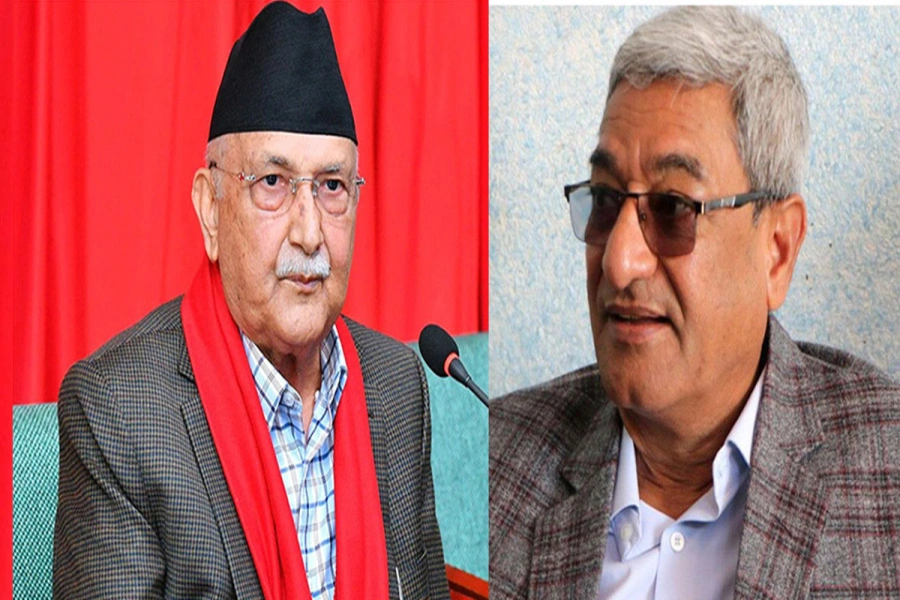
Conflicting accounts have surfaced on who proposed Karki’s name. First, Maoist Chairman Pushpa Kamal Dahal reportedly recommended Karki for the top CIAA job. Other members of High Level Political Committee swiftly approved his name. Second, it was CPN-UML leader KP Oli who floated Karki’s name during an informal discussion among HLPC members. Oli’s proposal reportedly pleased Buburam Bhattarai and Dahal, who seconded him instantly. Third, India wanted Karki in CIAA and Nepali politicians accepted the offer like faithful devotees of New Delhi. Given India’s effort to establish its influence in every sphere of Nepali polity, and its track record of repeatedly meddling in our internal affairs, this possibility cannot be dismissed. Hopefully, the real Indian interest in Karki’s appointment and the nature of his relation with Delhi will be revealed in time.

REPUBLICA
Two other leaders deserve to be mentioned in connection with Karki’s appointment. Nepali Congress’s Krishna Prasad Sitaula is said to have telephoned President Ram Baran Yadav to pressure the latter to okay Karki’s name last Tuesday. Former home minister and UMDF coordinator Bijaya Kumar Gachchadhar had been vociferously pushing for Karki. Outside observers have no way of knowing behind-the-scene deals, if there were any. But these names would not have circulated in the media if they had nothing to do with the Karki saga. Let us now examine the individual interests of all those who plumped for Karki. Not surprisingly, every name in the list has some degree of notoriety attached.
Dahal and Bhattarai are among the leaders against whom complaints have been lodged with the CIAA. Maoist leadership has been charged of embezzling Rs 10 billion from PLA funds allocated for former combatants in various cantonments. Likewise, Dahal and Bhattarai doled out considerable sums to party cadres from state coffers during their tenures as the head of the government. Naturally, Bhattarai and Dahal would want someone to cover their tracks at the CIAA.
Compared to Dahal and Bhattarai, Oli should have had little to fear from CIAA and no reason to root for Karki. After all, there are no complaints against him at the CIAA, nor has he been indicted in graft cases. Why did he stand for Karki then? Some inferences can be drawn. Oli is accused of protecting criminal elements within the party, chiefly Parshuram Basnet, now the central committee member of UML’s youth wing, Youth Association Nepal. A money laundering case is pending against Basnet. Oli is also a vocal defender of notorious dons whom he has allegedly roped into YAN. Oli could have been looking to curry favor with Karki to protect his henchmen from CIAA’s clutch. Much like Baburam Bhattarai, Oli is also known as someone who is close to New Delhi establishment.
While Sitaula’s complicity in multi-billion rupees Sudan scam (which took place in 2007 when he was serving as home minister) has not been established, it is unlikely that such large-scale corruption could have been carried out without his direct or indirect role. Besides, Sitaula openly defended Rubel Chaudhury, the Bangladeshi son-in-law of Sujata Koirala, back in 2010 when Chaudhury was accused of misappropriating millions in Sudan scam, misusing his family visa, running a VoIP racket and supplying fake Nepali passports to Bangladeshis. The likes of Gagan Thapa and Arjun Narsingh KC had raised the issue with the party president back in 2011 and it had caused quite a stir among NC rank and file. Perhaps Sitaula wanted Karki as CIAA head to cover his own misdeeds. Unsurprisingly, Sitaula too is considered ‘India’s man’ within Nepali Congress.
Bijay Kumar Gachchadhar is an open book. There are corruption cases against him at CIAA. As home minister, he is said to have halted Nepal Police’s investigation into money laundering. He reportedly transferred officials at Central Investigation Bureau to halt investigation so that Ganesh Lama, the central committee member of Gachchadhar-led Madhesi People’s Rights Forum (Democratic), against whom an anti-money laundering case is pending at CIB, could go off the hook. Gachchadhar’s interest is to save himself and his cronies. No wonder he has started to sing Karki’s praise by projecting him as the most competent officer the nation has had.
These leaders and others who remained silent over the issue must have feared reprisal from the CIAA. If so, their fear is genuine. During the first half of this decade, CIAA had established itself as the most efficient anti-corruption watchdog of the region. Back then it raided a number of houses of top politicians and bureaucrats and brought the corrupt to book. Some former ministers and bureaucrats are still serving jail terms.
New CIAA chief won’t act against political actors who catapulted him to power, entrenching impunity during his term.
Now Karki has come to CIAA on the back of dubious leaders who need to be brought into the ambit of investigation. But Karki can use this opportunity to salvage his image. He need not go searching for corrupt people, for they are all around. He may start with cases of fraud in the cantonments. But chances are that he cannot and will not act against the same actors who catapulted him to power. In that case, he could very well institutionalize misrule during his six-year-long tenure. This is likely because a level of collusion between the head of judiciary (who is also the head of the government), head of CIAA and head of the state is no more a secret. Besides, the current government is not expected to control misrule, it is only mandated to hold elections.
Predictably, the four parties and the government are now trying to make Karki episode seem like a normal course of event. They now want to ‘move on’ and complete the electoral processes. Of course, people have power to punish those involved in the Karki saga in the upcoming polls. Meanwhile, a Supreme Court verdict on the case is also eagerly awaited. Whatever the outcome, the controversy over Karki is unlikely to die down for a long-long time.
mbpoudyal@yahoo.com
Related story
Maintain Your Two-wheeler in Monsoon