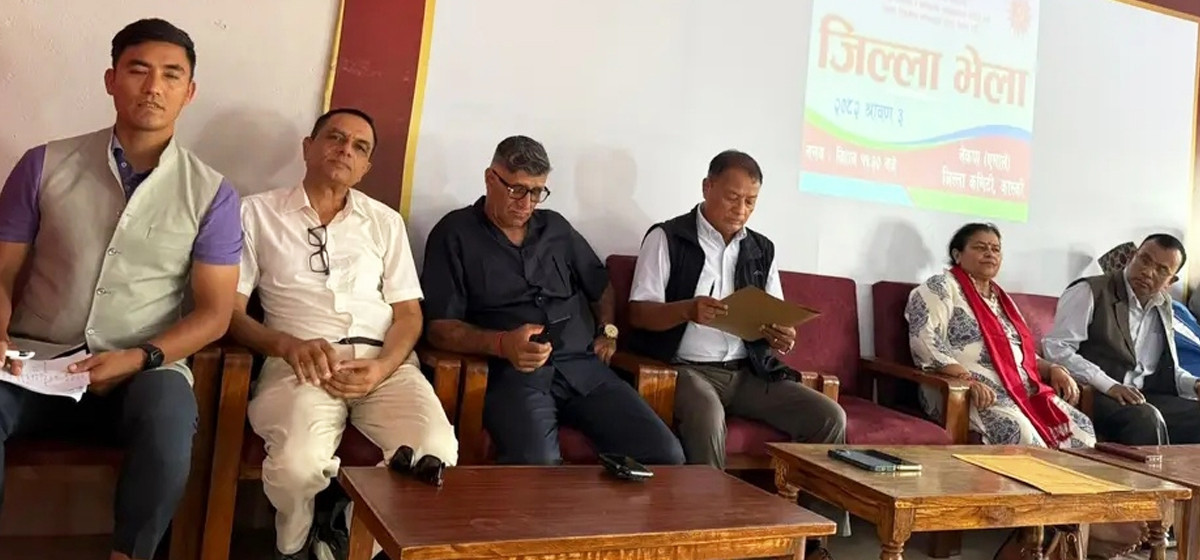
Leaders and cadres of the newborn Rastriya Prajatantra Party (RPP) seem upbeat about their electoral prospects. They bet they will emerge as a new force to be reckoned with in the new CA polls. Good luck with that. But what has been touted as a genuine rapprochement between Rastriya Janashakti Party and Rastriya Prajantanta Party is actually a forceful marriage of convenience between two disparate forces. One (under Surya Bahadur Thapa) sided with king Gyandendra until his last days, the other (under Pashupati Shumsher Rana) defied the king’s move and joined the democratic movement with the likes of Nepali Congress and CPN-UML. Rana was placed under house arrest under the regime that Thapa backed. It is too soon for the bitterness between the two Panchayat veterans to have disappeared. [break]
Thapa has been critical of Rana since 2004. Back then, he had publicly challenged Rana to take to the streets if “[He] were the grandson of Mohan Shumsher!” Until recently, Thapa used to speak of Rana with derision. Nor has Rana happily accepted Thapa as the president of the unified entity. Rana sacrificed for the sake of unity. In his own words, he has “consumed poison to save the party and to make it the fourth largest force in the new polls.” In a way, Thapa has come to toe the ideological line that Rana had been advocating for years. Rana’s party had voted in favor of republic while RJP was still dithering in 2008. Thus, Rana relenting to forfeit presidency to Thapa has been something like granting house ownership to a member that once deserted it. The unity, therefore, could be a short-term arrangement. RPP’s history suggests so.

Republica
Unity and split are common in RPP. Strangely, this shortcoming has proved to be both blessing and curse for its leaders. Though RPP has not been able to secure more than 19 seats in post-1990 politics, it has remained in center stage of power for nearly two and half decades—from 1990 to 2013. RPP was divided in the womb. When the country bid farewell to Panchayat and embarked on democratic path in 1990, there were two RPPs, quaintly named RPP (Thapa) and RPP (Chand) after erstwhile Panchayat PMs Surya Bahadur Thapa and Lokendra Bahadur Chand. In the first general elections of 1991 both Thapa and Chand bit the dust. Following this, they decided to unite for 1994 mid-term polls. The unity paid off—the party secured 18 percent of popular votes, sent 19 MPs to the parliament and became the third largest force after NC and UML. For Thapa and Chand who had done all they could to quell the Democratic Movement of 1990, such a comeback would once have been unimaginable. It formed a key ally in Sher Bahadur Deuba’s government in 1995. In 1997, Chand led the coalition government with UML and a few months later, his rival Thapa colluded with NC to oust Chand to become the PM himself. This led to another split in 1998. Unity was forged again on the eve of 1999 polls. But this time they received their comeuppance: RPP was reduced to 11 seats from the 19 in 1994. When party chairman objected to Thapa joining the king’s government in 2004, Thapa formed Rastriya Janashakti Party. The recent unity is the third (after four splits). Given this, the latest unity cannot be taken for granted.
The future of this ‘now-strong-now-fragile’ party hinges mainly on two personalities. Not that RPP lacks leaders. There are plenty, but none matches the stature and influence of Rana and Thapa. While the five-time Prime Minister Thapa has a good hold over his constituency in Dhankuta, Rana’s appeal is of a different kind in Sindhupalchowk. In fact, Rana happens to be among the rare breed of leaders who consistently won elections from 1973 to 1999. He lost the CA polls because he was not allowed to enter his constituency, and several booths, many of them his good holds, were captured by rebel forces. Rana is popular among his voter base not because he represents RPP but because he is Pashupati Shumsher Jung Bahadur Rana. (As a resident of Sindhupalchowk, this scribe has been a first-hand witness of people’s craze for him). His supporters regard him a king. They call him raja saheb and babu saheb and are desperate to steal a glance of him. Every time he visits his constituency, he is led by a naumati band while supporters follow him, shouting slogans in his favor. It is almost like a celebration for his supporters when raja saheb comes to visit. If allowed to campaign freely, there is a strong chance that he will win from his Sindhupalchowk constituency yet again.
But the problem with him and Thapa is that both of them are ageing. Thapa, 85, has had a cardiac arrest and Rana, 74, has begun to look frail and weak. Once Thapa and Rana retire, RPP could become spineless. RPP has largely remained the party of old former panchas, and has not been able to bring country’s youth into its fold. This is the reason the party needs to prepare new and vibrant young leadership while the two are still active.
RPP lacks a strong credible agenda for the polls. It supports republic but has accepted federalism reluctantly. It is against a Hindu state, but is not a staunch supporter of secularism. So there is little chance that supporters of monarchy and Hindu state will vote this party. Nor will it be able to garner support from Madhesis, Janajatis and Maoists who are among the staunchest supporters of secularism and identity-based federalism. According to the leadership of the newly formed RPP, the Big Four have terribly failed the nation and the country needs a strong democratic force like RPP to rescue it. True. People have become deeply disillusioned by the Big Four, but not to the extent that they have started to look to RPP as an alternative. Historically, RPP has gained power not of its own virtues, but courtesy of internal feuds and splits in NC and UML. If this were not the case, Chand and Thapa would never have been PMs in a multiparty democratic set up. Nor would they have become PMs again in 2002/3, if NC and UML had not defied the royal takeover.
Yet there is an unoccupied political space that RPP may claim. There is a clear polarization between federalists on one camp and anti-federalists and supporters of monarchy and Hindu state on the other. But there are no forces pushing for a system that believes in republic, rule of law, progressive agenda, secularism, good governance, workable decentralization, but is anti-federal in nature. If RPP is able claim this space, it may be able to woo many voters unhappy with the Big Four’s stand on federalism. After all, RPP does not lack catchy slogans. The unity convention’s banner reads: Samabesi Rastrabad, Janapacchiya Udarbad: inclusive nationalism, pro-people liberalism. Sounds impressive.
mbpoudyal@yahoo.com
Related story
Aishwarya Rai Bachchan's death hoax goes viral


-1200x560-1774606010.webp)