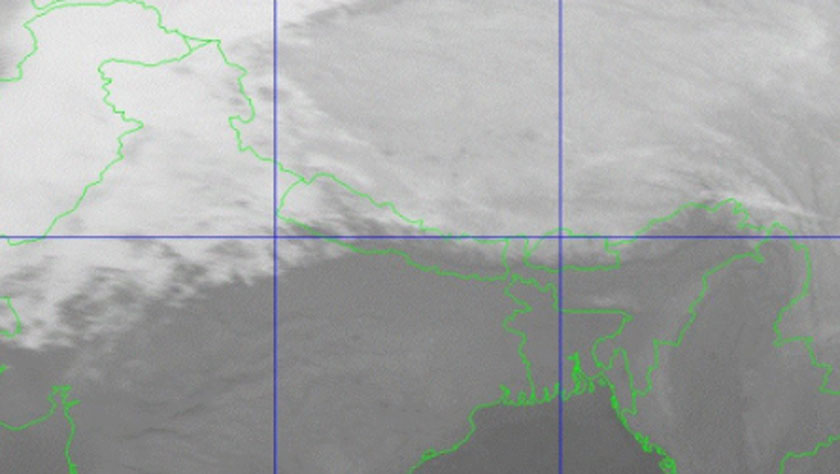
The extent of human casualties wouldn't be known for weeks and months, given the country's rough terrains and demolition of traveling routes. The human cost will likely be multiple times the current figures: more than 5,000 dead and over 10,000 injured. In the last such quake in 1934, some 8,000 people died but the country's population then was no more than five million, compared to 28 million today.Looking ahead, the bigger tragedy may not be what happened during the earthquake but what kind of relief efforts the government launched and how effectively this was carried out. Early indications are that government hasn't yet been able to come up with a credible plan to face up to this cataclysmic event. Official information on disruptions and damages isn't available. Whatever foreign help has been sent, much of it has been unsolicited and haven't been moved from the delivery points to where relief efforts are needed.
It is not that the government wasn't aware of the looming catastrophe. At least since early 1990s, geologists saw the Himalayan region as a hotspot for a mega-temblor, their warning based on studies of tectonic plate movements. Especially over the past one decade, geologists have issued warnings of mega-size earthquakes in the Himalayan region—it was not a question of whether it would happen but when.
However, there wasn't much preparedness for dealing with this kind of emergency—not the government level, nor from the residents, and not from international agencies who should have known better. By all accounts, there was very little in terms of earthquake preparedness, or exercises and drills to mimic an actual earthquake.
Looking back, all seems spilled milk and so we need only to look ahead. For this, too, the outlook is grim, not because the country lacks resources to finance relief and rehabilitation but because there is growing doubt if the government can commit to such an effort and can resolutely carry it out.
Record of government performance—in good times as well as bad—had been that of inaction and aloofness, which underlie traditionally lethargic and unaccountable governance that is perceived as feeding the people with big dreams and grand visions while doing little of public priority, specifically tackling corruption and improving public services.
Otherwise, it is hard to justify the time and money Nepal has devoted for new constitution—six years and five billion dollars. The money would have been better spent on improving public service delivery, most importantly in capital Kathmandu, which has suffered up to 14-hour power blackouts; non-existent public water supply; poor road conditions; and monstrous public hygiene.
This background of government performance—or a lack of it—needs to be kept in foreground before judging the efficiency of relief operations and follow-up rehabilitation and re-building efforts that would be needed to restore what has been lost.
The common perception is that government operated assistance programs are run poorly, with much of the resources generated from foreign assistance as well as those mobilized at home lost on the way to delivery. The problem is that Nepal government and official agencies generally can't be trusted to make good use of public money. This is not to discourage foreign assistance for relief of earthquake victims and, further, making resources available over long-term re-building. Rather, the intention is to drive home the point that any such assistance, now and in the future, must be handled by donors and donor agencies themselves or, at the minimum, subject to close monitoring by assistance-givers.
Unsupervised assistance will only serve the givers' interest—helping them shade their guilt of not doing enough in times of distress. To ensure that all such assistance—foreign as well as domestic—get delivered to the right people and is utilized for intended purpose, there will have to be direct involvement of assistance-givers; that they would closely monitor end-use of their assistance money. Otherwise, much of it will be wasted.
It is common experience of poor countries facing calamitous situation like ours that very little of unsupervised assistance reaches the needy, much of it siphoned-off by government intermediaries and private sector profiteers. In the aftermath of major disasters like the recent one in Nepal, the bulk of aid end up in the black-market and also in the homes of government officials. This actually happened after one smaller earthquake struck eastern part of the country in 1988, when most of the blankets donated by aid agencies were recovered from the homes of relief officials and storage facilities of some large businesses.
Looking back at the monumental inefficiency of official infrastructure in handling of development assistance, earthquake relief left to government hands will not get to the truly needy, at least not the large part of it. Foreign relief agencies that have come forward to help must also provide their own personnel to direct the distribution of their assistance so that that it goes to its intended end users.
What we actually need is a 100,000-person strong US Peace Corps-type volunteers to manage this scale of catastrophe and ensure a fair distribution of aid funds. It is true that such direct involvement of assistance-givers, although good in principle, would be difficult in practice, even un-implementable. But then it follows that giving of aid will, in large part, benefit just the aid-givers, in terms of psychological relief they would get by giving, while those who have suffered in real sense will be left to fend for themselves.
The author teaches economics at Northern Virginia Community College, US
shah1983@hotmail.com
Related story
One to Watch launches new acceleration program