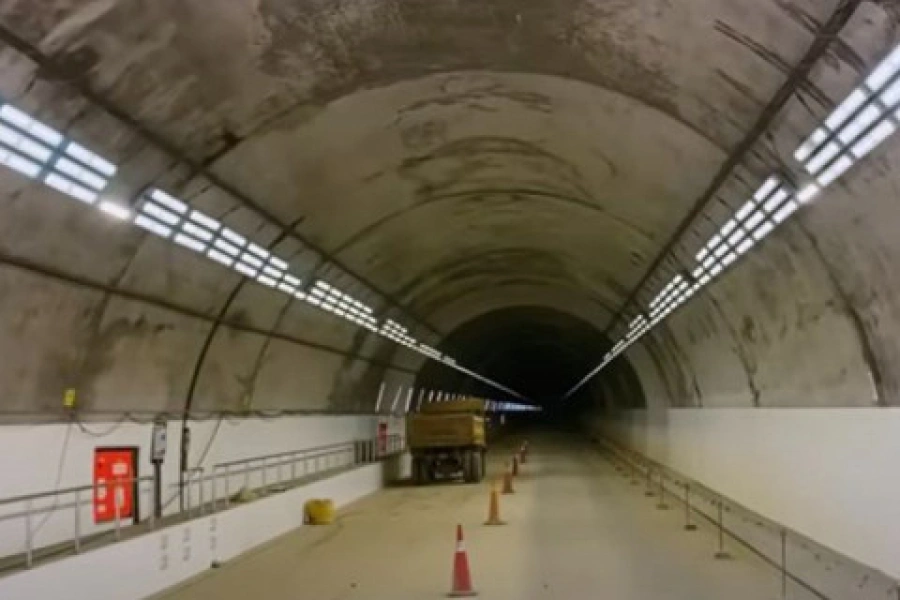
The trial operation of the Nagdhunga–Sisnekhola Tunnel marks more than the opening of a new motorway. It signals the start of Nepal's tunnel era and a shift in how the country should think about transport infrastructure. For decades, travel into Kathmandu through Nagdhunga meant hours of traffic, steep climbs, and uncertainty. The new tunnel promises to change that. Yet its long-term success will depend not only on the tunnel itself, but also on the highways that connect to it.
The 2.68-kilometre tunnel, built by Japan's Hazama Ando Joint Venture with financial support from the Japan International Cooperation Agency, is Nepal's first road tunnel. The project cost around Rs 25 billion, including construction, land acquisition, and compensation. During its three-month trial period, only emergency vehicles will use the tunnel. A Chinese–Nepali joint venture will manage the tunnel, operate its safety systems, and collect tolls ranging from Rs 60 to Rs 600.
The tunnel cuts the distance between Balambu and Sisnekhola by about 2.5 kilometres and is expected to reduce travel time by nearly 30 minutes. More importantly, it removes one of the country's worst traffic bottlenecks. Anyone who has travelled through Thankot and Nagdhunga knows how quickly a minor disruption can turn into hours of gridlock. The tunnel, which bypasses the narrow, winding route, offers a practical solution that should improve travel reliability, reduce fuel consumption, and lower vehicle operating costs.
Three new tunnel roads to be built next FY

Its value goes beyond convenience. Kathmandu depends heavily on supplies transported by road. Delays at Nagdhunga affect the movement of food, fuel, medicines, and industrial goods. Faster entry into the Valley will strengthen supply chains and improve productivity. It also demonstrates that Nepal can complete technically demanding transport projects that were once seen as impossible.
Still, celebrating the tunnel alone would miss the bigger picture. A world-class tunnel cannot deliver its full potential if vehicles spend hours crawling on damaged highways before reaching it. The approach roads have remained the weakest link. Maintenance of the Nagdhunga–Muglin road has continued for years. Several sections remain under repair, landslide-prone slopes still disrupt traffic, and contractors continue seeking deadline extensions. Travellers heading to Kathmandu from Chitwan, Pokhara, and the western districts still face long delays before reaching the tunnel entrance.
The same concern applies to the Tribhuvan Highway. Although it remains one of Nepal's busiest transport corridors, many stretches need widening, better drainage, stronger slope protection, and regular maintenance. Building an advanced tunnel while neglecting the roads leading to it limits the benefits of the entire investment.
This should be a turning point in transport planning. However, infrastructure projects cannot be treated as isolated structures. A tunnel works only when the connecting highways, bridges, and traffic management systems function together. Nepal now has an opportunity to create a modern transport corridor from Kathmandu to Muglin and beyond, one that matches the quality of its newest engineering achievement.
Maintenance must also remain a top priority. Road tunnels need constant monitoring, not occasional repairs. Air ventilation systems, fire safety equipment, communication networks, lighting, emergency exit systems, and checks for damages should all be carried out regularly. If these requirements are ignored even slightly, commuters and vehicles will be put at risk.
Since Nepal has never operated a road tunnel of this kind before, maintenance should be considered a permanent priority. The tunnel is a remarkable example of what Nepal can achieve, showing that the country is capable not only of adopting new technologies but also of raising the standard of daily travel.
The next task is just as important: complete the highways, strengthen maintenance, and build an integrated road network that matches the standard the tunnel has set. Only then will Nepal's tunnel era become a genuine transport revolution.