

The catastrophic flash floods that swept through the Bhotekoshi–Trishuli river corridors have left deep scars across Nepal’s Central Himalaya. Torrential waters claimed lives and destroyed settlements, while bridges collapsed before residents’ eyes, major national highways were washed away within seconds, and key power plants ground to a sudden halt. Rescue teams have completed their immediate relief operations and are preparing to begin disaster assessments. Post-Disaster Needs Assessments (PDNAs) should be prioritized as authorities finalize reconstruction plans. Nepal’s Prime Minister, Balendra Shah, delivered an emotional address to the United Nations General Assembly (UNGA), appealing to the international community for support. His message highlighted the plight of mountainous regions and emphasized that their residents cannot survive on short-term aid alone. Nepal must urgently shift its national focus toward long-term resilience planning and proactive disaster risk reduction across the Himalaya.
These recurring catastrophes are no longer once-in-a-century atmospheric events. They are increasingly becoming seasonal threats in a rapidly warming Central Himalaya. Nepal currently scores between 8.5 and 9.0 out of 10 on certain global risk indices, indicating a critical level of vulnerability. Continuing to focus primarily on emergency relief is a recipe for future disasters. To build a safer and more sustainable future, Nepal must move beyond emergency shelters and temporary handouts. This article examines three interconnected drivers of Himalayan hazards—fragile geology, accelerating ice melt, and haphazard development—before exploring pathways toward genuine resilience and proactive climate security.
Understanding Risks
The Himalayan landscape is inherently fragile and geologically active, consisting largely of young rock formations and unstable sediments. On steep slopes, loose soil and fractured rock can become increasingly unstable as the climate warms and permanently frozen ground, or permafrost, thaws at high elevations. This degradation can trigger more frequent and extensive rockfalls. The resulting debris can block narrow gorges, forming dams that may later collapse and unleash catastrophic landslide-dam outburst floods (LDOFs) downstream.
Changes in the high-altitude cryosphere are accelerating. Himalayan glaciers reportedly melted 65 percent faster over the past decade than their historical average. Accelerated glacial melt has contributed to the formation and expansion of thousands of glacial lakes across Nepal and the neighboring Tibet Autonomous Region (TAR). Traditional monsoon patterns across the mountain range are also changing. Instead of steady rainfall, parts of the Central Himalaya have increasingly experienced short-duration, intense downpours and cloudbursts.
Disasters across Nepal’s Central Himalayan region have grown increasingly complex over the decades, from the devastating cloudbursts of 1993 to the multiple-hazard events recorded in 2026. A timeline of these events reveals how recurring hazards can develop into prolonged socio-ecological crises. Beyond local geological instability, large-scale infrastructure expansion in the Tibet Autonomous Region may affect transboundary headwater catchments and increase cascading risks downstream in Nepal. Glacial lake outburst flood (GLOF) statistics further underscore the dangers associated with high-altitude lakes, although these risks have not always received sufficient attention.
High-altitude tourism and mountaineering also place growing pressure on fragile mountain ecosystems. Hundreds of thousands of tourists and climbers travel through the region, leaving behind human waste, urine, and microplastics. These pollutants can affect fragile glacial environments and vital freshwater headwaters, contributing to environmental degradation.
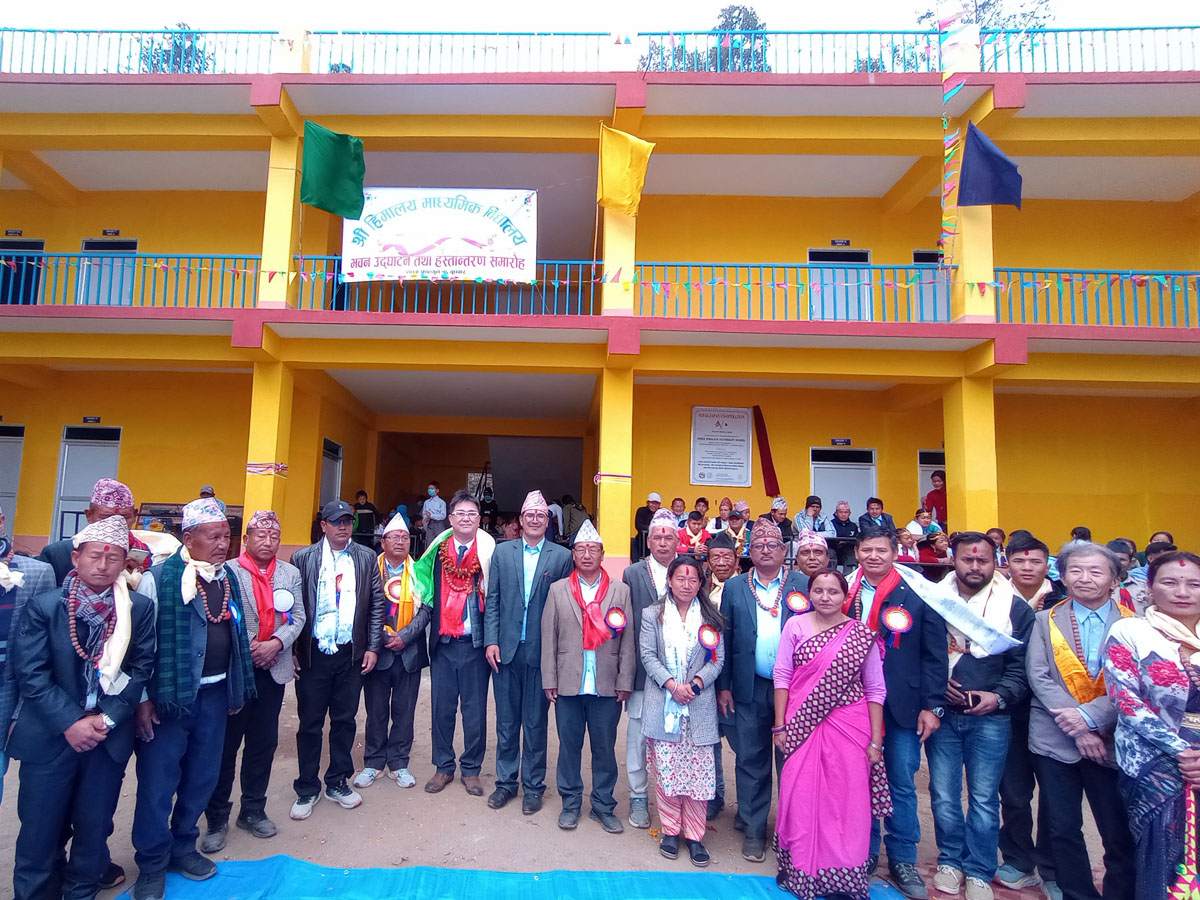
Japan hands over classroom building to Shree Himalaya Secondary...
Disasters in fragile mountain ecosystems can destroy agricultural land, disrupt small businesses, and sever transport links within minutes. These recurring disruptions can push vulnerable and marginalized communities into severe economic hardship, psychological distress, and forced migration unless the underlying causes of their vulnerability are addressed. Major public infrastructure investments in Nepal’s mountain districts will continue to face repeated damage during each monsoon season unless development accounts for the structural risks inherent in the landscape.
Building Resilience
Tall concrete walls designed to contain surging waters have repeatedly proved inadequate against the powerful forces of nature in mountainous regions. Genuine resilience to extreme weather requires a three-dimensional approach to development—one that gives rivers sufficient space to flow safely without overwhelming human settlements. Nepal must strengthen its absorptive, adaptive, and transformative capacities.
The first, absorptive capacity, involves nature-based solutions to protect vulnerable mountain slopes from erosion. Vegetation, including suitable grasses such as vetiver and plants such as bamboo, can help stabilize soil along steep slopes and riverbanks. When appropriately selected and maintained, these nature-based measures can complement engineered interventions and reduce erosion caused by powerful monsoon flows.
Adaptation requires redesigning critical infrastructure in high-risk mountain regions. Future hydropower projects should consider underground power stations and specialized tunnels or channels that redirect large volumes of gravel and debris away from sensitive turbines and other critical structures. Investment in early-warning systems (EWSs) is equally essential. AI-assisted technologies could help monitor weather patterns and identify emerging mountain hazards. These systems should combine affordable, automated monitoring in high-altitude catchments with high-resolution satellite imagery and other relevant data sources. Timely alerts would give downstream communities enough time to follow well-rehearsed evacuation plans without delays caused by bureaucratic obstacles.
Transformative resilience calls for strategic land-use planning that prioritizes the safety and long-term needs of communities living in highly vulnerable hillside settlements. Voluntary relocation and planned land-allocation initiatives could reduce exposure to hazards and the high cost of providing public services to isolated hilltop settlements. Better connections to regional services would improve access to markets, hospitals, safe drinking water, and modern educational institutions.
Such relocation must also respect communities’ social and cultural ties to their ancestral lands. Land-pooling arrangements could allow families to retain ownership within a consolidated hillside community equipped with safer housing and essential public infrastructure. Any such initiative should be developed through meaningful consultation with affected residents and fair, transparent land arrangements.
Community-based disaster preparedness is another essential pillar of Himalayan resilience. Local residents are often the first to respond when disasters strike mountainous areas. Equipping them with practical disaster-management skills, including search-and-rescue techniques, first aid, and evacuation procedures, would strengthen their ability to protect lives before external assistance arrives.
Combining traditional local forecasting knowledge with modern science and technology could further improve preparedness. Communities should be actively involved in identifying risks, developing evacuation plans, and maintaining early-warning systems so that resilience measures reflect local realities and needs.
The Way Forward
The government must demonstrate strong political will and take immediate action to reduce risks in Nepal’s mountainous regions. Lawmakers should prioritize the implementation and enforcement of hazard-zoning regulations in vulnerable areas. Road construction in fragile mountain zones must follow rigorous civil-engineering and environmental standards, while the use of heavy earth-moving machinery should be strictly regulated according to local geological conditions and assessed risks.
Nepal also needs to strengthen geostrategic data diplomacy with its neighbors, China and India. Greater cooperation could facilitate the timely exchange of hydrological and meteorological information from the Tibetan Plateau and other transboundary catchments. Such information is essential for improving early-warning systems and helping downstream communities prepare for flash floods that frequently damage lives, settlements, and infrastructure.
At the same time, Nepal should build on its diplomatic outreach, particularly following the prime minister’s address to the UN General Assembly, to strengthen its international climate agenda. Through the United Nations Framework Convention on Climate Change (UNFCCC) and its Loss and Damage framework, Nepal should advocate for climate justice, stronger international support, and greater recognition of the specific vulnerabilities of mountainous regions.
These efforts should be backed by investment in resilient infrastructure, community preparedness, scientific research, and cross-border cooperation. By integrating disaster risk reduction into development planning and pursuing a stronger international climate agenda, Nepal can lay the foundation for a safer future for its high-altitude communities.
The challenge is not simply to rebuild what disasters destroy. It is to rethink how Nepal develops its mountain regions so that communities, ecosystems, and essential infrastructure can withstand the risks of a rapidly changing climate. Building a resilient Himalaya must become a long-term national priority rather than a response triggered by each new catastrophe.
The author is Research Director, The Governance Innovation Lab