DOMESTIC SITUATION
A politically-unstable, economically-weak, ideologically-incoherent and nationally-divided country will, undoubtedly, have little international clout. Let us not mince words; this is exactly what Nepal’s position is at this point of time. First, it is not easy for smaller and weaker countries to make themselves properly heard in the international arena; they have to earn international credibility through demonstration of consistent, dependable and democratic behavior at home. Completion of the peace and constitution-writing processes would have helped enhance domestic image internationally. There is no telling our leaders are fast losing their international standings and credibility, consequent upon their obvious failures in fulfilling these twin objectives. Prolonged deadlock in the election of the new prime minister due to the continued abstaining, in the meantime, has reduced the stature of our leaders further to a Lilliputian height!
Of course, there is no denying the soundness of the proposal. Two economically-thriving neighbors agreeing to work together with Nepal for stability, peace and also to accelerate socio-economic development would have been wonderful. But international relations are not always governed by idealism and rationality. Protection of vital national interests, even it means through power projection, has always been the core of a nation’s foreign policy. And this is more so with powerful countries. Why would India, or China, for that matter, want to agree to form such a relationship for the sake and interest of Nepal and at the behest of a leader who has yet to prove his trustworthiness and credibility in their eyes ?
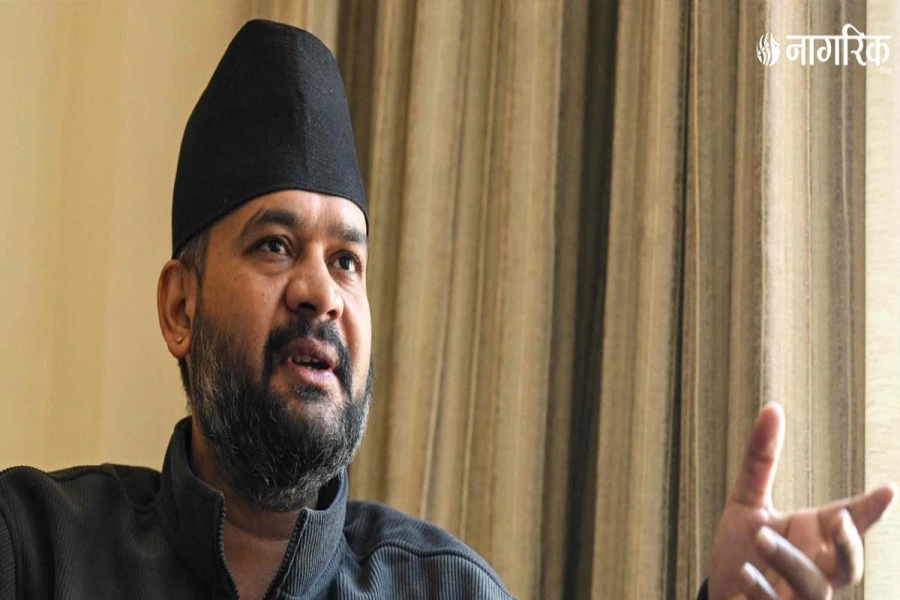
Dr Baburam Bhattarai’s idea of Nepal trying to offer itself to be a bridge between India and China, in order to gain trust of and profit from the prosperity in both the neighbors, merits serious attention.
The credibility deficit aside, the proposal may not enjoy consensus from the other two countries. China and India are not only two emerging, but also fiercely competing regional economic superpowers. They are also vying for enlarging their military and strategic footprints in the region and beyond. Apart from economic and strategic, they have a range of other issues to differ from. While China appears making overt efforts to attract countries from South Asia away from India in an apparent bid to isolate it, India seems well aware of Chinese move and is making every effort to retain its influence. India is also seen busy enhancing its engagements with countries from Southeast and Fareast Asia, besides deepening its ties with the US to possibly neutralize Chinese influence in Asia. Analysts closely observing these issues think that the simmering confrontation is bound to come to a boil, sooner or later, the way the two countries are moving ahead in the race to outpace the other.
According to them, these confrontations seem inevitable as their search for more energy to keep the engine of economic growth and the scramble for capture of markets in the region become more intense. The US and the Western democracies seem equally concerned about the economically- and militarily-rising China as a grave threat, particularly to democratic stability not only in Asian region but also to the whole world. China’s efforts to influence the developing countries from Central Asia, Africa and Latin America to embrace its “politico-economic governance model” for quick economic development and social harmony is something the US and other Western democracies have been viewing with great unease.
They regard the Chinese model as one which will have no place for democracy, individual freedom and respect for human rights. This is something the US wants to prevent at all cost in Asia through its long-term strategic partnership with India, which President Barack Obama has underlined repeatedly in his recent India visit. But, analysts view that America which currently has over US$60 billion worth of trade with China does not want a direct confrontation. They argue that along with the pursuit of the doctrine of constructive engagement set in motion by former President Bill Clinton, it intends a long-term and enduring strategic partnership development with India and other countries in Asia for further consolidation of democracy to counterbalance China.
BRIDGE-MAKING DIPLOMACY
Nepal, therefore, should try to play it safe by staying out of such competitions. For us, temptation for wanting to replicate the Chinese “politico-economic model” or nursing ambition for “special relations” with India will be a sure recipe for disaster. In this context, Dr Baburam Bhattarai’s idea of Nepal trying to offer itself to be a bridge between India and China, in order to gain trust of and profit from the prosperity in both the neighbors, merits serious attention. It may perhaps be more prudent to pursue this bridge-building diplomacy, as this idea sounds more pragmatic and deliverable for Nepal. First, completion of the much-prolonged peace and constitution-writing processes is important and a necessary condition for that. This would usher in political stability and peace in the country, thus creating conducive environment for the application of the bridge-making diplomacy.
Display of credible behavior, pragmatic conduct of its foreign policy and protecting and promoting our national interests and independence, without impinging on theirs, is also absolutely crucial. Until we are politically-stable and economically-self-reliant, we would also do well to abide by the letters and spirit of the treaties and agreements that we have currently with our two neighbors. Standing, thus, on the foundations of the existing treaties and being aware of our vulnerabilities, we should act as a bridge and refocus exclusively on trade, economic and infrastructure development, including hydropower, to promote lasting peace, stability and economic prosperity in the country.
Concurrently, works also must be pursued on drawing a new contour of our foreign policy, which would articulate our long-term national interest protection needs and contain as well, a clear roadmap for an economically-profitable, politically-credible and trustworthy relationships vis-à-vis our two immediate neighbors. In the meantime, wisdom lies on the part of our political leaders to exercise prudence and not to scale- up neither anti-India nor pro-China rhetoric for cheap popularity.
bhimsen29@ gmail.com
Related story
Walk in the clouds: World’s longest pedestrian suspension bridg...