The ensuing chaos obstructs traffic for five minutes before a couple of traffic constables facilitate passage of the microbus to clear the road.
- Related Story: Small traffic violations lead to big traffic problems [break]
This incident that occurred on a recent afternoon is just one of many examples of traffic jams in Kathmandu Valley. The trouble is it is not the worst.
Traveling in the Valley during morning and evening rush hour is always an ordeal, and tiresome traffic jams throws punctuality out the window. This is not to say the traffic situation is hunky-dory at other times either. One never knows when an over-enthusiastic driver or rally will stop traffic.
Infrastructure
Lack of sufficient infrastructure required to support the increasing number of vehicles on the roads, with the addition of driver indiscretion, provides a potent combination, making traffic jams a routine nightmare for Valley dwellers.
"Do you call this infrastructure?" hits back Indra Prasad Neupane, senior superintendent of police at the Valley Metropolitan Traffic Police when asked if the regular traffic jams were due mostly to lack of infrastructure or adequate traffic police force.


There is just 802 kilometers of black-topped road in the Valley which means every kilometer has to make room for 250 vehicles.
To make matters worse, the roads are narrow and ill-maintained.
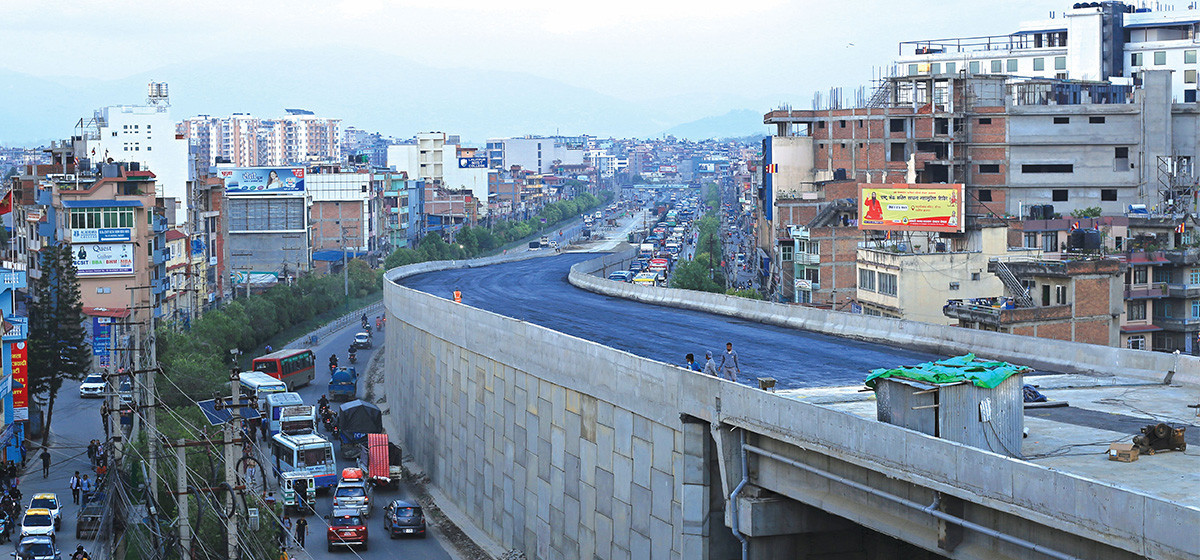
The government is trying to address the problem at the most notorious junction, Koteshwar, by broadening the Tinkune-Surya Vinayak section of the Arniko Highway. But a lot has yet to be done at other junctions such as Chabahil, Balaju bypass and Lainchour.
| Reasons for traffic jams |
| a. Lack of infrastructure |
| b. Lack of discipline and awareness among drivers |
| c. Lack of skilled traffic policemen |
| d. Lack of tough punishment for violation of traffic rules |
| e. Long queues at roadside gas stations |
| f. Perennial protests and rallies |
Parking space
There are not enough parking spaces for the ever-increasing number of vehicles inside the Valley.
“We have time and again requested the government not to allow construction of big commercial complexes without adequate parking space and stop giving car ownership permission to those who don’t have their own garage. But to no avail,” rues Neupane.
There is also no provision made for the hundreds of trucks that enter the Valley every day, nor for separate tempo and microbus parks.
“We plan to remove the micro bus and tempo stand from Kalanki. But we cannot just tell them to go away without giving them an alternative stand,” reasons Neupane. Traffic movement has been remarkably eased in Kalanki after traffic police forced all long-distance buses to operate from the New Bus Park.
Discipline
It is not just a matter of managing Valley traffic better with the present level of infrastructure. A little bit of discipline on the part of drivers can also go a long way towards resolving the issue.
Microbuses and buses stop everywhere, without any warning, to pick up passengers; creating a problem as motorcyclists are always looking for short-cuts. Drivers also tend to wander from their lane in search of a way out, further compounding minor traffic jams.
 Sundhara
Bijay Rai
“They do so in lack of proper traffic knowledge,” says sub-inspector Kaman Singh Khatri at the Metropolitan Traffic Police, Gaushala. “We had provided training to the drivers of Swayambhu Yatayat and Nepal Yatayat a year back and that has helped.”
Such training for drivers of buses and microbuses is intended to help them realize they should not stop their vehicles within 25 meters of intersections and use only bus pockets to pick or drop passengers.
Tougher Punishments
A Bolero belonging to Maoists (license plate number Ba 0001 Aa 90) hit a Tata mobile (Ba 5 Cha 5468) driven by Sapta Bahadur Pradhan in Koteshwar from behind at 3:30 pm, November 24. The mobile driver, unaware of the identity of the offender, stopped to confront the offender, stopping vehicular movement. The Maoists lectured Pradhan for a while, and then sped away towards Bhaktapur without listening to the traffic constable deputed there.
If the Maoists did not even wait to report the accident to the traffic police, one can only wonder whether or not they obey traffic rules.
Enforcing tougher penalties on violators will help matters. The present level of punishment is nowhere near harsh enough, and the burden also does not necessarily fall directly on the offender fostering a culture of impunity.
“Bus drivers do not have to pay fine themselves. The owners pay,” says Sita Ram Hathechhu, inspector at the Metropolitan Traffic Police, Koteshwar.
There are also no tough provisions to handle protestors who block roads. Almost anybody can stop traffic by putting a vehicle or obstacle across the road for the most trivial of issues. Political parties believe organizing rallies and protests is their fundamental right.
Funnily enough, there is no provision for punishing pedestrians who also complicate matters at crossings and intersections.
 Koteshwar
Bikash Karki
Skilled traffic policemen
Traffic policemen even aggravate the situation in some cases. “Many traffic policemen themselves trigger a jam by starting interrogation right in the middle of the road and mixing it up while signaling at intersections,” Hathechhu admits.
The regular transfer of the police force exacerbates the problem. Traffic policemen are rarely posted for long periods inside the Valley. Just as one becomes acquainted with the nitty-gritty of Valley traffic, he/she gets transferred and someone else has to start the process all over again.
There is also a lack of traffic police officers as a whole. In the present scenario, one officer has to cover 1.6 km of road and 402 vehicles. “We repeatedly request for more quotas but are not provided enough human resources,” senior superintendent of police Neupane laments.
Petroleum Crisis
It seems somewhat comical that the availability of petroleum products also affects traffic management. During periods of fuel shortage, which has become the rule rather than the exception, long queues of vehicles at roadside gas stations make mockery of traffic management in the narrow roads of the Valley.