

It is likely that some ministerial hopefuls of Koirala coterie had already ordered their bespoke Laweda-Suruwals in May this year. Nearly six months later, those awaiting a call from the presidential palace are still waiting in anticipation. Premier Baburam Bhattarai proved to be a more astute player in the game of political brinkmanship.

PHOTO: REPUBLICA FILES
It was apparent that the decision of the Council of Ministers to dissolve the CA in line with the diktats of the Supreme Court and then seek fresh mandate had disconcerted the presidential secretariat at Shital Niwas too. Unsure of his constitutional position, legal authority, political backing, administrative acceptability, military power and diplomatic support, President Yadav lost the nerve to go for the jugular of the prime minister. Instead, the head of state merely issued a meek missive declaring that the head of government had become a caretaker one with the announcement of fresh elections.
The statement of the obvious did nothing to change ground realities. In parliamentary tradition, a caretaker premier is duty-bound to hand over the reins of government to a legitimate successor, which is usually the majority leader of the house. The inability to conduct elections on the designated date is a moral and a political failing, not a constitutional failure. Even by the most specious interpretation, no legal eagle could suggest the head of state in any parliamentary system to sack the head of a legally formed government.
It took downcast stalwarts of the Nepali Congress almost six months to collect their wits. They spent the interlude in utter confusion. Most former lawmakers wanted the restoration of the dissolved CA. In popular elections, voters had made some very weighty worthies of the grand-old party bite dust. They wanted nothing to do with the house that had refused to admit them. However, there was unanimity in the party that the Maoist-Madheshi coalition should hand over the reins of the government to the NC posthaste. Any reason? It was their turn to head “the unity government” of “political consensus” to conduct fresh elections!
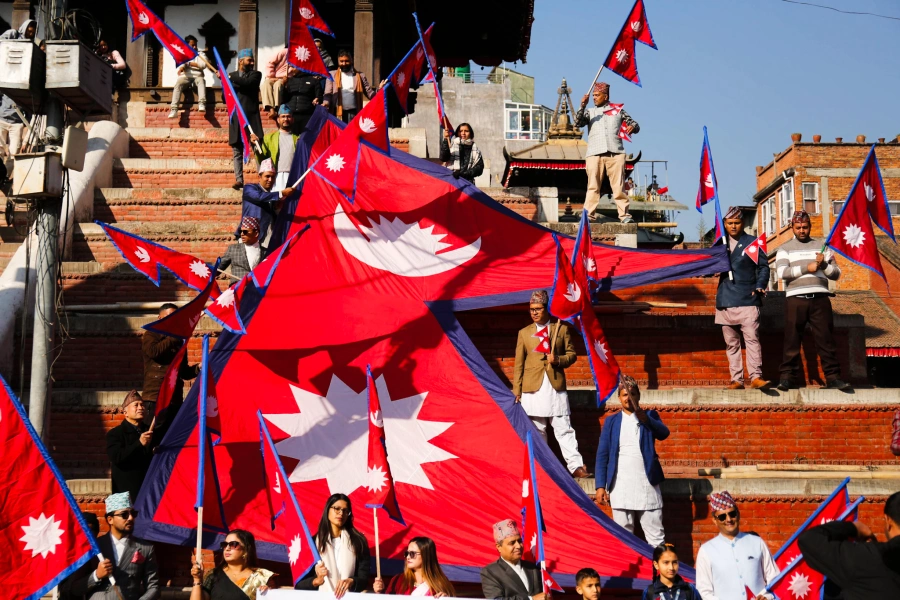
The party finally woke up from its reverie and decided to go to the people in the name of Ganeshman Singh. The significance of protest rally at Basantapur on November 9, 2012 need not be judged by the unremarkable size of the crowd. When last time round the NC had hit the streets in 2006, the headcount at its ‘mass meetings’ at Ratna Park used to be in hundreds. It was not unusual to see Ram Sharan Mahat rubbing fingernails of his hands—according to Baba Ramdev, the act makes gray hairs turn black—to while away the time. Apart from Girija Prasad (GP) Koirala, the second most energetic participant at such rallies used to be late Chhaya Devi Parajuli, another youthful septuagenarian from Sunsari.
The process that humble gatherings of Ratna Park set in motion ultimately resulted in the signing of 12-point Understanding, the Comprehensive Peace Agreement, the Constituent Assembly Elections, and finally the declaration of Nepal as a Federal Democratic Republic. Mass politics tends to chart its own course.
AGITATION MODE
There is no telling whether the NC would have the energy to persist with prolonged and peaceful protests. The outcome of such a political program is even more unpredictable. The protests, however, are sure to reenergize the moribund party.
No matter who starts or wins a war, the conduct of armed conflicts changes the balance of power on both sides of the fence. Any Political agitation is war by peaceful means. It infuses vitality into stagnant societies. The only thing that remains to be seen is the resolve of the NC leadership in resisting the lure of consensus politics.
Politics is competitive by definition and consensual government in a democratic polity is an exception. In a country like People’s Republic of China, where the regime enjoys broad-spectrum dominance over all instruments of control—the party, the police, and the propaganda machinery—it was relatively easy for the outgoing President Hu Jintao to get away from all possible conflicts by instructing his minions to build a “Harmonious Society”. In any functioning democracy, however, claims, counterclaims and contestations are common. Dynamic stability is the best that can be achieved in a plural society.
It is heartening that the party has chucked the harmonium and taken up the drum. The decision made Sushil Koirala sing songs of awakening. The maturity from petition politics to agitation politics is an encouraging sign. In deeply divided and highly unequal societies, political consensus is merely a ruse to give continuity to existing injustices. From the point of view of the marginalized and the externalised people of the country, even cheap populism is preferable to high paternalism or benevolent patronism.
Agitation, however, does not imply continuous confrontation and cessation of all conversations. The NC has probably seen the futility of collaborating with an unpredictable force like CPN-UML. Had Messrs Jhala Nath Khanal or Madhav Kumar Nepal stood by their promise, either Pushpa Kamal Dahal or Ramchandra Poudel would have been the premier and the country would have been on a different course by now. Koirala has probably realised that the value of UML in Nepali politics is that of a joker—its significance lies with other cards that a player holds in his hands. On its own, it is pretty much useless.
The UML would make Koirala climb a bamboo pole and then vigorously shake it from the bottom. On issues of vital national interest—peace, security, social welfare and the budget that makes such things happen—even a protesting party has to separate political reservations from mindless opposition.
BUDGET BONANZA
Autumnal festivals combine ethos of at least two stages in the evolution of human civilization. Animal sacrifice alludes to the hunters who matured into herdsmen. Fruits and grains signify the progression of gatherers into agriculturalists. Hunter-gatherer ancestors of humanity must have loved something like Dashain with its almost inhuman animal sacrifices. It is possible to argue that herdsmen and agriculturists of yore were perhaps more comfortable in worshipping dogs, crows, cows, oxen, and siblings. Unpredictability of outcome, however, is common to both traditions. That could be the reason people gamble in this season.
The government would have the budget even if it has to ask moneybags to mobilize their minions in other parties to support the move. The NC has shifted all its responsibilities to the President.
The Structural Adjustment Program (SAP) began to sap the energy of national economy from mid-eighties when the country surrendered its fiscal sovereignty to the Bretton Woods sisters. Its attitude towards the budget may prove to be the wild card in the hands of the government.
The political class would go into auto energy saving mode for the winter. The budget question has to be settled one way or the other before the temperature goes further down. The show of hands is due in about a week. At stake is the constitutional processes and democratic future of the country.
cklal@hotmail.com
Related story
Kukur Tihar, the festival of dogs, being celebrated (with photo...












-1779250876.webp)





