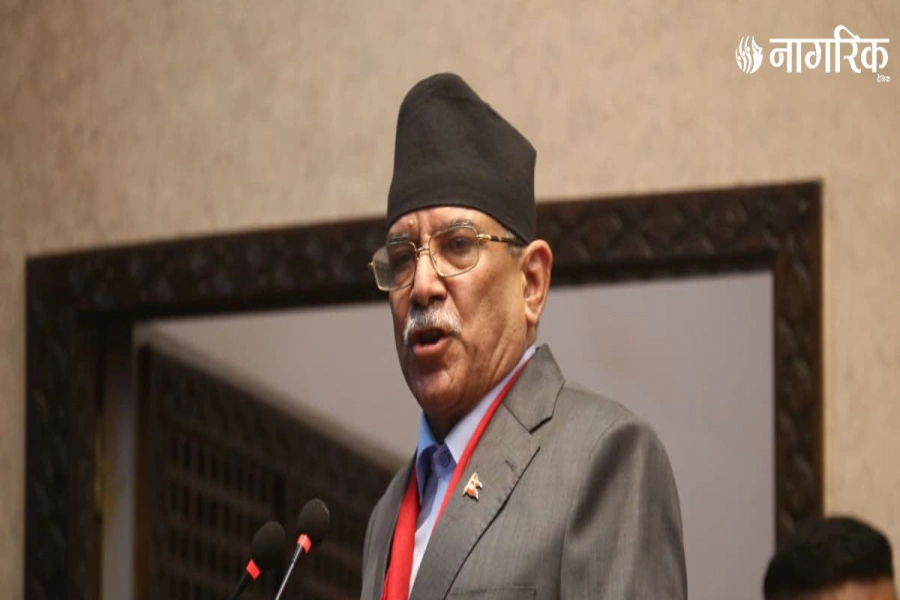
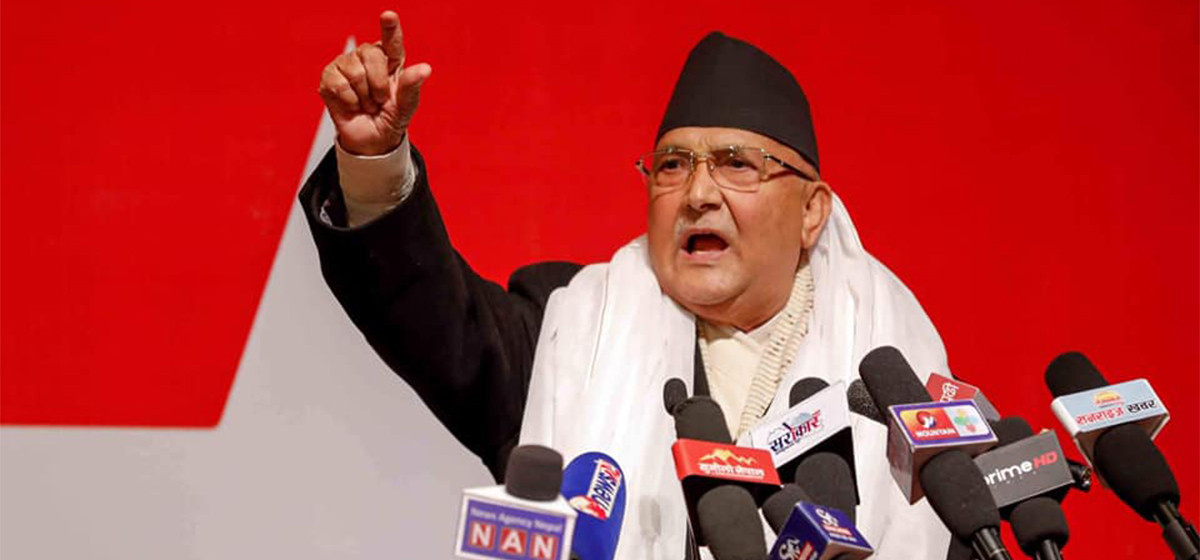
It is noteworthy that neither any common programs could be announced nor a full-fledged government could be formed though nearly one month has passed since the prime minister took oath of office, thanks to their wrangling over power sharing and political agendas. So far they have carefully avoided typical communist jargons and rhetoric such as total change, great leap forward etc in their joint statements. All that two big communist partners of the coalition have agreed to is to work together for “an order headed toward socialism” as stated in the 7-point pact signed between them; nevertheless, the pact itself has been seriously questioned and challenged by the majority of the CPN-UML, the party chaired by the prime minister himself.
By all account, over-reactions are unwarranted as a radical communist alliance is not possible in the first place given the adverse state of geo-politics, international situation and power balance within the country. Moreover, second largest partner of the coalition CPN-UML- now a left-of-the-center force despite its communist history and nomenclature, has traveled a long path of transformation during last 20 years adopting ‘People’s Multi-party Democracy’ as its guiding principle; it simply can’t take a U-turn to arrive where it was two decades before. Its hardliners, especially those who joined the breakaway group CPN-ML when the party split in 1998, had already defected to the Maoist ranks during the last 10 years. Those who remain are too few to make a Maoist dominated alliance of extreme-left possible.
Besides, there are several reasons why democratic forces including Nepali Congress (NC) need not take the coalition as a big threat. The ever spreading dispute within the Maoists is, among other things, an outcome of ideological differences within that party; where, in a strategic move, the tactical chairman has sided with the dogmatic leader Mohan Baidya who advocates for ‘people’s revolt’ and vehemently objects Baburam Bhattarai’s line of mainstreaming the party. A coalition with partners who have more differences than similarities cannot survive for long, therefore, it is quite far-fetched to think that the present coalition poses a threat to democracy
There are other reasons as well why NC need not reciprocate the poorly glued ‘polarization’. First, dividing politics into black and white, when there are pretty large grey areas in between, is wrong. CPN-UML is an example of such grey area which has not yet fully converted into a liberal-democratic party, although is on the process of being one. In this situation, the formations of democratic vis-à-vis communist blocs will push the party to the communist camp. Even the overwhelming majority of liberals within that party will be either forced to join the left lobby or forced to break the party which may invite backlash. The polarization will, therefore, compel most communist parties including CPN-UML to halt or slow their ongoing journey of gradual democratization.
Even Baburam Bhattarai of UCPN (Maoist) may have to compromise his principle by siding with his hard-liner comrade Mohan Baidya in the name of left unity, should such a polarization come into effect. The division will also push smaller communist parties, such as CPN-ML, CPN-ML (Socialist), CPN-Samyukta etc, to switch their alliance. On the other hand, communist parties like Rastriya Jana Morcha and Nepal Peasants and Worker’s Party that have been taking commendable stance against the Maoist-instigated ethno-centric federalization of the country, may have to give up their issue-based approach in the politics of ideology-based groupings.
At a time when even the Maoists and the prime minister himself who is dependent on them for his survival feel shy, for understandable reasons, to admit that this is a left alliance, let alone a left polarization, Surya Bahadur Thapa, a leader having few cadres but plenty of strong common sense has spoken in favor of communist versus democratic polarization.
Moreover, a coalition conceived through secret deals and cursed to born with bitter inter/intra-party feuds over bhagbanda (power-sharing), especially over the allocation of Home ministry, will not last long. At a time when even the Maoists and the prime minister himself who is dependent on them for his survival feel shy, for understandable reasons, to admit that this is a left alliance, let alone a left polarization, Surya Bahadur Thapa, a leader having few cadres but plenty of strong common sense has spoken in favor of communist versus democratic polarization. As a leader believed to have close links with the Indian establishment, if his contentions are echoes of South Bloc, the latter must be conveyed that they are wrong. They made mistakes when they brokered a flawed 12-point accord; they made blunders when they offered sanctuary to Nepali Maoists to fight a bloody war. With all the wisdom of their leaders and the intelligence of RAW, time and again they had been wrong whether in Nepal or in Sri Lanka or elsewhere in the region.
Unfortunately, our selfish, inept and poorly educated leaders buy the assessment and advice of New Delhi without a hitch and second thought. Apart from his narrow interests and animosity toward the then king Gyanendra the reason why late G P Koirala aligned with the Maoists was that the Indians had assured him about them. A leader with poor analytical skills he would never see things differently when it came to Indian soliciting, the way B P Koirala could and take stand accordingly. Although Ram Chandra Poudel recently ruled out any attempt of political polarization, party president Sushil Koirala seems somewhat drawn toward the idea.
NC, now forced to be content with a mere 22 percent of popular vote compared to 37 percent it received approximately in the last three parliamentary elections thus slid to 2nd position from a long time standing in the 1st position in national polity, has done enough damage to the nation and to itself by its poor organizational capabilities, lackluster performances both while in government and in opposition, never ending in fights and finally, by its suicidal error of embracing the Maoists, mainly to serve the interests and ambitions of late G P Koirala. It is high time now it learned from its past mistakes. Time is on the side of democracy, which means it is on the side of NC and not that of the communists; but the latter do possess the necessary organizational capabilities to win the game of real politick which NC doesn’t. They also know how to benefit from the foolishness, greed and weaknesses of NC and its leaders.
So, NC should improve its organizational and leadership shortcomings and meanwhile support democratic elements within communist parties in their fight against intra-party hard-liners rather than form a characteristically dysfunctional front of liberal democrats that will only push the liberal lefts to align with the radicals in the name of communist unity.
jeevan1952@hotmail.com
Related story
Globalization or Polarization? Trump’s New Nationalism in an In...