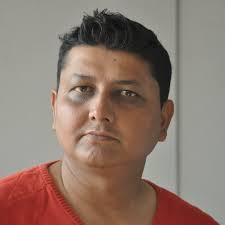
Rakesh was given the responsibility to lead the Nepali team with the hope of qualifying for the semifinals of the South Asian Football Federation (SAFF) Championship. [break]But the mantle of leadership was passed to Sagar Thapa as the team geared up to take on the Maldives at Bangabandhu Stadium, Dhaka. The extension of Rakesh’s career seemed to be in the lurch after similar trend continued in the match against India.

Rakesh’s dreams of winning 50 caps for the national team remained unfulfilled. He began his career from the AFC U-16 qualifiers from Birgunj in 1997 and won his 49th cap for the national team as he entered the field to play against Afghanistan in the dying minute. Rakesh holds the record of playing full time in 33 matches.
But Rakesh is not disheartened. “My country’s victory is more important to me than my personal victory. I suggested my coaches to replace me because my juniors are in better form than me,” said Rakesh. “I’m not worried about myself but am disappointed that our team did not qualify despite performing well,” he added.
Nepali team’s coach Krishna Thapa and manager Birat Jung Shahi also praised Rakesh for his decision to let the new generation come forward. “Rakesh suggested us to give juniors the chance to lead as they were in good form,” said Shahi.
Meanwhile coach Thapa said, “Rakesh wasn’t in good form and we needed good players for victory. He did a great favor by deciding to stay in the bench. He is a true gentleman.”
History shows that Nepali football captains had to end their careers rather abruptly.
Upendra Man Singh was made the captain of Nepali team during the 2005 SAFF Championship, Karachi. However, he had to watch all three matches helplessly from the bench as Nepal got stopped in the first round. Upendra said, “I was in the same situation in Karachi as Rakesh is here now. A team is more important than a player.”
Hari Khadka also faced a similar fate a year later. Hari was designated the captain of Nepali team during the 2006 AFC Challenge Cup but Basanta Thapa took command of the team from the very first match against Bhutan. As Nepal paved way to the semifinals, Hari played only one game against Bhutan as a replacement for Basanta in the 77th minute and was confined to the bench in rest of the matches.
Deepak Amatya was the captain of the Nepali team during the 8th South Asian Games 1999, Kathmandu, but he too was confined to the bench as Nepal’s British coach Stefan Constantine was more confident about young players. Bal Gopal Maharjan, Upendra Man Singh and Dev Narayan Chaudhary took over the mantle as Nepal moved to the final during the event.
In 1998, another captain Mani Shah also took retirement from international career in the same way. He was the captain during the Bangkok Asiad where he carried the national flag representing Nepal in the opening ceremony but sadly only to remain as an onlooker. It was Deepak Amatya who led the team against Japan and India.
Raju Shakya’s 17 years’ career also ended in a similar fashion. Shakya who helped Nepal clinch the title of the SAG Gold Cup in 1993 for the second time was overlooked during the First SAFF Championship 1997 after Nepal unexpectedly lost 2-0 to Pakistan.
Shakya was replaced by new generation player Sandesh Shrestha in the decisive match against Sri Lanka. Shakya resigned from the national team subsequently.
The All Nepal Football Association (ANFA)’s President Ganesh Thapa’s farewell from international football was slightly different. Thapa was in the closed camp session during the Sixth SAG in 1993. He was expected to lead the Nepali team but surprisingly was not even included in the team. Raju Shakya who replaced Thapa, won gold medal in the event held in Dhaka.
Rakesh was fortunate among the lot as he could at least play for 40 seconds in the last match against Afghanistan before retiring. Other captains had to retire traditionally from the bench.
Related story
Worth of stories