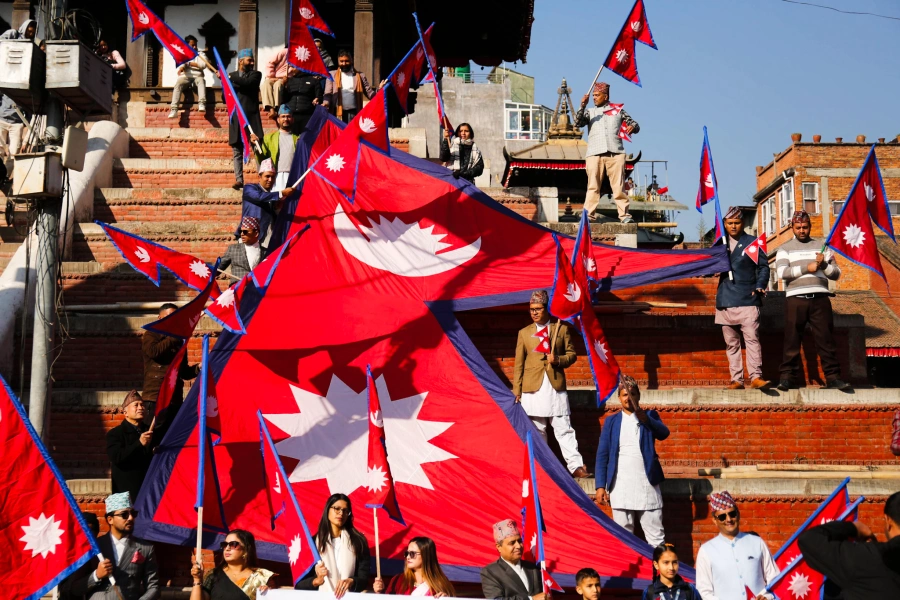
At the other end of these grounds, namely at the Open Air Theater, the Maoists had organized a gathering on the very same day to present to the public its version of the constitution which was done so by an array of party leaders sitting on stage in sweltering mid-day heat, in the midst of several thousand ordinary Nepalis. The merits and demerits of this constitution notwithstanding, it nonetheless was a sort of symbolic victory if nothing else for the Maoists in being able to put before the public this important document. That this occurred on Republic Day could not have been a coincidence, nor was it coincidental that the only person who appeared to be one step ahead of the Maoist was a Nepali Congress leader who one day earlier--and remarkably in an individual capacity--made public his version of a draft statute. The contents of Narahari Acharya’s draft notwithstanding, the larger point being that the ability to be proactive in politics is a sign that one does not take for granted the importance of meaningful political symbolism--which in essence is derived from a recognition that the public desires to see a political process that is punctual, focused, forward-looking and attentive to detail. Proactive politics, in other words, is a powerful source from which to derive effective symbols.
Symbols are in fact everywhere in politics, and that is why it is important for officials to take the time to determine that these symbols are presented in the most forceful, impeccable and meaningful way.
Whether a symbol is powerful or not, whether it is progressive or not, it can be understood as a public posture, and in politics posture sets the tone for the content of politics itself, and more generally for the norms which society tends to adapt to and act upon. In this context, one would have imagined that a paradigm shift from Monarchy to Republicanism in Nepal would have given way to a dramatically and drastically different way of doing business. Of course, and as US President Obama discovered after assuming office, despite earlier pronouncements calling for radical change and so on, a nation is like a heavy vessel at sea, to change its course requires a steady, not abrupt shift of action. In spite of such logic, the Nepali public had been keenly anticipating change in the wake of the 2006 movement, but alas it has been slow to come, and surely the manner in which Republic Day celebrations unfolded this year was an indication that despite a severe deadlock that continues to persist in the consolidation of the Nepalese republic, top government officials were unmindful to demand a recalibration of national celebrations which ought to have been more subdued and austere. In short, the status quo of how public ceremonies are enacted continued to be the status quo--a sort of passivity that reflects very poorly on the state.
One of the most interesting symbols of contemporary Nepal I have seen is actually not in Nepal at all, it is hanging on a wall in Beijing at the Embassy of Nepal. It is a portrait of Nepalese President Ram Baran Yadav, which is placed in the main hall of the Embassy and is hung besides a similar portrait of Chinese President Hu Jintao. There is nothing peculiar about President Yadav’s portrait in itself, what was striking instead was that it hung on the wall in a slightly crooked position on a day when many distinguished guests had assembled there to welcome the Nepalese Premier and his delegation. A simple thing such as the physical placement of this important symbol of Nepal’s nascent republic had been overlooked, and it reminded me of the first Premier of the People’s Republic of China, Zhou Enlai, who left nothing to chance as he would personally inspect in the minutest detail meeting rooms and dining halls before guests arrived, to ensure that precise and correct arrangements had been made. Symbols are in fact everywhere in politics, and that is why it is important for officials to take the time to determine that these symbols are presented in the most forceful, impeccable and meaningful way. Weak symbols in politics are an indication of some weakness in the political process itself, and these weaknesses are consequently always open to attack and subjugation.
Symbols are exuded in almost all directions by the state, and indeed symbols also emanate from politicians themselves on account of the way they talk and behave and dress in public. These symbols are then reacted upon (or even emulated) by the general public, and that is why to be a public official is to assume such an extraordinary responsibility, because the actions of the state and of its officials have such wide-ranging implications on society for an extended period of time. I was in a small shop the other day and overheard a conversation between a shop-keeper and a person who appeared to be his friend. The shop-keeper was urging his friend to join a political party only if there was some immediate material gain to him and his family. The shop-keeper argued that his friend should take advantage of ‘ these unscrupulous political leaders ‘ and even extract a job or some money from them because ‘such leaders have been looting us all along anyway’. Of course it cannot be plausibly argued that all politicians and the entire government apparatus of Nepal is corrupt, but corruption is widespread in the country and public corruption when it is taken to be a symbolic action, tends to severely erode the confidence and loyalty that citizens have towards their state. This is a very dangerous process whose damage is spread across an entire generation.
Another symbol I have seen in republican Nepal relates to the steadily expanding activities and clout of a plethora of foreign agencies and organizations, and more specifically an entire class of energetic and educated Nepalis who are compelled (or otherwise choose) for a variety of reasons to work at such agencies, whereas if they served their own government, their efforts could be far more instrumental and decisive to actually bring about the sort of change that is proscribed in international development discourse. It is unfortunate that the government of Nepal, due to the relatively weak role of the civil service which is mostly overridden by party politicians, and also because of the inability to provide adequate pecuniary benefits, is unable to attract this group of Nepalis, but on the other hand foreign agencies have also done a huge disservice by virtually making it impossible for their Nepali staff to have the desire or willingness to migrate to government service. For example, the pay-scale of a government officials vis-à-vis a Nepali staff of an international development agency or project is vastly disproportionate; life-styles are divergent and so are the methods of work, and office environments are also sharply dissimilar and so on-- the point being that the symbolism this conveys is detrimental in so many different respects. And this bring us to a much larger point, which is, why is that the government of Nepal has still been unable to project a strong symbol and signal, that foreign agencies and organizations, despite the assistance they offer, will never be allowed an overweening role in the formulation of Nepal’s development agenda which has all too often been foisted on the country. Again, the question narrows down to a need to become more politically proactive and thereby to fashion and sharpen Nepal’s political symbols so that this country can move forward decisively and confidently.
bhaskar.koirala@gmail.com
Related story
64 political parties registered for PR, 3,424 candidates (with...