This conversation takes place at Tilganga in Kathmandu, the speaker’s workplace. On the other side, right across the Ring Road, is the Pashupatinath Temple complex where the cremation ghats are situated on the banks of the Bagmati River. “Meanwhile, I’m in a hurry to do whatever I can,” the man says.
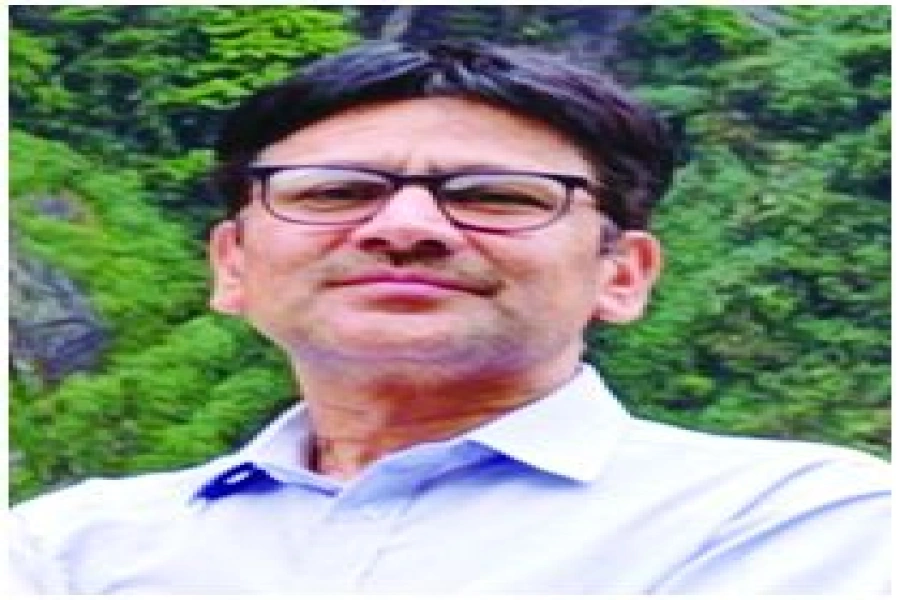
This is Dr Sanduk Ruit, explaining his works. Starting at eight in the morning, he does 20 surgeries daily on the average by three in the afternoon in his second home – the Tilganga Eye Center, that recently became the Tilganga Institute of Ophthalmology. He then attends his private eye clinic on New Road till 7:30 in the evening before going to his other hospital-related appointments.
 Dr Sanduk Ruit.
Kehsab Thoker
Related story
Group of foreign Rotarian restoring eyesight in remote villages...

But Dr Ruit, who received the Ramon Magsaysay Award in 2006 for introducing cheap sutureless operation technique to perform cataract surgery and manufacturing inexpensive high-quality intraocular lens, would have been lost to the medical world had it not been for a personal tragedy.
The ophthalmologist, whose inexpensive intraocular lenses have given sight to hundreds of thousands of poor Nepali and other cataract patients, dreamt of becoming a pilot during his schooldays. But the death of his younger sister of tuberculosis while she was a student at the Mahendra Bhawan School in Kathmandu in 1964 changed his heart.
“Treatment of tuberculosis wasn’t effective then. She also caught pneumonia and passed away. That pinched my heart and I decided to be a doctor,” the 54-year-old eyesight specialist reminisces.
Born in the remote Olangchungola Pass in Taplejung District of northeast Nepal as the eldest of five children – two sons and three daughters, three of whom died young – of uneducated parents, Dr Ruit was fortunate that his father was passionate about providing proper education to his children. A smalltime businessman trading with the adjoining Tibet, his father sent Dr Ruit to St. Robert’s School in Darjeeling for studies and also provided financial support in his early medical career.
Dr Ruit later joined Siddhartha Vanasthali School in Kathmandu and got his School Leaving Certificate (SLC) from there in 1969. He completed his MBBS from King George’s Medical College in Lucknow, India, and was fascinated by ophthalmology long before he joined the All India Institute of Medical Sciences in Delhi for specialization in 1981.
“Nepal’s senior eye specialists such as Drs Ram Prasad Pokharel, NC Rai, and Madan Upadhyaya encouraged me to choose ophthalmology while practicing after my MBBS,” Dr Ruit recalls.
It was no coincidence, either, that he married an ophthalmic nurse in 1987. “I’ve gone against the norms in everything in my life,” he jokingly refers to his love marriage, which was a rarity in those days. He then turns serious and admits that his wife Nanda has been a pillar of strength to him in his difficult days while pursuing his dream project of Tilganga.
He waged many battles before he and a few likeminded people came together to start the Tilganga Eye Center on June 7, 1994.
 Tilganga Eye Hospital
Keshav Thoker
“Many failed to read the rationale behind starting a new eye hospital when there was already an eye hospital at Tripureshwor [in Kathmandu],” Dr Ruit explains. “So a big delegation met the then prime minister to prevent the opening of Tilganga. We virtually went underground for six months,” he says.
Fifteen years later, his dream project has now become a model institution for many countries, and he has realized his dream of providing state-of-the-art eye care in Nepal and in other Asian nations.
His 19-year-old son – he also has two daughters, one 16 and the other 14 – is currently studying medicine at Manipal College. But Dr Ruit does not want to impose on his son and force him into ophthalmology.
“We have a very competent team of young doctors at Tilganga to take over from us,” he says with contentment.
He feels proud that he became the first eye specialist to win the Ramon Magsaysay Award from the Philippines. “It brings a sense of excitement,” he concedes. “Being able to give light to patients is equally satisfying as it gives me very nice warmth in the heart,” he adds.
And he is not willing to part ways with that feeling anytime soon.