Indeed, the quest for equity in this society is a long way from the reach of the commoner but we should not allow indifference to overcome the right to demand more and better services for the people.
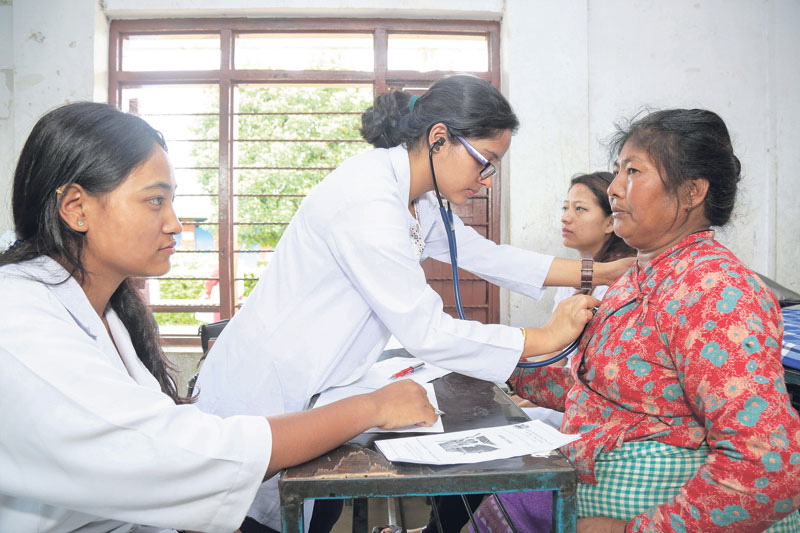
Shanta Chaudhari is a 35-year-old mother of a nine-year-old girl Sakina and lives with her husband in Samsherjung VDC, Banke, not far from Nepalgunj. On May 18, as the storm was approaching, Shanta rushed to an orchard in the village where her daughter was playing to bring her to the safety of home. The storm caused a heavy branch of a tree to fall off and the branch fell on Shanta´s back, causing spinal injury.
Now, Shanta is being generously treated by the Spinal Injury Rehabilitation Center near Dhulikhel. Despite being supported by the hospital, circumstances are making the life of her family impossible as her treatment, although subsidized, still costs something around 15,000 rupees a month, not much for many people but a huge amount for the vast majority of the Nepali population.
Still, Shanta was lucky as she managed to receive 39,000 rupees from the Government of Nepal while her uncle managed 50,000 rupees after selling his oxen and the local people from her VDC collected another 10,000 rupees. Obviously, this is not enough and Shanta’s family had to contract some debts in order to partially meet her health expenditures. Shanta’s condition is critical but she might improve with lots of therapy and special treatment, something that is out of the capacities of her family. The hospital itself is in a difficult position as there are many cases of spinal injuries happening everyday in the country, especially in the rural areas.
What should be done in order to help out Shanta or any other person experiencing such a personal misery? Why are stories like Shanta’s allowed to happen? Indifference is the worst disease that might get inflicted upon a cohesive and just society, something all Nepalis are striving for but only few can really achieve.
Certainly there is no easy solution, and it might be tempting to blame the government or development partners for failing to achieve a just and equitable space where the rights of the citizens are not only proclaimed but are indeed groomed and nurtured, in order to make constitutional obligations a reality.
The Nepal Health Sector Program Implementation Plan (NHSP) II, 2010-2015, certainly goes in the right direction, highlighting the role of non-state actors, including the communities in the health care provision. At the same time, when we come to the sensitive issue of public-private-not-for-profit partnerships, the plan recognizes the existing limitations and challenges in framing a cooperative framework in the service delivery. The recent efforts in establishing, thanks to donors’ contributions, a basic health care service in rural areas are indeed commendable.
South Africa recently announced the launch of a pilot universal medical insurance for all its citizens. Something similar should also be devised for Nepal.
These are encouraging steps but much more should be done and achieved. The bottom line should be clear: The state is ultimately responsible and guarantor of health of its own citizens but deeper and stronger cooperation with not-for-profit and for-profit sector is indeed indispensible. The long-term goal of establishing an equitable and just national health system should move forward with the health facilities at grass roots level at its core.
The public hospitals at district and regional level are in dismal status and this should be reversed rather than allowing the free flow of sick people forced to come to Kathmandu for “quality” care. Also, in this case, the NHSP II lays the framework for strengthening of health care system at local level but unless these strategic directions are matched by strong willpower and adequate resources, the promised changes will not materialize.
The provision of public service should be based on the “public” outreach of the services provided rather than the legal status of the service providers. It is time to regularize the myriad of private hospitals all around the country.
Provided they are meeting the national standards and provided there is an existence of and compliance to a monitoring framework, a challenge well highlighted in NHSP II, why not create an enabling environment where non-state actors are allowed to offer public health service with reimbursement mechanism by the state? In this effort, the issue of accessibility and equity will be paramount.
Moreover, stronger attention should be given to an integrated approach linking health care with social security, with bolder actions to be built on the sketches of a welfare state already existing. Safety nets like conditional and unconditional cash transfer, a more generous and universal health care system also for non-communicable diseases should be ensured and funded with tax payers’ contributions and external aid.
Obviously, coming up with a universal social security system is something extremely expensive and daunting in its designing and implementation due to fragile national politics. The existence of a minimum pension system is significant and should be strengthened.
The potential of micro-insurance schemes should be fully explored with a clear regulatory framework. Also, in this case, the government could forge a partnership with private and not-for-profit service providers, playing the role of enabler, funder and evaluator. South Africa recently announced the launch of a pilot universal medical insurance for all its citizens. Something similar should also be devised for Nepal.
To conclude, the story of Shanta is not only a blunt confirmation of the sorry status of what should be a national health service but also a clear reminder of the status of denial experienced by the vast majority of citizens who are deprived of the right to health. The citizens of this country should not end up believing that resignation and hopelessness are inalienable aspects of their lives.
simogal2000@yahoo.ca
Related story
Revised interest rate corridor system introduced