

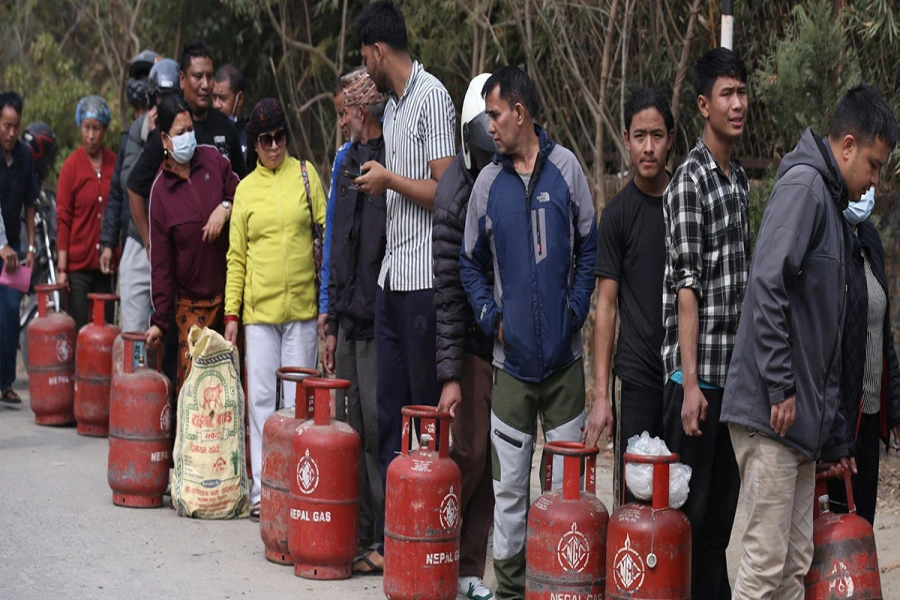
These youths braved scorching heat and long queues, and some of them lined up for the whole night hoping to get inside the stadium early in the morning. Women, who were also in queues in significant numbers, got a raw deal as it often happens with them. Officials failed to show even a basic cultural sensitivity, so there wasn’t a separate line for the women. As these youths in the queue constantly pushed forward, some jestingly and others with frustrations, the lines became so tight that everyone’s body was in unavoidable physical contact with others.
Scenes likes this often bring out our repressed anger against the politicians. Not that these youths are trying to leave the country just because of our politicians. Nor is it true that it’s just our politicians alone who are responsible for all the mess that we are in today. But the scenes like these remind us of how meaningless the politicians’ unending fight over power is. And this also renders the whole debate over which leader should be our next prime minister completely irrelevant.
Youths going abroad for work, which brings both money and experience, is not a bad thing in itself. And I myself have written a number of articles, in a way, highliting the benefits of foreign employment.
But one thing is for sure – poverty and unemployment are at the root of this foreign exodus. That our parties have engaged themselves in politics of poverty since 1950s and that poverty still remains the major challenge of our society only exposes the poverty of our politics.
Nepali Congress (NC), the grand old party which spearheaded movement against the Rana oligarchy, was the first party to champion the cause of the poor. Soon democratic socialism became its philosophy and ending poverty and feudalism its overriding concern. The present-day CPN-UML entered the political landscape with an exceedingly pro-poor agenda. It was so radicalized in its ideas and intolerant in its orientation that it perpetrated the beheading of nine Jamindaars in Jhapa. With time, both the NC and UML mellowed, leaving the radical space to the Maoist party. But the politics of poverty continues.
Lifting people out of poverty is an extremely difficult undertaking for the simple reason that you cannot hand down prosperity. We can distribute handouts but that hardly suffices, and if done improperly, it can only impoverish the people even further in the long run. Our political parties must understand that attacking poverty needs more than rhetoric and it certainly needs cooperation among themselves for well-thought out, implementable, long-term intervention. The never-ending political bickering is, therefore, as detrimental as our lack of competence in understanding poverty and our lack of resources needed for addressing this problem.
However, if we are sincere about it, we don’t have to reinvent the wheel to make sensible policy interventions against poverty. There are enough of experiences from around the world and we just need to analyze them, understand them and figure out what works and what doesn’t in our own context.
China, Brazil and India have made impressive gains in lifting millions out of poverty and there are important lessons for poverty-stricken countries like Nepal. Martin Ravallion’s policy research paper done for the World Bank, “A Comparative Perspective on Poverty Reduction in Brazil, China and India “, is a great resource for understanding poverty.
The first lesson of this study is that you cannot attack poverty in a meaningful way unless there is a sustained economic growth and a decent degree of macro-economic stability. You may not be a taker for the “trickle-down theory” (as economic growth takes pace, its gains gradually trickle down to the people at the bottom of the economic ladder) but you cannot deny that poverty reduction is impossible without growth.
China is a shining example. As long as China practiced a full-fledged socialist economic model with farms collectivized and industries nationalized, its growth stagnated and the Chinese society remained frozen in poverty. Till 1981, 80 percent of the Chinese population was below the poverty line. By 2005, only 16 percent Chinese were still below that line. No other country in history has attacked poverty so rapidly and so successfully.
What miracle had happened after 1981? It wasn’t any miracle per se; it was just a matter of undoing what Mao Zedong had done: Deregulating the economy and de-collectivizing the farms. Foreign investment in manufacturing and Chinese farmers’ free spirit in agriculture propelled Chinese growth, subsequently lifting millions from below the poverty line. This offers an invaluable lesson for our hidebound comrades and so-called socialists.
But the Chinese case also offers an equally important lesson to those who want to leave poverty alleviation to the whims of free market alone. Access to capital is the key to poverty reduction. Once China de-collectivized land, it was more or less equitably distributed among the farmers, giving all of them an access to productive capital. Nepal will have to find an innovative solution to this issue of lack of productive capital in the hands of the poor.
Brazil’s poverty reduction came more as a result of its social policies and the Indian achievement, though modest, was a result of service-sector growth. There is near consensus among the economists that manufacturing sector’s growth is of little help in attacking poverty.
Again, as in China so in Brazil and India, poverty reduction became possible only because of sustained growth and macro-economic stability. Communist parties in Nepal tend to place little importance to macro-economic stability and they are often profligate with spending once they are in power.
They typically misunderstand that inflation hurts the poor more than it hurts the rich. With higher prices, rich people just lose their savings but the poor often lose things as basic as medicines and meals.
Our politicians must take responsibility for attacking poverty and this must go beyond rhetoric. They can pick the best of policies that have worked abroad and apply the ones that best suit our own context. If they fail us generation after generation, the people will some day descent upon Singha Durbar in rage, and that day the politicians will be left with no option but to head toward the foreign embassies for refuge.
ameetdhakal@gmail.com
Related story
Poverty: A Multidimensional Problem, Nepalese Context


-1784075952.webp)


