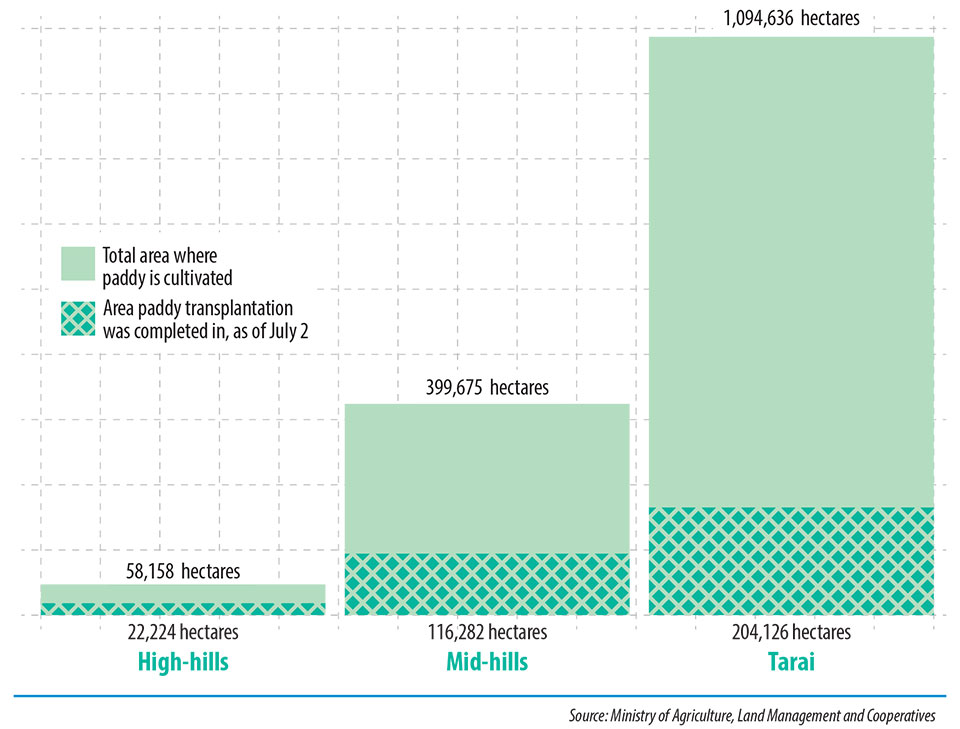
According to Ministry of Agricultural Development (MoAD), plantation has been done in 87 percent of paddy fields as of Monday, compared to 90 percent in the corresponding period of last fiscal year.Paddy, a staple crop, accounts for one-fifth of the total agricultural output. About one-third of the paddy acreage of over 1.42 million hectares is completely dependent on monsoon rains.
MoAD officials attribute relatively weak rainfall this year to drop in paddy plantation.
Paddy plantation as well as production is largely dependent on monsoon as huge swathes of paddy fields lack irrigation facility.
"Scarce rainfalls during plantation season have reduced average plantation this year. Though plantation figure is lower than last year, it is not a significant decline," Shankar Sapkota, spokesperson of Ministry of Agricultural Development, told Republica.
According to Department of Hydrology and Meteorology (DoHM), rainfall until third week of August was lower compared to past years. DoHM considers 1400mm of rainfall as normal for monsoon season that kicks off from the second week of June and continues till the end of September.
Sapkota, however, said ministry was hopeful that plantation figure will go up as many areas have received rainfall this week. "Generally, plantation is done until the last week of August. If there is good rainfall this week, it may give a boost to plantation figures," he added.
Data shows that far-western region has reported highest plantation figures of 175,500 hectare (99 percent of total paddy fields), followed by mid-western region (97 percent out of 183,174 hectare) and western region (97 percent out of 324,566 hectare).
Similarly, plantation has been completed in 80 percent of 417,007 hectare in eastern region and 81 percent of 386,705 hectare in central development region.
The final plantation data is subject to go up or down slightly based on the patterns, rainfall recorded this week and other factors, according to MoAD Spokesperson Sapkota.
According to a data, paddy production rate stands at 3.3 tons per hectare. A total of 4.79 million tons of paddy was produced from 1.42 million hectare of land in the last fiscal year.
Drop in paddy production is likely to increase import of rice from India. According to Nepal Rastra Bank, rice worth Rs 12.37 billion was imported in Nepal in fiscal year 2013/14. "Last year we had a deficit of 600,000 tons of rice. But we had surplus of 156,000 tons of edible food," Sapkota said, adding, "Rice import is increasing due to rising per capita consumption of rice amid falling paddy production."
Related story
Plantation completed in 50% of paddy fields in 14 districts