

Located in the same area, Master Weaver is owned and run by second-generation members of a Tibetan refugee family. In the early 1970s, the family pioneered private manufacturing and sale of Tibetan carpets outside the then only carpet-weaving center in Nepal at the Jawlakhel Tibetan Refugee Camp.[break]
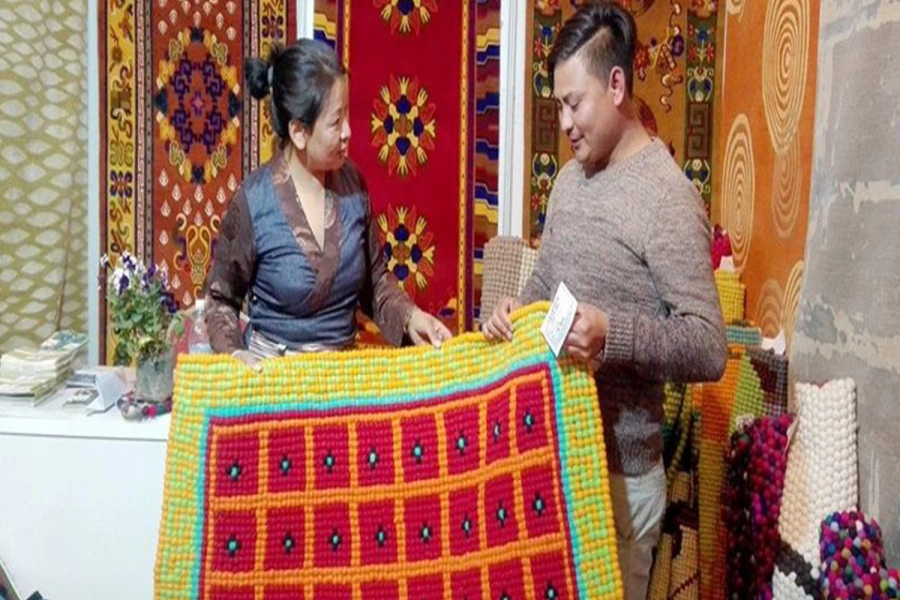
For Pema Karpoche, director of Master Weaver, Tibetan carpets are actually a form of art. With a hobby for antique Tibetan carpets, he has a collection of some 100 such carpets dating back to the 18th and 19th century. An ardent admirer of art himself, Karpoche makes his own designs for his carpets and some of his original pieces also have his signature and the company logo on them.
Master Weaver has been doing exclusive production of classic handmade Tibetan carpets in modern, antique and fusion designs. However, Karpoche says reproducing antique Tibetan carpets are always a viable option as they never go out of fashion.
According to him, there are five major factors to consider in creating a fine carpet – material, quality of dye, workmanship, finishing (washing, clipping, design sculpting), and aesthetics (design conception and color combination).
 “The most important part is the color combination. If you mess the colors, then it’s like wasting everything else that goes in making a carpet,” shares Karpoche.
Making a single carpet takes a lot of effort and group work – from the selection of colors to designs, laying it all on graphs, and then to weaving.
“Every step of making a carpet has to be carried out carefully and attentively. Especially, while weaving, you can’t take chances in using shades of yarn, no matter how similar it looks, or the whole design will be spoiled,” informs Karpoche.
He visits his factory at Bungamati regularly to make sure that during the actual weaving process, with every inch coming out of the loom, his ideas are translated to life.
Karpoche believes that carpet is one of the most valuable assets for the interiors. He also suggests that people use vibrantly colored carpets for a subtly colored room whereas use carpets with minimal designs for a room that in itself is already colorful.
“It’s all about creating balance,” he says.
Some rugs are also used as wall hangings, and the idea works like beautiful artifacts and a theme to build upon for the overall décor of the room.
Most carpets are made of wool, but weavers also use other materials, like raw and fine silk, for designs and motifs.

According to Karpoche, the main threat to a carpet is moth infestation. Regular dusting off and vacuuming is very important, especially the parts of carpets that are pressed under furniture. He also suggests sending the carpets for professional washing at carpet factories rather than doing it at home.
Many carpet factories like Master Weaver also offer carpet washing as after-sales services.
“While washing these carpets, only the weavers can do it with careful consideration, as no one knows the value of these pieces better than their creators,” shares Karpoche.
These carpets have not had stronghold on the domestic market as they have remained as high-end possessions amongst art admirers. Also, there are comparatively cheaper carpets available, and people don’t invest much on interiors. But Karpoche is optimistic about the growth of his products in Kathmandu, even if it is amongst a niche group.
Related story
Nepali carpets worth over Rs 3 billion exported to USA





-1778925320.webp)





