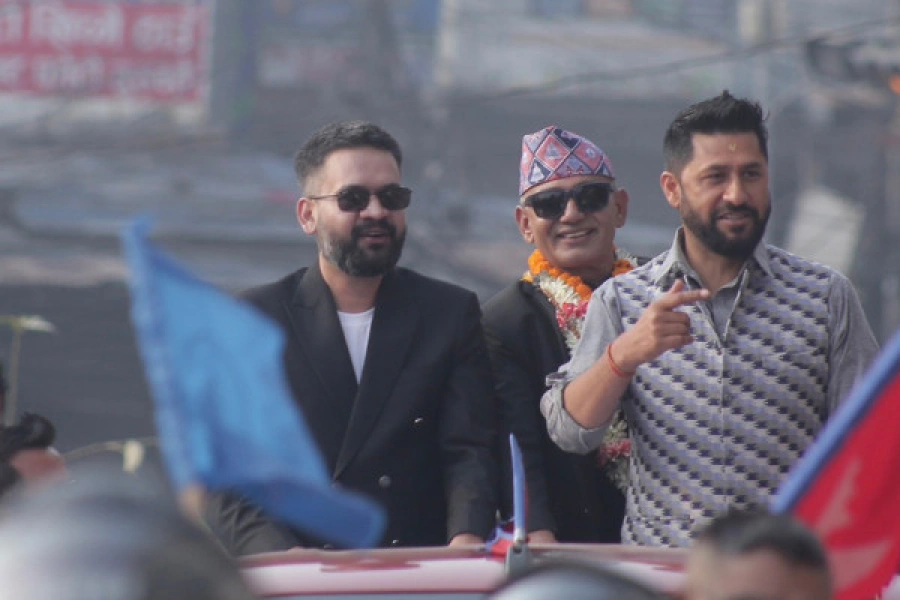
History repeats itself. Now the supreme Maoist leader acts like a king; and his cronies, as the former courtiers. Thus, some have named the present PM as King Prachanda. Normal traffic within the city comes to a halt when he travels overseas. Initially, ambassadors had to line up to see him off. The military plays the salute in his honor. National and international flights get delayed so that “King” Prachanda can leave first.
Note also that both Prachanda and his courtiers have begun to spread myths about themselves, as the “Bishnu in Narayanhiti” and the former royalists used to do. Let’s sample a few.
One, the country wants a people’s republic. The Maoists desire this toy so much that they have hypnotized themselves to imagine that all Nepalis wish the same. Recently, CP Gajurel had the audacity to say that the Constituent Assembly (CA) may never write the constitution because other parties don’t like what the Maoists want and vice versa. Actually, right now, most Nepalis want food, cooking gas, petrol, diesel, kerosene, and an end to blocking of our highways. Without fulfilling these basic demands, the ruling Maoists try to fire up the imagination of the whole nation with the utopia of a people’s republic.
The few People’s Republics we know have dismal records. North Korea courts the perpetual famine. Cuba gave the private citizen the mobile phone and the computer just last year (2008). China has performed economic miracles only by abandoning communist principles, but still has a horrid human rights record. See how it has coaxed, with policemen patrolling, the Chinese embassy, Boudhanath and other sensitive sites, Nepal into subduing Tibetan’s justified protests for independence. With a gagged press and censored internet, China lags behind India in information technology. Repression has a price tag!
Most Nepalis wanted a democratic republic; and the Maoists talked about it first. Many shed their blood during the 2006 April uprising for that ideal. The revolution then focused itself against the oppressive monarchy, not for an equally repressive, one-party, Maoist dictatorship called the People’s Republic. The answer still is: liberal, democratic republic, yes; autocratic, Maoist people’s republic, no. By bringing up the People’s Republic now and them, the Maoists have deliberately ignored the more pressing issues like constitution writing and development.
Two, the CA election, giving the Maoists the most votes, has vindicated them. Maoist leaders and disciples use this argument whenever people have demanded genuine repentance for the 15,000 deaths the rebels directly or indirectly caused during the ten-year-long rebellion. In a BBC (Nepali) interview, Pushpa Kamal Dahal said he didn’t have to repent because those deaths have "liberated" the society.
Neither the Maoists nor their advocates have admitted how the former rebels managed to become the largest party in the CA. However, last year Jan Mulder, the chief of European Union’s Election Observation Mission put it very mildly when he said of the April (2008) CA election: "Political parties should make a real commitment to end the culture of coercive campaigning and allow voters the freedom of choice." He added that the environment for the freedoms of assembly, movement, and expression didn’t meet international standards. Though all parties erred in this area, the Maoists topped the list by issuing an 11-point instruction to their cadres to adopt all measures, including violence, to prevent other parties from winning.
Thus, during the CA election even Maoist opponents voted for their malefactors because they feared further persecution for not doing so. Some opted for the rebels in the hope that more responsibility would reform them. People haven’t forgiven or forgotten Maoist atrocities just because the former rebels have won the most votes.
Three, the Maoists serve the poor. After “King” Prachanda began sleeping on a bed costing 150,000 rupees and went to China immediately after the Koshi deluge last year (contrast the Sri Lankan president who left Nepal for home immediately after hearing of attacks against his cricketers in Pakistan), this myth has exploded beyond repair. It wasn’t true to start with. Mostly whom did the Maoists kill? The poor. Whose infrastructures did the rebels destroy? Those benefitting the poor. Because the Maoists bombed bridges, communication towers, hydro-electric plants, and government buildings, they have pushed back development thirty years back (according to some estimates), and harmed the poor above all. PK Dahal has yet to comfort some really poor, like those injured in the Maoist-engineered, Madi bus-bombing. Today, the Maoist-led government lathi-charges the victims of the insurgency.
Four, the Maoists fight feudalism. This passes as long as feudalism applies to others, not the Maoists themselves. By a strange twist, the Maoists have become the biggest feudalists through confiscating property belonging to the "capitalists". Maoist landlords distribute plots only to those swelling their vote banks. Their serfs are the squatters, YCL cadres, ex-PLA folks, and anyone submissive to them. Whenever their much-hyped land reform program comes (if it ever does), Maoist worshippers will surely benefit.
Five, if this (Maoist-led) government fails, the country will sink. Strangely enough, dictators the world over, for examples the military rulers of Burma and Robert Mugabe of Zimbabwe, think that their nations cannot do without them. Though the Maoists have been in power just for seven months, they have begun to think the same. King Mahendra justified the butchering of nascent democracy in 1960 to "save the nation". Gyanendra said the same in 2005. Now, Prachanda has begun to think that without him we can’t survive.
In contrast, the Maoists betray their lack of self confidence only too often. Recent Maoist paranoia caused by the visits of Gyanendra and some political leaders to India and Delhi serves as a good example of this.
However, this myth that we cannot do without a Maoist government has its sinister side. With the YCL still functioning and the PLA folks biding their time in cantonments, the Maoists can make it hell for any government after them. So, should the country sink under any other coalition, the Maoists will have assured it.
Some myths have consumed their makers. Gyanendra was too cocksure that for the sake of his ancestor Prithivi Narayan Shah Nepalis would never discard the monarchy. How wrong he was! The sooner the former rebels embrace civilized politics, the better. Leaving myths aside, most Nepalis wish this Maoist-led government success.
rameshkhatry@googlemail.com
Related story
Beware of myths