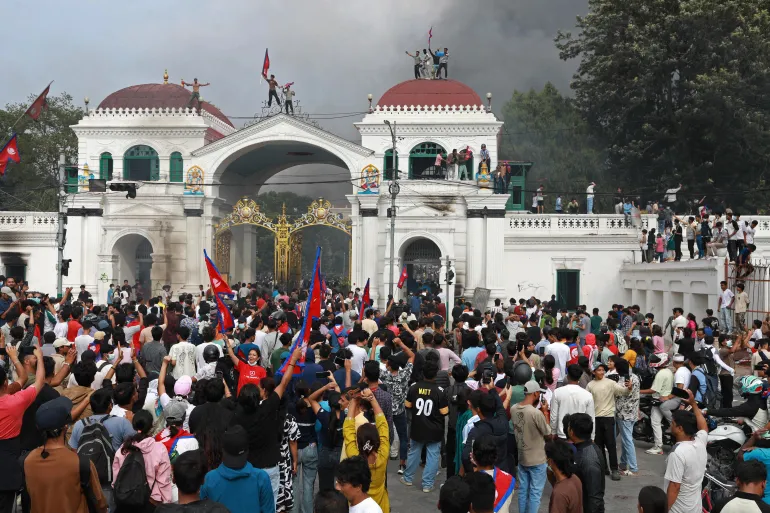
We long complained about ghosts of Panchayat but today we rise in unison to glorify its administrative divisions.
Revolutions, as the world has come to know, are a way of life. Some, like us, have it almost every day while others have them once in a century. Whatever the frequency, both their and our revolutions have similar effect on commoners.
Revolutions for whom?

My first encounter with revolution was when I was in grade five. In the heat of the battle, it felt like we were part of the greatest revolution ever. We never got to see what actually happened. Rather, we were told that such and such event has happened and therefore we should revolt. We readily obliged and started shouting out loud.

The plot was that one of the teachers had meted out corporal punishment to the future king of Nepal who studied in our school. There was a buzz, slowly gaining momentum that such a teacher who did not have any respect for not just future king but avatar of god Vishnu should not be allowed to stay 'one-minute' longer in Nepal. The 'high' of revolution was such that some commanders had come upon with the idea that all British teachers should leave Nepal immediately. We shouted: "Yeah! Yeah!" The faces of many told a story that they were in no mood to take an insult. The insult was not on a fellow school student but, as some of the seniors had worked out by next five minutes, but on mother Nepal. It was my first encounter with my one patriotic self as well with others' patriotism.
In no time, we all charged to the basketball court where we saw some senior students along with the prince and the teacher. It was a seventeen-minute revolution. The big voice of British teacher easily downed the voices of what seemed like the entire school. In fact, only 20 percent of students had gathered. We had thought it was the day that would end the 'British rule in Nepal' and therefore were surprised how our revolutionary instinct had caved in so easily. As the mood was getting quiet, his voice boomed, "Please go back to your hostels. Dinner today will not be served for you all". The great revolutionaries, all in their prime, meekly walked away, leaving the future king all by himself. The seventeen-minute revolution was over.
Since then revolutions have become a part and parcel of my life. The final one culminating in a 'rice-plantation' on the stretch of the road that never got built, right in front of my house. I must say I too have grown fond of revolutions. That was my last. In between there were many.
Just when I thought days of revolution were over, seriously, I was confounded to hear of yet more. And how naïve I was to think that people wanted federalism with a final draft of constitution. The demands have become so confusing I am curious what those four leaders talk about when they sit to draft yet another model.
Some argue that the places where such revolutions have taken place of late are places that have been traditionally silent and thereby the rising there is good sign. However, one can also argue that whatever they have been requesting was not something that existed from time immemorial. The Panchayati rulers decided that it would be best to divide the country into some regions. We complained about the ghost of Panchayat haunting us, but today we rise in unison to glorify Panchayat. It's not the development regions we seem to be concerned about anymore. Even the districts now seem to have come up with an idea that the Panchyati identity that they were given is supreme.
It's the democratic parties that complicate matters. The process we have come to witness is that four parties get together to decide on state matters including the number of states that the country should have. The reason I am citing this example is that leaders actually sign the documents which is a work of experts. Sadly, they think of themselves as 'be all and end all'.
However, the problem is not with those four. If the elected representatives of those parties do not have any problem with their leaders making decisions, I should not either. But I do have a couple. One, how on earth can they come out and say that this is something we decided 'collectively' when I do not subscribe to it. Second, how can the cadres first say that they have given unconditional powers and rights to their leaders and no sooner a decision gets made, they voice their disapproval.
We have revolted so much we have become habituated to it. There was a time when I used to get angry with the kind of jargon Prachanda and his ilk used because they were hard to understand for someone not well versed in Nepali and also because they repeated the drivel so many times. The irony lies in the fact that Prachanda harped on about revolution against this and that—army chief being one—but nothing happened. Instead, his prescribed formula of federated statehood has become the eye of the storm.
Revolutions demand innovation. Many feel that the Arab Spring would not have been possible without social media. It probably has set precedence on how to make use of social medium at a time when government is trying to impose a complete ban. What's our innovation? We reward those killed in the name of revolutions with five million rupees. If the state has killed a man, make state pay but why encourage martyrdom?
hiteshkarki@gmail.com