As we waited for the translator, Navraj Kunwar’s cell phone rang and he said something to Rashmi Amatya in sign language, smiling shyly. All excited, she grabbed the phone from her brother-in-law’s hands and said in her unclear words, “Hello! Come, even if you have headache.” [break]
Amatya, who recently concluded her second solo art exhibition entitled “The Silence” at The Art Shop on Durbar Marg, was all excited but a bit anxious that her translator was not in yet.
The young artist is gifted with extraordinary talents and lovely features but probably God thought it too much to bestow on her the common gift of hearing, consequently altering her speech.
She can read lips and babble some words, but her own words reverberate nothing to her but silence. Being all too familiar with it, she has tried to reveal her feelings and experience of being hearing-impaired through each of the 23 paintings that she recently showcased at the exhibition.
Kunwar, who was there to encourage the new member of his family, gave a shot at translating Rashmi with his limited knowledge of sign language. She was grateful, but uneasiness was clearly evident on her face, as her views were not being put across the way she wanted it. Then turning around, she pulled at her ears slightly with both her hands, gave an innocent look through her grayish blue eyes, and said, “Sorry.” Clearly this was not working for her.
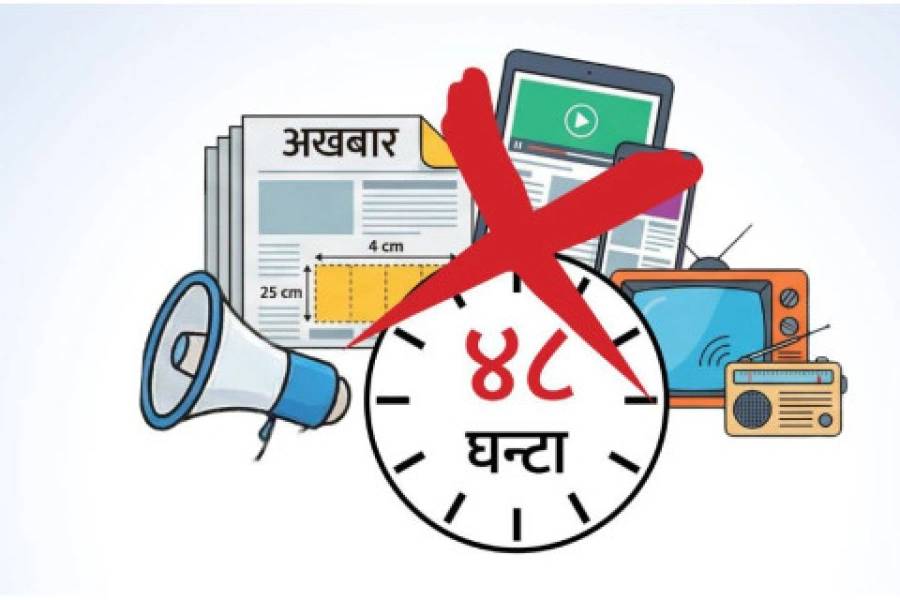
EC closely observing and monitoring by-election silence period


Amatya explains one of her works.
Bijay Gajmer
Finally, when Sunita, the translator did arrive, the scenario changed instantly. Amatya showed much more vigor and seemed exalted while Sunita translated for her. Now it was a passionate artist talking to us.
Even though she was hearing impaired, Rashmi’s parents had sent her to a normal school since she could babble some words. But with her limitations, she could not do much in her studies nor connect with people around her. Eventually, she attended a special school. But right from the early age of four, she turned to sketching. And at the age of 13, she had her first solo exhibition that was well received by viewers. Now art has become her best friend and the only mode of expressing her inner self.
In her recent works, which took her two months to assemble, she pours out her feelings and critical views on the treatment of the hearing impaired by our society.
Meanwhile, commenting on her works, senior artist Sashi Bikram Shah says, “Her works are well-composed and imaginative. But I would like to suggest to her to focus on single but concrete themes and techniques rather than diverting to many approaches.”
On one hand, she has tried to express encouragement and empowerment to the hearing impaired by using the images of opening doors, and hands reaching out to bright lights.
But more emphasis has been given to portray the sufferings and social stigmas that the hearing impaired face in our society. For this, she uses bound figures, leafless branches with thorns, and ironical images of bells tolling unheard.
Pointing towards a painting with children engulfed in darkness, she explains “I drew that when I was deeply moved by an incident in Lalitpur, where a hearing impaired girl, who was kept confined in her room for years, hanged herself.”
She points out sadly that the suicide happened in a metropolitan city like Lalitpur, where the opportunities for hearing impaired are much more than in the villages. “We can imagine how grievous the situation might be in the remote areas,” Rashmi adds with genuine concern.
As passionate she is about her art, she is even more keen on helping people who are hard of hearing. She attends programs organized by the Mahasangh for hearing-impaired people like her. The different stories of sensory and physically impaired people have often been the basis of inspiration for her art. Many times, she draws rough sketches as she tries to capture the essence of the stories. She says her recent works must be the first of its kind in Nepal about the hearing impaired, and is altogether a passionate appeal to have their silence speak out and heard by people.
It looked as if talking about the Mahasangh’s programs brought back the memories of the difficulties she has had to face as a hearing-impaired person, and she grew a little tense. She started speaking fervently about there being no help for empowering the hearing impaired on the part of the government, and one rather having to depend on foreign aids. And that the weekly Saturday news broadcast by Nepal Television for hearing impaired was insufficient.
Meanwhile, a foreigner who entered the gallery exclaimed loudly, pointing at the painting of a white dove caught up among leafless branches, “That’s exactly what’s happening to this country.”
Amatya, on the other hand, seems to have relaxed a bit. Apparently, Sunita translated what the abrupt visitor had said about her painting. She then proceeds to tell us of her new undertaking – reading poems and painting to the poem’s theme. But still the seriousness has not left her. She adds, “I strongly feel that the hearing impaired should be educated by just giving them a chance to experience the outer world for themselves.”
Simply put, the plea must be heard and acted upon.

-1200x560-1781083488.webp)