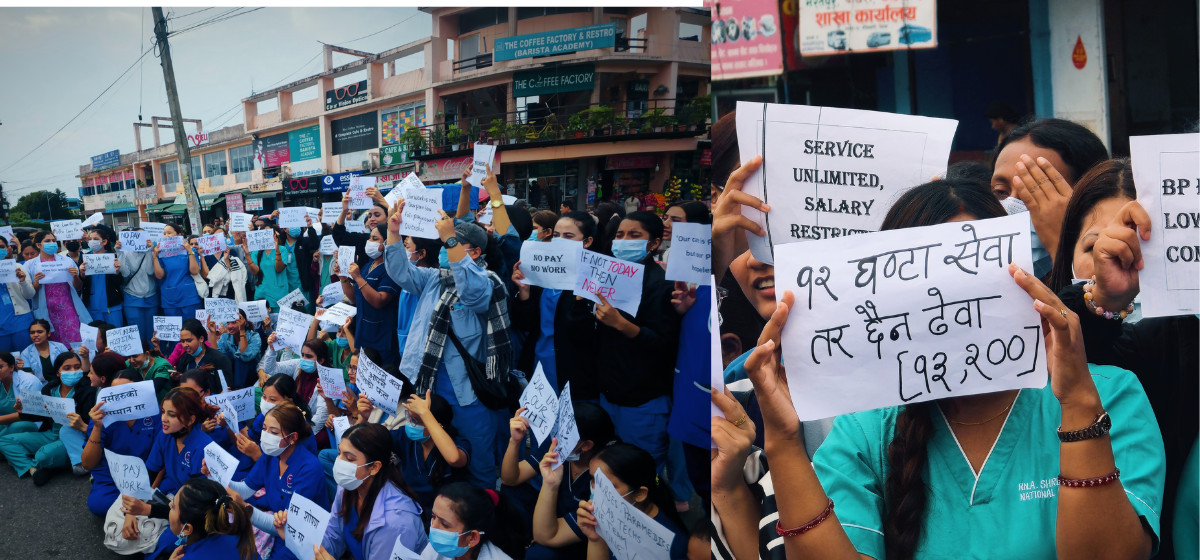
A democratic government earns public trust by responding promptly and sincerely to citizens' legitimate concerns. When grievances are addressed through dialogue and timely decisions, democratic values are strengthened. When they are ignored until they erupt into crises, both governance and public confidence suffer. The ongoing agitation by nurses is a reminder that the government must abandon its habit of reacting only after situations become critical. On Monday, nurses from Tribhuvan University Teaching Hospital and Bir Hospital staged demonstrations in support of nurse Jyoti Ranabhat, who entered the fifth day of her hunger strike demanding reforms in nursing education, patient safety, and nurses' pay and working conditions. The Nepal Medical Association and the Nepal Nursing Association have both urged the government to act immediately to protect her life. Health and Food Safety Minister Nisha Mehta says the government is trying to resolve the issue through dialogue. Yet the protesting nurses remain unconvinced, arguing that the authorities have failed to demonstrate the seriousness the situation demands. Their skepticism is understandable. Nepal has witnessed too many agreements that were celebrated at the negotiating table but quietly forgotten afterward. The nurses are not merely asking for talks; they are seeking credible assurances that commitments will be implemented. Given the steady exodus of skilled nurses and other healthcare professionals from Nepal, their demands deserve urgent attention rather than bureaucratic delay.
Nurses on the frontline in the battle against COVID-19 as Inter...

Unfortunately, the government's response reflects a familiar pattern. Peaceful protests are often ignored until public pressure intensifies or lives are endangered. Only then do authorities rush to negotiate. Such an approach sends the wrong message: that citizens must resort to extreme measures before the state is willing to listen. A democracy should never function this way. Kathmandu is currently witnessing protests by various groups seeking solutions to different concerns. Peaceful demonstrations are not signs of instability but expressions of democratic participation. The Constitution guarantees citizens the right to peaceful assembly and expression, and governments have a corresponding responsibility to engage with those voices. The real problem is not that people protest; it is that the state often treats dialogue as a last resort instead of the first. This reluctance reflects a deeper weakness in Nepal's governance culture. Too many officials continue to view early engagement as a sign of political weakness or administrative defeat. Such a mindset belongs to a feudal past, not to a modern democracy. Governments display strength by listening, negotiating and resolving disputes before they escalate, not by waiting until public anger reaches a breaking point.
The current administration came to power promising good governance and a more responsive style of leadership, particularly after widespread dissatisfaction over the handling of public grievances culminated in the Gen Z movement of September 2025. Many Nepalis hoped that the culture of indifference and delayed responses would finally end. The government's handling of the nurses' agitation, however, risks reinforcing the perception that little has changed. The government must not wait until this protest turns into a tragedy. Senior political leaders should engage directly with the protesting nurses, address demands that are practical and justified, and clearly explain the constraints surrounding those that require longer-term policy or financial decisions. More importantly, any commitments made must be implemented faithfully. Empty promises will only deepen public distrust. No citizen should have to put their life at risk through a hunger strike simply to be heard. A government does not lose authority by responding to legitimate demands; it strengthens its legitimacy. Resolving the nurses' agitation through sincere dialogue is about far more than ending one protest. It is an opportunity to demonstrate that this government values democratic engagement, respects those who serve the nation's healthcare system, and understands that responsive governance begins with listening before it is too late.