We have all been told during the last few years that an earthquake was a near certainty in Nepal even though no one was sure when it would strike. I think the Nepali elite never took this warning seriously. Deep inside our mind we all seem to have been convinced that the land of Pasupatinath, Muktinath and Buddha would be spared of devastation if ever a serious earthquake hit the nation. Sure, we did suffer from earthquake about eighty years ago but human memory is short. Those who experienced that earthquake are mostly gone and the devastation it caused was rapidly becoming an event of only historical interest—something you would see in faded pictures of that era and then consign it in some parts of your memory rarely to be remembered. We did have a serious earthquake in the eastern part of the country nearly three decades ago but it was far from Kathmandu and did not affect the ruling class in the capital in any significant way as the present disaster.
Of course there have been a group of dedicated professional engineers who with their foreign counterparts have been warning us about the peril of this indifference but their concern was never taken seriously either by the government or the “chattering class” in Kathmandu. As for the government under Sushil Koirala disaster management was never in its thinking probably because according to one commentator the government itself is an “example of disaster”. This may be an overstatement. But the fact remains that a comprehensive report on natural disaster was prepared by the government of Nepal in 2009 and then it was forgotten as if a nicely typed report is all that is needed to deal with the wrath of nature. No government, including the so called “revolutionaries” who never tire of expounding their monopoly of knowledge on social development paid attention to this report.
Koirala government was more than happy to maintain this tradition of inaction. In the meantime Koirala has never been lacking in speeches on his commitment to democracy, people and democratic values including the repetition of “win-win solution” but when it comes to delivery of services what has been most remarkable is the lack of unity in his cabinet and the institutionalization of corruption, all in the name of the people. It is in this setting that the 7.9 scale earthquake struck the nation. Naturally the central government finds itself unprepared to face the calamity and is busy in patch work and band aid solutions that could spark another political earthquake if the pressing problems of shelter and other relief measures during the monsoon and the flood season, now more serious because of the earthquake, is not addressed quickly. This problem should not be taken lightly since we do not even have a local governance structure elected by the people since the last two decades. It is ironical and yet real that those who swear by the people are most reluctant to hold local level elections since it would erode their monopoly over a centralized government and with it the facility to use resources for partisan or individual benefit.
Immediately after the earthquake the performance of the army, armed police and the Nepal police deserves our appreciation.TIA authorities deserve thanks for keeping the airport open 24 hours to handle the flow of goods and people. Similarly the medical fraternity including the Teaching hospital in Maharajgung in Kathmandu quickly responded to the situation and the health ministry seems to have coordinated reasonably well with both national and international agencies as well as other friendly nations that have responded to the crisis.
Foreign response
Great Leadership: A Road Less Traveled

India was the first country to respond to the crisis. Within six hours the Narendra Modi government had dispatched a large contingent of Indian relief and rescue personnel including army teams trained in this kind of work ready to assist under the guidelines and rules of the Nepal government. Prime Minister Modi made it clear that India as a true friend was willing to help Nepal in this hour of crisis depending upon the need and request of Nepal.
Indian help after the earthquake has been substantial and significant. Modi as the PM of India gives the impression of a new and decisive style of leadership that is completely confident of its South Asian civilizational identity and fully inclined to help Nepal realize its economic ambition. This is a positive scenario provided Nepal as a sovereign nation is clear about what needs to be done to take the country forward.
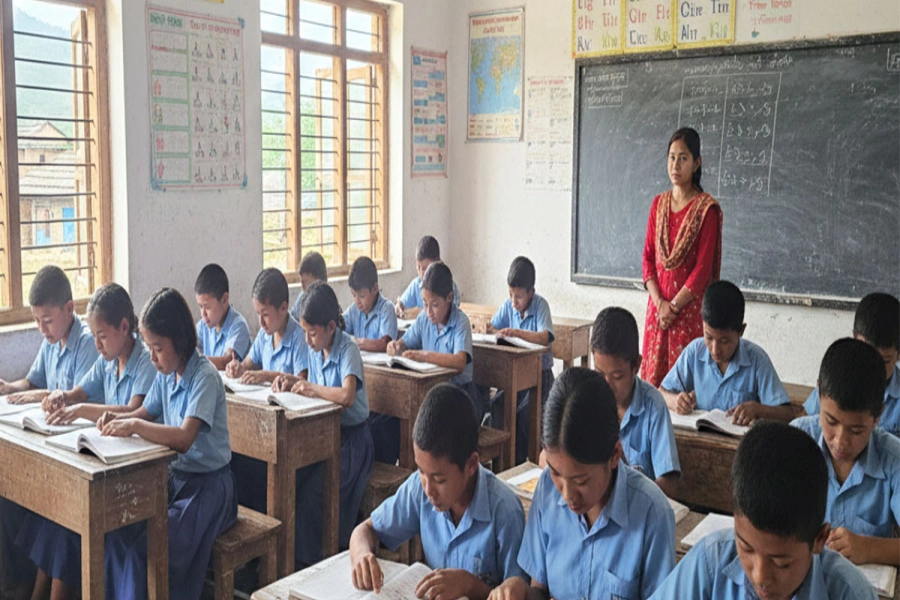
Apart from help at the governmental level, many international non-governmental agencies have also been active. A few days ago I met in Nuwakot a highly skilled young Indian professional in his late 30’s helping the construction of a school. He was dressed in half pants and was just like any other worker in the scene. Here was a high caliber professional who could make millions in his own country or in any nation around the world working like an ordinary worker in the dusty field of Nuwakot. As I found out his motivation was at its core spiritual based on the ideal that service to mankind is the supreme religion (seba hi paramo dharma).
On the other hand it is also true that there are some elements in the Indian press and perhaps also in the bureaucracy that have somehow internalized the “white sahib” mentality that can manifest as a new kind of “brown sahib” syndrome. This would be unfortunate and it is against these tendencies that political, bureaucratic, media and civil society leaders in both India and Nepal will have to remain vigilant.
As for our northern neighbor the response to the earthquake was quick and firm. The Chinese president Xi Jinping expressed the commitment of his nation to help Nepal in any way the government wanted.Chinese relief and rescue personnel were in the field using new technology to save lives under the rubble. Similar contributions have been made by many countries including the US, Britain, Israel, Bhutan and other nations and international agencies from different parts of the world. In this context the sad loss of six American and two Nepali military personnel in a helicopter accident while on a rescue and relief mission highlights the risks that these brave officers accepted to help the people in distress.
Where’s the money?
In the aftermath of the earthquake international development agencies and donor nations have announced millions to help the earthquake victims but finance minister Ram Sharan Mahat complains that it is not reflected in action. He has a valid point. It is true that we have a weak state and a government that is noted for underperformance rather than anything else. Nevertheless it is an elected government and there is no question about its legitimacy. So the idea floated by some donors that they should be allowed to launch their own reconstruction program should not be entertained. Funds for reconstruction should come to the treasury. However, a compromise solution could be accepted involving the following three steps:
First, funds for reconstruction will be deposited in the government treasury. Second, each donor country will prepare its plan in consultation with the Planning Commission so that there is overall coordination with the master plan of reconstruction. The plan will outline detailed design and cost estimates. Third, once this is done the money deposited by the specific donor nation in the Nepal government treasury will be automatically released to the concerned donor nation for the implementation of the jointly approved plan on a phase wise basis.
Falling short
For Nepal the problem so far has been to coordinate the relief efforts honestly so that the generosity and goodwill of the people in other countries is put to good use. The problem is lack of inter-ministerial coordination that often degenerates into open name calling between ministers. There is lack of effective leadership with a sense of vision to give clear-cut direction in case of difference of opinion in the government.
In a crisis of the nature we are facing today difference of opinion is not uncommon. In fact if it is not there it should be encouraged. But after a point when all the arguments have been made and alternatives presented the basic question as to what needs to be done has to be addressed by the leader and in our case the prime minister. Only then can we think of correct measures and plans to meet the challenge. This is where we have so far been far short of the challenge.
The author is a senior leader of the Rastriya Prajatantra Party