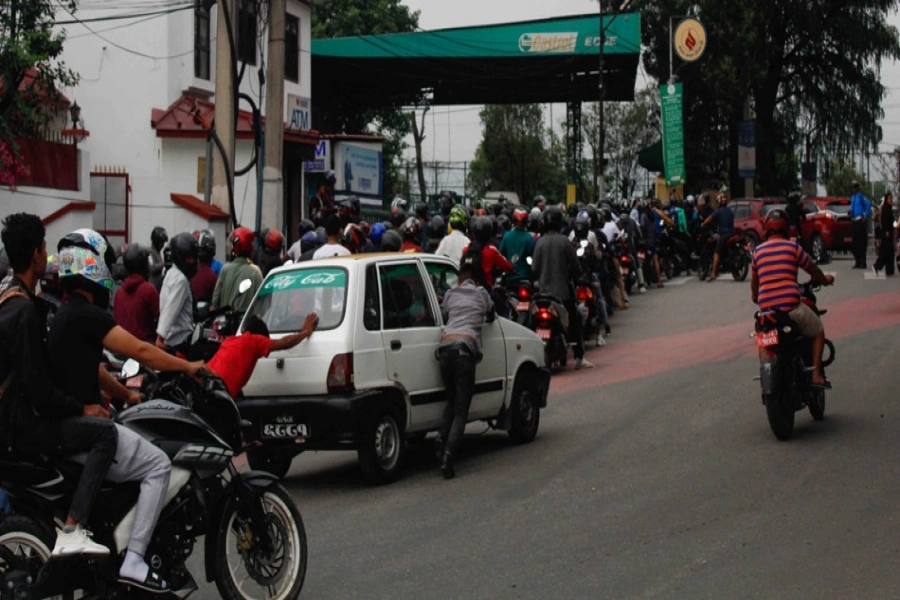
Total mismanagement, rampant corruption, nepotism, politicization of academia and media, criminalization of politics, more than a quarter of the country's population toiling in the heat of Middle Eastern dictatorships and many more either in the process of or harboring desires to leave the country, eroding nationalism, growing foreign interference in domestic politics, shortage of bare essentials, deteriorating law and order situation, inflation and widespread despair.You can be forgiven for thinking that this is what happens in a dictatorship, but this is happening in our democracy. The defenders of the system never tire of preaching that it is the leaders that have failed us, that the system in itself is perfect. Patience, they tell us, will result in institutionalization of democracy and we will be a functioning democracy, if not soon, then by the time of our grandchildren (or if you already have grandchildren then by the time of their grandchildren) for sure. Some even argue that the politics is a reflection of the society and so long as there is no "progress" on the social front, we have to put up with the dysfunctional democracy, or in our case, the tyranny of the few.
We have heard and read these useless arguments many times. No scholar and leader explains to us why we have to wait for so long to have a functioning democracy when we can watch the latest Hollywood flick the same day it is released in the US? And nobody asks, let alone explain, how we can progress by allowing the same set of leaders to take turns to rule. We dare not even slightly hint that if politics is the reflection of the society, then perhaps it's time to explore an alternative model of democracy than the one we are forced to bear. A democracy that guarantees good governance and rule of law but does away with periodic elections that return the same set of people, by turns, to power, which only exacerbate the problems.
We cite Jefferson and Hamilton, Lincoln and Locke, those of the distant past and lands to impress the readers that we know what we are talking about. But we hardly mention what the people, the common folks living in the here and now—Joshi and Hussein, Limbu and Lamichane—really think about the way our country is being run. How many of us have read articles citing the experiences a cab driver or a porter, or of an owner of a local working class eatery who is seeing his/her income dwindle due to the shortage of cooking gas? Ask these people what they think about the present system. Tell them to have patience and lecture them about the virtues of democracy when it finally takes roots after 50 or 100 years. They will either think of you as a prophet whose words are difficult to decipher, or more rightly, a lunatic.
Our democracy allows us to talk about the problems (and that's the only beauty about it) but forces the writer or speaker to censor himself/herself when it comes to providing solutions to our problems. The solution to all our present woes, 99 percent of our writers, speakers, leaders and activists proclaim, is more democracy, not less, without explaining what exactly more democracy entails in our context. However, the majority, which does not read or write but is clever and informed, is clamoring for a strong state, democratic or otherwise, but one that can take care of our immediate problems. And our collective frustration with the present system is justified because our democracy is not only dysfunctional but also very expensive and it only adds more stress to our already stressful lives.
Take the real case of a family living in Kathmandu with a monthly income of around Rs 40,000. Both husband and wife have MBAs from a reputed institution in Nepal. They rent an apartment for around Rs 15,000 a month. That leaves the family with Rs 25,000. Then they have a school-going child and understanding the value of quality education, they send their child to a good school and the monthly fee is around Rs 5,000-7,000. Then they have to buy the cooking gas in black market paying at least Rs 1,000 extra, which comes around Rs 2,500. They also have to buy food and once or twice a month they have to entertain guests at home or take their child for lunch/dinner outside or get together with their friends in a medium-tier restaurant.
They have to spend more than Rs 1,000 on water to drink, cook and clean and around Rs 1,500-2,000 on electricity and Rs 2,000 on mobile phone and internet. Now calculate what saving do they have at the end of the month. It would be rather silly to imagine that they are happy with the system and that they see any hope for a bright future for their child. They fill out the US DV Lottery every year, Google often to check their eligibility for PR in Canada, Australia, New Zealand or wherever. And this is a story of a family where both husband and wife are educated and have decent jobs.
Imagine what it is like for those who for various reasons do not have the education and their jobs only pay Rs 10,000-15,000 a month. The current system neither provides them with the bare essentials nor with dignity and decent life. And yet their sufferings make no headlines or the topic of an op-ed of the self-declared democrats. This is the biggest contradiction of our democracy: The majority's sufferings and aspirations are ignored by the ones claiming to be democrats.
It goes without saying that democracy in our country is for a handful of elites who know how to exploit the system to their advantage—of the elites, by the elites, for the elites. Perhaps only a handful of us are really excited about exercising our voting right and go to bed each night thinking who we will vote for in the next election. Most of us go to bed thinking how will I manage another cylinder of cooking gas or how to do I settle abroad or when will be the next time I will be able to take a long shower. The situation is so pathetic right now that one would be hard pressed to find anyone aged 18-45 who is happy to be in Nepal and does not want to go abroad. Therefore, rather than talking about abstract ideals and rights and blindly copying others, we should discuss and debate the system that can take care of our present problems, and instill confidence and hope in us.
Representative democracy should be our goal when we meet all the conditions necessary for it: independent judiciary and media, strong bureaucracy, apolitical security forces, thriving private enterprises, growing middle class and the public informed and aware of its rights. Representation and other rights that in our context are abstract ideals can wait; rule of law and good governance cannot if we are to embark on economic development and to keep the youth in the country. Otherwise if and when we become a functioning democracy, only the leaders and their cronies and maybe a bunch of old and weak yaks, goats, cows and buffaloes will be left in the country. Everybody else would have fled for greener pastures abroad.
trailokyaa@yahoo.com
Related story
No one should dream of going against democracy: PM Deuba