Habermas is talking about the citizenry—members of a state or inhabitants of a city—that can and often work together to advance their interests. Educated, informed, articulate, and with time to spare away from the daily grind, patricians are dominant in the public sphere. The upwardly mobile youngsters and aspiring professionals often join the conversation in the hope of improving their prospects. Participation is the key to the concept of public sphere, and middleclass strivers find the illusion of equality with the power elite hugely uplifting.
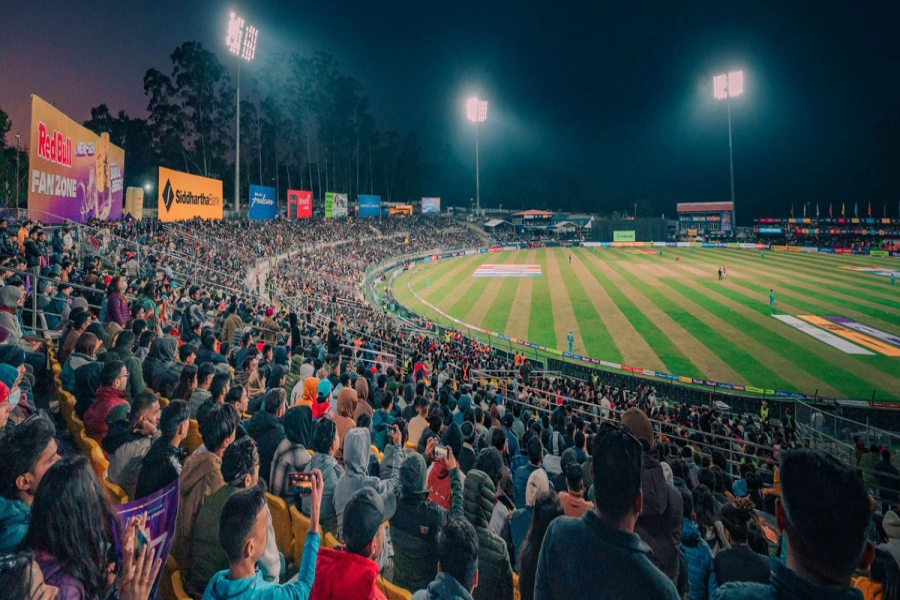
The people’s arena is hierarchical. Spectators pay for the privilege of watching from the gallery and the stands as players sweat it out in the sun or rain to prove their prowess. Stakes for the gladiators of yore were no less significant—their life and death depended upon the outcome of the game—than the keep that players of the modern age earn. Spectators contribute to the kitty directly through gate fees and by buying products advertised in the arena as well as in the media. A game is thus never only a game.
In the Hindi flick “Bhag Milkha Bhag,” athletics become the steppingstone of improving India-Pakistan relations as an unfortunate victim of Partition acquires the ability of shaking off the ghosts of his past. By getting the opportunity of hosting the Summer Olympics in 2020, Tokyo has asserted that it continues to be the premier city of Asia despite the emergence of Beijing and Seoul. Businesses that such events bring are important, but more significant are the messages conveyed to the masses: A game of this scale is a reassurance that everything is well with the economy of the host country.
Public sphere has been wrongly rendered in Nepali as Aambrit, which roughly translates as commoners’ circle. It would perhaps be more appropriate to call it Khasbrit—the circle of the privileged. People’s arena is the true Aambrit. However, the space for conversations between the inarticulate commoners—graffiti, street protests, mass meetings and teashop guff—is shrinking. The public sphere has begun to encroach upon an arena that had earlier been left for the people to express themselves.
BOURGEOIS ICON
Launching of a new gadget from the stable of Steve Jobs—may the soul of the restless marketer rest in peace—is always big news. Even in a place like Kathmandu, a group finds discussions about relative merits and demerits of the latest iPhone and hottest Galaxy relevant. Wish smartphones made its owners smarter! Some of the most rabid hate mail a columnist often gets bears the telltale signature line: Sent from my iPhone. Then again, perhaps it is in the nature of expensive possessions to make their owners behave insolently.
The expression ‘status symbol’ says it all. When status is bought rather than attained, the possessor has a strong urge to flaunt it in the ways that the person knows best. The only way to put power to test is to misuse it and then see how much one can get away with! Patricians can afford to be obnoxious. Foul language adds to their allure. The bourgeoisie can manage to couch its transgressions in high-sounding terms. The lumpenbourgeoisie fares far better in the domain of hero-worship.
The pantheons of patricians and plebeians are different. The glitterati frequent art galleries, and attend musical soirées and patronize stage shows where entry is by invitation. Plebeians love their heroes and heroines of the celluloid, hum along with Lok Dohori singers and admire their neighborhood toughies who seem to have everything going for them. The bourgeoisie have their ideal entrepreneur, favorite banker, family ‘god-man’, and the iMan, who continues to live in their pockets and sling bags. The lumpenbourgeoisie finds fulfillment in the sporting arena. The game itself has very little to do with their obsession. Every sporting event is an opportunity for the lower middleclass to show that it wears its nationalism on its sleeves.
When Nepal defeated India at the SAFF13 quarterfinals, football fans at the Dashrath Stadium forgot that many of their mothers too wore dhoti at home. On the television screens, painted faces waving the Double Triangle appeared possessed by evil spirits. The Afghans won the semifinals, and the paroxysms of the Nepali audience died down as suddenly. The next day, India and Maldives would play another semifinal in an empty stadium. Even finals were staged to vacant stands. Apparently, sporting events have little to do with games being played in the arena. More important is the photo-op of flag-waving.
Divisions between classes are distinct. However, the Nepali language has created a community where the mother tongue binds Gorkhalis of different backgrounds together. Little wonder, the only real heroes of the Nepali-speaking community are litterateurs. Bhanubhakta is the touchstone to test and mark belongingness. Few read him anymore. Lekhnath Poudel is becoming equally obscure. However, Laxmi Prasad Devkota lives. For the literate population of all classes, the creator of Muna Madan is worthy of being painted on the wall. So what if he has to share the space with the iMan?
DEPOLITICIZING SOCIETY
Politics is disruptive no matter in which way it is conducted. Regressive forces want to take the country back to some fictional age of national glory. Progressives claim to lead the nation out of the mess towards a just society. Even forces of status quo would like keep the illusion of momentum intact so that nobody realizes that the country is merely going round and round in circles. The chattering classes have valid reasons to detest politics: It interferes with their businesses, socializing, travels, games and other matters of pressing concerns.
About the government itself, the power elite does not worry too much. It is a minor irritant and can be handled easily. The electorate of Nepal voted the Maoists as the leading party, the PEON booted them out, and made proxies of power elite—nobody is fooled by the high sounding high level committee—took over the reigns at midnight maneuvers, making it worthy of a thriller. The noise of politics irritates the bourgeoisie no end where small events create big ripples. People refuse to remain in their predetermined place. Politics changes the divine order of things in the land of Lord Buddha, who was born in Nepal; mind it—and Lord Pashupatinath. Did King Shuddodhan, the ruler of Kapibastu, have any inkling that his realm would someday be conquered by Gorkhalis? The question would have hugely amused his son.
Unless it has something to do with ‘Buddha was born in Nepal’ graffiti indeed affects the aesthetic of city streets. So does hoarding boards, hideous buildings, dysfunctional lampposts, hanging electricity and telephone wires, heaps of garbage, vehicles that belong to the junkyard and construction material dumped in the middle of the road. Slogans painted on walls signify that at least some residents are bold enough to use the space to communicate with fellow beings.
The mainstream media functions as the megaphone of the public sphere. Street protests have begun to lose their efficacy. The so-called social media is a forum for the leisure class. Headlines of the marginalized—of the left, right and centre—have to be painted on walls to grab attention. It was contestations over the space on the Democracy Wall that drove the first wedge between the Marxist-Leninists and Maoists in the 1980s. Sadly, not politics but art is writing over the slogans of the externalized. Having secured its interests elsewhere, the bourgeoisie now wants to claim every little space left empty on the margins.

Photo Courtesy: Apoorva Lal
Creation of homogeneity has always been the undeclared aim of the public sphere. People’s arena is heterogeneous, speaks in multiple languages and shouts to be heard. It must be tamed to serve the will of the public. There are understated ways of appropriating whatever little space is left for the inarticulate. Homogenization through language is subtler than the imposition of the dress of the dominant community as the national attire. Marketization—everything has a price, nothing has value—lures the disadvantaged into deals that appear fair.
Perhaps the most dangerous trend has been the replacement of politicization with NGOization that creates a false sense of equality without addressing any of the underlying factors of inequality, oppression and marginalization.
Polls are all very well, but let city walls and rural posts speak the language of the street.
Lal contributes to The Week with his biweekly column Reflection. He is one of the widely read poliitical
analysts in Nepal.
Related story
International Day of World's Indigenous Peoples observed (In Ph...