

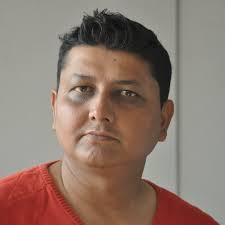
He has now become the chief justice with distinction of first Nepali lawyer to claim the top judicial post.

Sharma comes from a family that fought for democracy and freedom. His mother was jailed for two years for protesting the Panchayat rule in 1962 while his father had to remain out of country for eight years due to a political reason. His father Keshav Raj Pindali was a story writer and a journalist.
A Bachelor’s in Law and Bachelor’s in Science, Sharma wanted to be a journalist and even passed an examination to be a sub-editor of the government-owned The Rising Nepal in 1967 though he was already in the legal profession. But he was denied an appointment letter because he was the son of “an anti-national element”, a reference to his family’s involvement against the Panchayat rule. He then continued with legal profession.
Republica’s Political Affairs Editor Kiran Chapagain talked to Anup Raj Sharma at his private residence on Friday evening on his priorities, challenges of the judiciary and his landmark verdicts, especially during the King’s direct rule in 2005. Excerpts:
Where do you find the judiciary as you prepare yourself to assume the post of chief justice?
 I do not buy the over exaggerated views which proclaim that the judiciary is finished and that it is marred by corruption. Of all the institutions, I find the judiciary still functioning despite major political changes. In my view, the judiciary has succeeded to preserve its existence. In the transitional period, the judiciary has been an institution that has been facing attacks.
 What are the reasons behind such attacks?
There are two reasons. First, it had to face such attacks because the national politics went out of track. If national politics moves in the right direction, the judiciary is prone to face less attacks. Second, cases those were more political in nature and less constitutional have been brought before the court while political ones should have been settled politically. Had politics been in the right direction, the court would not have to face such cases. Consequently, the court has gradually become a target of attack due to the political environment.
What should the judiciary do to protect itself from such attacks?
There are a couple of steps that needs to be taken but these measures are beyond the control of the judiciary. For instance, laws are not being enacted while laws should be enacted to ensure that the judiciary works effectively. We have frequently stressed on judicial autonomy. Autonomy means judiciary should be allowed to decide rules and regulations governing its employees. At present its employees are civil servants of the government. Besides, judges, including the Supreme Court judges, should be assertive and bold.
What major challenges do you see for the judiciary?
First, justice is expensive. We have cumbersome procedural laws. As a result, it takes three years even to give final verdict on priority cases. This has made our justice expensive. Second, speedy justice, which does not mean summary justice, is another challenge. Modernization of the judiciary through the use of information technology is yet another challenge. But, among all, implementation of court verdict stands as the most challenging one. Court verdicts have no meaning if they are not translated in practice.
What will be your priorities?
I will be in the office for three and a half months only. It is meaningless to come up with ambitious plan. But I’ve set aside three priorities. First, I will work toward deciding cases, especially of the old people and women. Second, there should be no longer delaying of court dates. Cases should be heard even if people are not present on the given date.
Besides, use of information technology can significantly reduce expenses involved in seeking justice. For this, there is need for suitable information technology software. I will try to introduce softwares. They are now in the designing process. In addition, I will sit with Nepal Bar Association to implement the latter’s report on judicial anomalies. I have plans to establish a mechanism within two months to act on the report after going through it. Similarly, a division on verdict implementation will be established at the Supreme Court. Each district court and appellate court should also keep on monitoring implementation of verdicts. Every month, district courts will have to give their report to appellate court and the appellate court to the Supreme Court if any verdict is not implemented.
Which verdicts would you consider the most important ones passed by you during your career as a judge to date?
Naturally, the most important verdict is the one related to media sector [First, his ruling in August 2005 had paved the way for resumption of broadcast of news from FM radios during the King’s direct rule. Second, he had shared a bench with then Justice Min Bahadur Rayayamjhee to lift the ban on broadcast of news imposed by the King-led government, in Nov, 2006.] Second, the verdict related to the dissolution of then King-formed Royal Commission for Corruption Control. [Sharma was a member of a six-member bench that had passed the verdict in February 2006. The verdict was a setback for the royal regime and had encouraged pro-democracy movement.] I also consider verdicts related to gender issues as very important ones. Besides, a division bench shared by me had also passed the first order to release a detainee [Gauri Pradhan] during the king’s rule. [The order had paved the way for release of a few hundred pro-democracy activists during the king’s direct rule.]

What is your view looking back upon the verdict that allowed FMs to broadcast news?
The verdicts were related to the then government and I had expected that I might have to face some allegations from people in power then. But I am proud of the verdict. I would like to share one anecdote. A few days after the verdict was passed, a taxi driver asked me whether I was the same person who passed the verdict allowing news broadcast while traveling with my family in a cab in Kathmandu. I replied, “Yes”. Then the cab driver told me that he liked the verdict very much. My point is that even a layman felt the effect of my verdict. I consider it an achievement.
I, as the son of a journalist and a member of a family that fought for freedom, have always held the view that the country will be in crisis if two institutions – independent judiciary and the press – stopped functioning. These two institutions are always targeted by a tyrannical government. If these two institutions exist as complementary to each other, democracy will flourish in that country. So I urge journalists to give fact-based news about judiciary in an objective manner so that readers can judge on their own. Media should highlight the good deeds of the judiciary; it will project a good image of the judiciary before the people.
Did you receive any threat for passing such bold verdicts?
No, I did not receive any threats. No one dared to threaten me directly nor indirectly. Also, no one dared to ask me to pass the kind of verdict s/he wanted.
Didn’t you have any fear lurking in the back of your mind for passing the verdicts given your family background?
No, I never had any lurking fears. But during the time of state of emergency [from Feb 1 to May 28, 2005], I had fears in the corner of my mind that I might be sacked [by the then king] by invoking Article 127 of the then Constitution. But I was mentally prepared because I come from a political family that fought for freedom.
Ministry of Law and Justice has been working toward making judges’ property public. How do you see the move?
I have no objection of carrying out such a move. In my opinion, what I have already declared and submitted [to the Judicial Council], will be made public.
Will you take any initiative to make public the property details of judges?
I will talk to my colleagues. But if they do not have any interest in this regard, I cannot do anything.
The judiciary is leading in terms of the development of information technology compared to other governmental institutions. What are your plans to further develop the role of IT in the judiciary?
I will give priority to maximize utilization of IT in the judiciary. Besides, efforts will be concerted to give IT training to judges and court staffs. I also plan to provide ADSL Internet to chief judges of appellate courts. If funds become available, the chief judges will be provided with laptops so that they can prepare causa list from their residences. Efforts will be made to make judiciary paperless and make it friendly to court clients in terms of information technology.
Any final words?
I hope that the new constitution will be drafted on time and it will be a democratic one. As long as national politics remains on track, everything will be fine. If it goes out of track then that will have multi-faceted effects on different sectors.
Related story
Reduce Backlog of Lawsuits









-1780813474.webp)


