

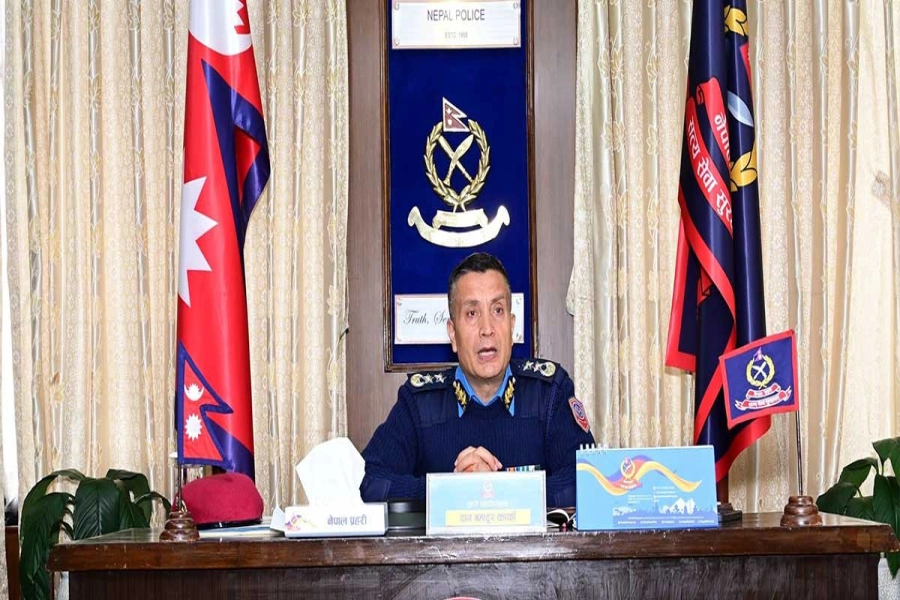
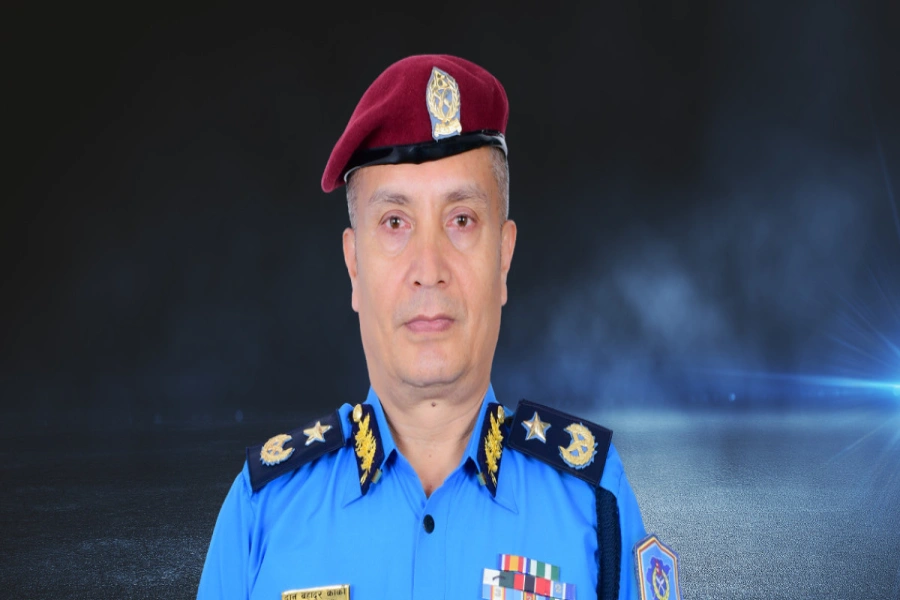
KATHMANDU, Nov 5: A cabinet meeting held on Tuesday did not discuss Nepal Police. The meeting was rescheduled for Wednesday. The Home Ministry had no plans to table any proposal on the police leadership at the meeting. However, news suddenly emerged that the government had decided to appoint Inspector General of Police Dan Bahadur Karki as security adviser to the prime minister.
According to sources at the Home Ministry, Home Minister Sudan Gurung himself had no prior knowledge of the decision to remove Karki from his post. Some information had been circulating from the Prime Minister’s Secretariat, but when a few ministers asked Gurung about reports that the police chief was about to be replaced, he reportedly had no clear answer.
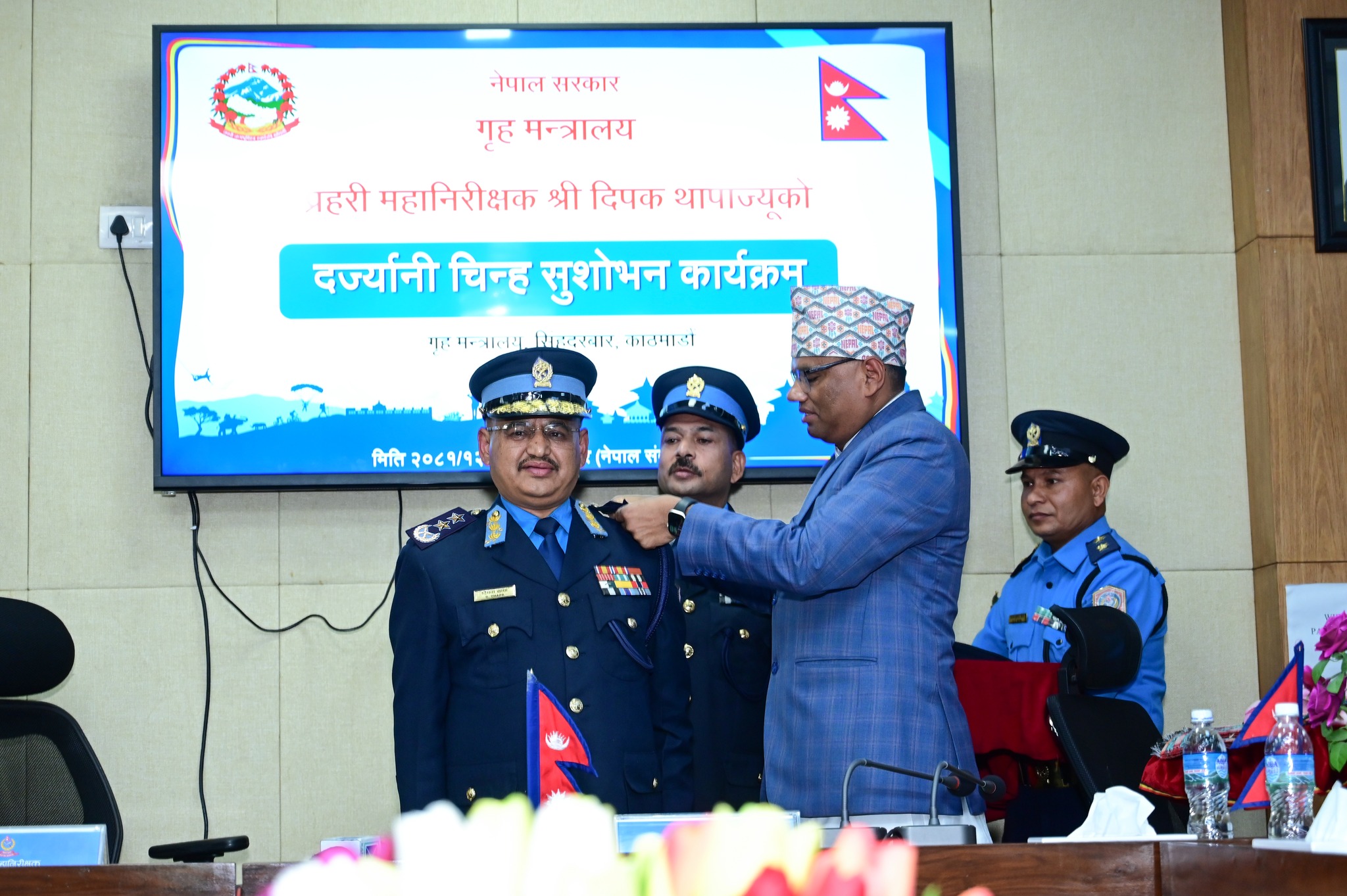
Acting on a proposal made by the prime minister at the Cabinet meeting, the government transferred Karki to the post of security adviser and promoted another Additional Inspector General (AIG), Dr Manokumar KC, to Inspector General. The government promoted KC on Wednesday and formally conferred the insignia of the IGP on him. Home Minister Gurung pinned the insignia on KC, who became the 34th chief of Nepal Police. The Home Secretary had earlier conferred the insignia.
At the ceremony, Gurung made no remarks about the change in police leadership. Congratulating the newly appointed IGP, he instructed him to strengthen relations between the police and the public.
A Home Ministry source said Gurung's failure to explain why outgoing IGP Karki had been removed further suggested that he was not fully aware of the decision taken by the Prime Minister's Office.
Tussle between the government and Karki
The government led by Sushila Karki had appointed Dan Bahadur Karki as Inspector General of Police on November 13, 2025 (Kartik 27, 2082 BS). Had the 30-year service rule remained in place, Karki would have had a tenure of 29 months. However, after a government led by Balendra Shah came to power following the March 5 election, Karki came under sustained pressure.
Soon after the government was formed in March, it directed the police to arrest former Prime Minister KP Sharma Oli and former Home Minister Ramesh Lekhak over their alleged roles in suppressing the Gen Z protests of September 8, 2025 (Bhadra 23, 2082 BS). The order required their arrest so that criminal proceedings could be initiated against them, leaving the police with little choice but to act.
Oli and Lekhak were arrested on March 27 (Chaitra 14) but were later released on court orders. No investigation has been conducted against them since.
Within the police organisation, concerns had already surfaced over Karki's inability to reject what were considered improper orders. These concerns followed media reports about the incident involving a vehicle and, more recently, the arrest of former Chief Justice Cholendra Shumsher Rana. The arrest of Inam Sapkota, who was linked to Rana, brought the confrontation between the police chief and the government to a head.
Information had reached the Prime Minister's Office that Inam had attempted to influence the case of businessman Bhatt, who was in prison, through Rana. Inam's name had reportedly emerged from Rana's mobile phone.
Home Minister directs IGP to probe unofficial participation in...

Inam was arrested at the airport on October 1 (Ashoj 14). After conversations with an Additional Inspector General (AIG) of the Armed Police Force were found on his mobile phone, the AIG was removed from the post.
A source said the government's decision to remove Karki followed reports that, while Sapkota was still in police custody, his mobile phone had been taken to the residence of Kumar Ben, chief adviser to Prime Minister Shah. The information triggered a dispute within the government over Karki's position.
The government had begun laying the groundwork for Karki's removal a week earlier. Journalists who published reports about pressure from the Prime Minister's Secretariat on the IGP to resign, as well as a conversation between Supreme Court Justice Hari Krishna Karki and Inam, who was in police custody, were arrested.
Following widespread criticism of the arrests, the government distanced itself from the action, claiming that it had not issued any such order.
The police, meanwhile, said the journalists had been summoned to identify their sources after publishing what it described as false reports about the relationship between the prime minister and the police chief. The IGP faced criticism for failing to reject what was described as an improper order to arrest the journalists.
A source said the decision to remove Karki was also linked to allegations that he had leaked information about pressure from the Prime Minister's Office to arrest the journalists and about Kumar Ben's alleged possession of Inam Sapkota's mobile phone.
After reports emerged that the government was planning to replace him, Karki convened a meeting of the Police Policy Committee.
Meanwhile, Rastriya Swatantra Party (RSP) chairperson Rabi Lamichhane was also opposed to removing the IGP. Prime Minister Shah and Lamichhane held discussions on the matter.
On October 31 (Kartik 14), the RSP directed the government to investigate the arrests of the journalists through a decision of its Secretariat meeting. The government did not implement the directive. Instead, it removed the IGP from his position, going against the party chairperson's preference.
On Wednesday, government spokesperson Sasmita Pokhrel and RSP spokesperson Jagadish Kharel also issued conflicting statements. Pokhrel said Karki had been removed and KC appointed as police chief in accordance with the party's directive. Kharel, however, said the party had issued no such instruction.
Karki preparing to move court
Following his transfer to the post of security adviser to Prime Minister Balendra Shah, outgoing IGP Dan Bahadur Karki is preparing to challenge the government's decision in court.
An officer close to Karki said preparations were under way to file a writ petition at the Supreme Court on Thursday against the government's decision taken on Wednesday.
A similar case involving the removal of a police chief reached the Supreme Court nearly 30 years ago.
Achyut Krishna Kharel, who was appointed Inspector General in February 1997 (Falgun 2053 BS), was transferred to the Department of National Investigation in March. Dhruva Bahadur Pradhan was appointed in his place.
Sher Bahadur Deuba was prime minister and Bamdev Gautam was home minister when Kharel was removed. Kharel challenged the government's decision in court.
While the case was still pending, the government changed in October 1997 (Ashoj 2054 BS). The government led by Surya Bahadur Thapa reinstated Kharel as IGP and transferred Pradhan to the post of security adviser.
After being transferred to the security adviser position, Pradhan resigned.
With the government once again replacing a police chief after nearly three decades, attention is now on whether Karki will approach the court and what ruling the Supreme Court might deliver.
Who is the newly appointed IGP KC?
Newly appointed Inspector General of Police Manokumar KC and outgoing IGP Dan Bahadur Karki belong to the same batch of police officers.
KC, who joined Nepal Police as an inspector in 1997 (2054 BS), is from Nuwakot district. He was promoted to Deputy Superintendent of Police (DSP) in 2010 (2066 BS).
Considered a professional officer with a straightforward approach within the police organisation, KC was promoted to Superintendent of Police (SP) in 2017 (2074 BS). He became Senior Superintendent of Police (SSP) in 2022 (2079 BS), Deputy Inspector General (DIG) in 2024 (2081 BS), and Additional Inspector General (AIG) in 2025 (2082 BS).
While serving as SSP, KC headed the Kathmandu Valley Crime Investigation Office and led the investigation into the fake Bhutanese refugee scam. Former Home Minister Bal Krishna Khand and former Deputy Prime Minister Top Bahadur Rayamajhi were convicted in the case.
KC holds a PhD in conflict transformation from Cambodia. As an AIG, he headed the Central Investigation Bureau (CIB).
If the current retirement rules remain unchanged, KC is expected to lead Nepal Police for around 18 months.
Speaking after receiving the insignia on Wednesday, KC said managing resources, handling transfers and promotions, and addressing grievances among junior police personnel would be major challenges.
He said he would give particular attention to investigating financial crimes, illegal cryptocurrency transactions and cybercrime.
KC also pledged to respond to the security challenges that emerged after the events of September 8 and 9 last year (Bhadra 23 and 24, 2082 BS). He announced plans to establish a team within the IGP's Secretariat to listen to complaints from junior police personnel.




-1793781552.webp)


