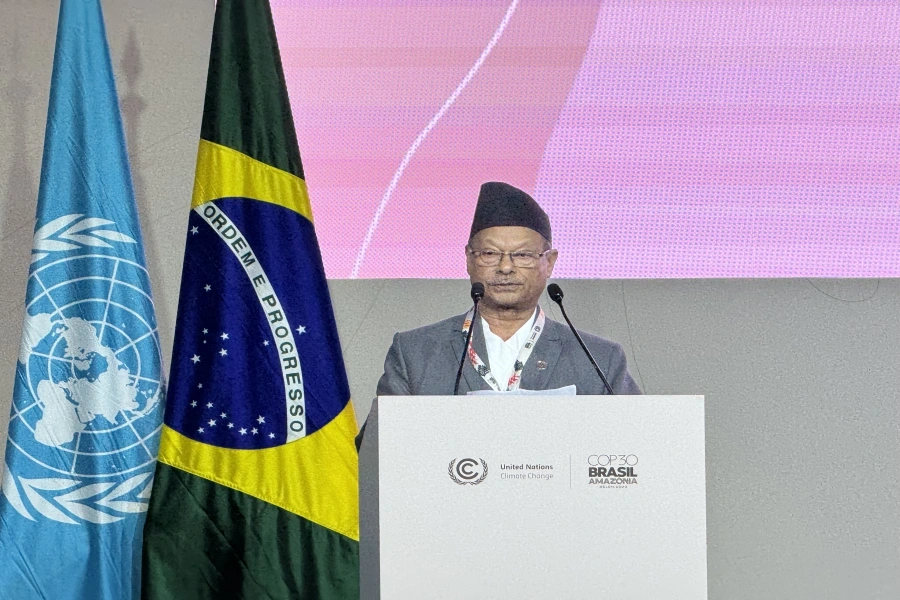
KATHMANDU, Oct 2: Foreign Minister Shisir Khanal has emphasized the need to put climate justice into practice rather than confining it to slogan.
Foreign Minister Khanal urged the international community to provide new, easily-accessible and grant-based climate finance to Nepal to cope with the crisis that surfaced from climate change.
Addressing the 'Kathmandu Climate Week-2026' organised in Kathmandu today, he underlined that Nepal's development, agriculture, infrastructure, water security, public health, energy transition, financial stability and foreign policy are directly connected with climate change.
"Although Nepal contributes 0.1 per cent of global greenhouse gas emission, Nepali people have had to lose lives and properties due to the climate crisis. Nepal's contribution to creating a climate crisis is negligible. We bear a disproportionate burden of its impacts," argued the Foreign Minister.
He stressed, "The meaning of climate justice is to accept this disproportionate burden and a concrete step should be taken to address it."
Minister Khanal pointed out the need of international cooperation in adaptation support, technology transfer and institutional capacity building is essential to mitigate the damage Nepal is facing due to climate change.
SHIFT for Our Planet: Youths urge authorities to make climate j...

He also expressed the view that the Fund for responding to Loss and Damage, established with the aim of immediately providing financial resources to the countries affected by climate-induced disaster, should not be confined to the complexities of administrative procedures.
Talking about Bhotekoshi flood and landslide, he shared that the disaster that occurred in the mountainous region had caused huge loss of lives and properties as well as made a serious impact on road, bridge, hydropower, infrastructures and livelihood of the local community.
Minister Khanal mentioned that climate-related disasters have created structural obstacles in Nepal's development process. He pointed out that it is concerning that the limited resources allocated for development often have to be spent repeatedly on rescue, rehabilitation, and reconstruction after disasters.
He emphasized that roads, bridges, electricity transmission lines, and urban settlements should be built to withstand climate-related risks for at least 20 to 30 years, keeping the risks of climate change in mind.
Similarly, Minister Khanal pointed out the need to reduce the gap between scientific research and policy decisions, emphasizing that data from studies on glacier melting and the state of glacial lakes should be quickly transformed into effective early warning systems.
He said that such a system should be able to deliver information in time to farmers at risk and residents of remote areas.
The Foreign Minister emphasized that government institutions need to be strengthened for the effective use of climate finance, and since climate-related risks are cross-border in nature, scientific cooperation with neighboring countries should also be expanded.
He mentioned that to protect the shared river system and reduce disaster risks, it is necessary to exchange water and weather-related data from the time without political influence with neighboring countries.
Foreign Minister Khanal shared that a Climate Diplomacy Section has been set up in the Ministry of Foreign Affairs to make Nepal's role in international climate change talks more effective.
He said that the structure would link Nepal's internal climate realities with international negotiations, making Nepal's diplomatic efforts more integrated, consistent, and active.
Referring to the Himalayas as the 'Third Pole,' Minister Khanal said that the water flowing from its glaciers affects the lives of about two billion people in the downstream areas and emphasized that protecting the Himalayas is not just important for Nepal but is a key part of global ecological security.
Minister Khanal expressed the view that Nepal's voice on the international stage, in view of the UN Climate Change Conference (COP-31) and the mid-term review of the Doha Work Programme should be based on the real experiences of communities, scientific evidence, and practical solutions.