Economic Freedom of the World: 2010 Annual Report uses 42 data points to construct a summary index and to measure the degree of economic freedom in five areas – size of government: expenditures, taxes and enterprises; legal structure and security of property rights; access to sound money; freedom to trade internationally; and regulation of credit, labor, and business.
Economic freedom score had increased for over two-and-a-half decades beginning 1980 but has recently shown deteriorating signals especially after 2008. Out of 10, Hong Kong scores the highest rating of 9.05. Nations in the top quartile of economic freedom had an average per-capita GDP of $32,744 in 2007, compared to $3,858 for those nations in the bottom quartile in constant 2005 international dollars. The message is that the nations who have good economic freedom score outperform non-free nations in economic well-being.
As changes to one area in isolation tend to decay back to prior levels, the lesson countries should learn is to achieve meaningful adjustments and reforms in economic freedom by undertaking simultaneous reform to the different areas of index. A lesson to Nepali politicians and policymakers is that state restructuring is not merely political restructuring. It is the summation of wider spectrum of socio-economic, political, cultural and an array of other related institutional reforms.
Reform is necessary. There are empirical evidences that show formal institutions such as tax and regulatory structures can be permanently reformed but there are some rights-based informal institutions like civil rights and legal structure and security of property rights, which resist permanent change. The bottom line is to avoid changing one area at one time but undertake simultaneous reform to the different areas of the index. It has helped others to achieve reforms in tough indexes that resist change. Nepal should acknowledge these evolutionary practices so successfully accommodated by the developed nations in their reform programs.
From policy perspectives, examples based on the findings of Economic Freedom can be linked to Nepal’s unemployment sector, which is one of the key indicators in the stated report. Studies have shown strong relationship between economic freedom and unemployment. Available regression results from data of 87 countries show that more economic freedom reduces unemployment largely among women and young people (these groups have above average unemployment rate globally).
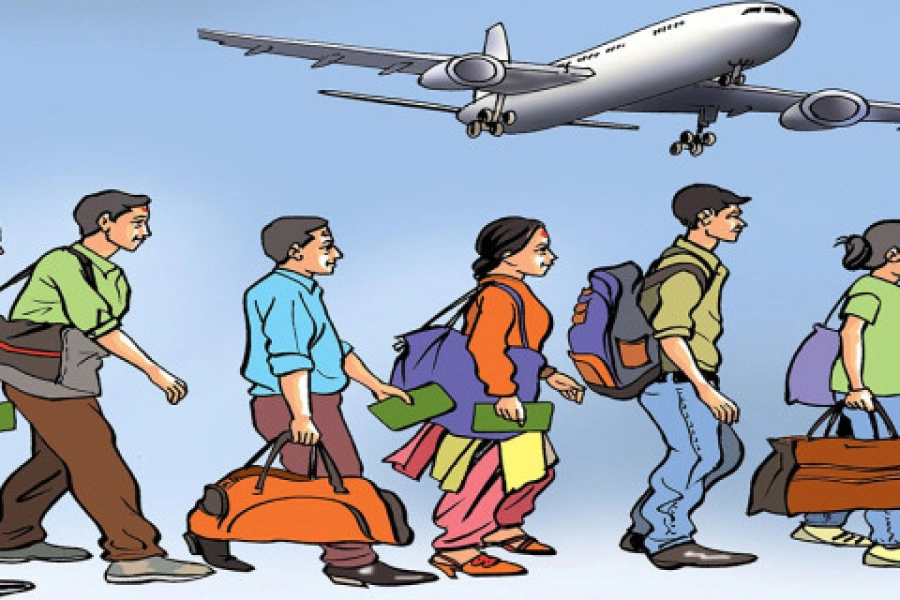
In Nepal, the victims of unemployment are the young people. The working-age group population of 15 years to 59 years has increased. In Nepal, youth between the ages 15 years to 29 years represent almost 25 percent of the total population. The unemployment rate among 15 years to 24 years remains at 6 percent and incidence of child labor is estimated to be 31 percent among 5 years to 14 years age groups.
The overall failure of unemployment policy is the inefficiency in turning Gross Domestic Product growth into job creation or wage increases. Therefore, the policy of placing employment at the center of economic and social policy-making could never be implemented. Unemployment has, thus, increased dependency of youths on their families. The possibility of breaking down family would mean their likely exposure to higher risks in unwanted activities.
Studies have shown strong relationship between economic freedom and unemployment. Available regression results from data of 87 countries show that more economic freedom reduces unemployment largely among women and young people.
Coming back to the question of how economic freedom affects unemployment, it has been demonstrated that restrictions on economic freedom would increase substantial cost in terms of higher unemployment. Given the predictable rule of law, workers and employees have been found to get strong incentive as the income they earn is legally secured. Similarly, entrepreneurs can be expected to hire staffs because the proceeds that come from employment are also legally secured. It suggests that weaker economic freedom discourages people to seek gainful employment by hiring workers and continuously practicing new innovations for expansion.
The impact of economic freedom has also been studied in income and growth in high-, middle-, and low-income country sets. The study finds that economic freedom is significant for a sample of all countries but only in some subsets. It is important for Nepal to examine the findings from Economic Rights and Government in Developing Countries: Cross National Evidence on Growth and Development, Studies in Comparative International Development conducted by Arthur A Goldsmith, which states developing country that score relatively better in protecting economic rights also tend to grow faster and score higher in human development. For this reason, there is a consensus that economic freedom is associated with democratic government and with higher levels of average national income.
The lesson policymakers in Nepal should learn is the possibility of acquiring the knowledge in understanding the effect of economic freedom on growth, output and investment that have highest statistical effects on these variables. It has been found that economic freedom enhances growth both by increasing total factor productivity and by enhancing capital accumulation.
Although there are both benefits and limitations of economic freedom, most of the countries in the world have benefited by engaging in economic reform programs. In Nepal, historical democratic movements have most of the times escalated against the centralization of political power. For long, the activists considered political change to be the determining variable for socio-economic change. Therefore, there is distinctly a missing link between political dissent and economic liberalism. The time has now come to investigate the impact on how the climate of political and popular opinion has affected the development of liberal policy to sustain growth, reducing poverty and promoting inclusive growth. If it is done, it would be possible to establish linkages between political dissension, economic freedom and institutionalizing democratic institutions.
To sum up, based on aforementioned linkages, if someone tries to examine the impact of Nepal’s ailing democracy on economic growth, one can safely say that it is not the redistributive policies of the governments that limit development but the lack of economic freedom.
bishwambher@yahoo.com
Related story
Freedom of press means freedom in country: NC General Secretary...