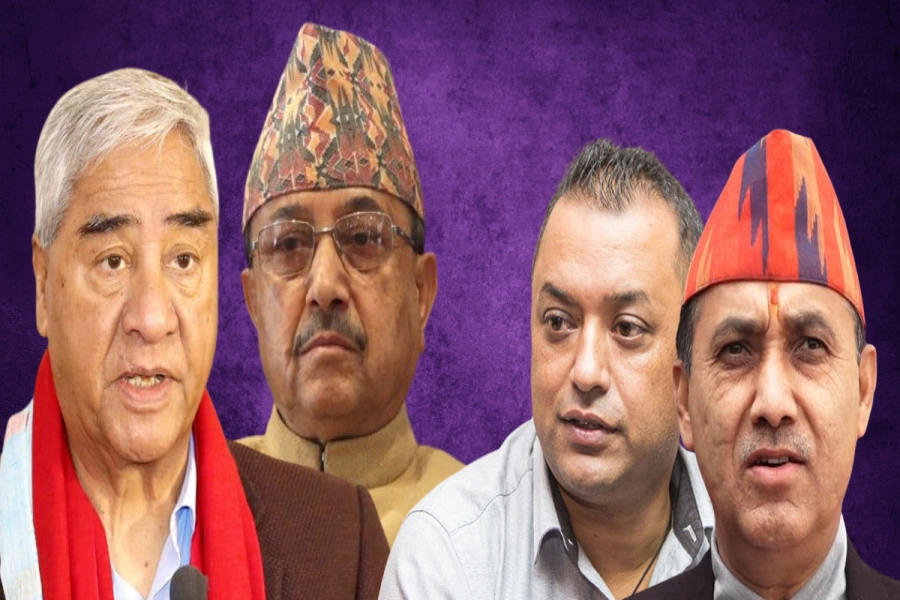
The Nepali Congress led by Gagan Thapa has kicked off its 15th General Convention Sunday at perhaps one of the most difficult moments in its long history. Around 7,500 delegates have gathered in Kathmandu to elect a new leadership that will chart a new course. But behind the ceremony, speeches, and elections lies a much more probing question: can Nepal's oldest democratic party remain united after the convention? The danger of a deeper rupture cannot be brushed aside. The dispute that began over the special general convention in January has developed into rival organizational processes. Gagan Thapa emerged as president from that convention, and his leadership received recognition from the Election Commission and later the Supreme Court. Sher Bahadur Deuba's group rejected the process, sought judicial review, and has pressed ahead with its own convention calendar. The Supreme Court has agreed to review its earlier verdict, although the Thapa leadership remains legally recognized for now. Then comes Shekhar Koirala. He has stayed away from both convention processes, arguing for party unity. Purna Bahadur Khadka has also remained outside the rival processes. Thapa, for his part, held talks with Deuba, Koirala, and Khadka in an attempt to find common ground. Those efforts brought some leaders back into the Thapa-led mainstream, but they failed to produce a settlement with Deuba. This leaves the country's oldest democratic party in a strange position. One side has convened its general convention, another group is continuing the parallel process, and the third side has so far refused to side with either of these sides.
NC District Convention in Chitwan postponed in view of UML Gene...

If the party's senior leaders cannot make a feasible compromise through discussion, the factional battles will lead to yet another split of the party for good. The Nepali Congress has experienced such a split in the past but managed to reunite on several occasions. It split in the early years of democracy and again in 2002, when Deuba formed the Nepali Congress Democratic. The latter split ended with reunification in 2007. History therefore shows both the party's capacity for division and its ability to come back together. But the stakes today extend beyond Congress. This is the party whose history runs through the struggle against the Rana rule, the restoration of multiparty democracy, and Nepal's later political transformations. That history does not give Congress permanent ownership of democracy. Nor should democratic politics depend on one party. Yet a weakened and fragmented NC would remove an important institutional voice at a time when Nepal is again debating the shape of its political system.
The Balendra Shah government has already opened a broad discussion on constitutional amendments. A government task force collected proposals touching 245 of the Constitution's 308 articles, including the electoral system, judiciary, federal structure, and form of government. Several established parties withdrew from that exercise, questioning its process and political ownership. The government itself has said the document is a basis for discussion rather than an amendment package. That makes the role of experienced democratic parties more relevant, not less. Although new political forces are entitled to challenge the old parties and redefine politics, constitutional change still requires far-reaching, broader debate, institutional memory, and political consensus. No contribution is to be expected from the oldest democratic party, a major player in promulgating the new constitution in 2015, if its leadership dedicates itself to internal power struggles. As the convention slogan speaks of respecting tradition and accepting change, the NC must turn this slogan into reality. Any change should now guarantee renewal of leadership, democratization of internal mechanisms, and accountability of the organization to the people. Respect for tradition implies preservation of the Congress culture of debate and accommodation. Winning control of Congress while losing the party through splits itself would be a pyrrhic victory. The delegates meeting in Kathmandu should therefore treat unity not only as a slogan, but as the first business of the convention.