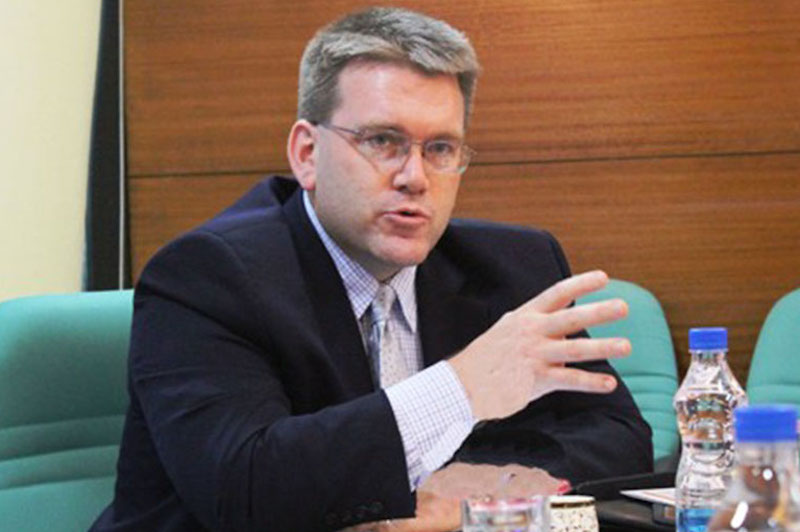
A “middle-class Nepali kid” who grew up listening to Grateful Dead and Neil Young, watching Butch Cassidy and the Sundance Kid in video parlors in the gallis of Jhonchhe and reading “Hindi commercial fictions and Robert Ludlum,” Upadhyay went to St Xavier’s School, Jawlakhel, and was what he calls a “typical Xavierian”.
When “Arresting God in Kathmandu”, a collection short stories, was released in 2001, he suddenly found himself in the middle of criticism vs. admiration. Quite a few Nepalis cried that he went overboard with “sex stories” whereas foreign media like the San Francisco Chronicle noted that he wrote like Chekhov - “but a Buddhist Chekhov who writes about love not with dark Russian fatalism but with a sense of the cyclical nature of life and its passion.”

Upadhyay is known to be good at craftily portraying stories in an extraordinary manner, and mostly of commoners. The situation of Nepal, Nepali society and its psyche which he views largely through the lens of western contemporary fiction based on reality are his subject matter.
With three books under his belt, of which two are anthologies of short stories and one a novel, Samrat is preparing to launch his fourth book and second novel, still untitled, next year.
Currently, he is the director of MFA program at the Indiana University where he also teaches Fiction Writing. “Life of a professor is busy,” he says. He was in Kathmandu with two of his MFA students. Last Week, the Week’s Editor Subel Bhandari met with this writer-at-large and talked about his writing, his inspiration and craft, his comparison with Manjushree Thapa and other upcoming projects.
Excerpts:
We have heard some news about your new book next year. Tell us more.
My new novel is going to release in 2010 spring (March), and Rupa is going to publish it almost simultaneously here in Nepal. I think I have enough people interested here in Nepal for my book.
The tentative title for the new book is Queen’s Pond (Rani Pokhari). I might just change (the name) to something else. I’m consulting my editor. It’s not a collection of short stories this time. It’s a novel that was originally 800 pages. But now it has come down to 450 book pages. A novel is a story of multiple characters at the same time. It’s something different from what I have done before. It is based in Nepali society and Nepali characters although there’s a cross cultural movement of a character who goes to America and comes back. I make a movement in that direction.
Most of your characters are on Nepal and Nepalis. Are you ever going to write about other cultures and characters?
I think there is something to the fact about the place where you were born and most of your emotional makeup. I was here until I was 21 and a lot of my growth occurred here. The fact that I was born and raised here in Kathmandu, its landscape is in my bones. Lot of the times when I write, I just naturally move in that direction. I also find there is a lot to write about Nepal. People ask me why I don’t write about the Nepali Diaspora. Somehow for me, there is enough material here right now. I can’t predict the future. I’m slowly gradually moving towards diasporic community. I have few stories where I have those characters. But Nepal is my subject matter and I’m a Nepali.
I’ve tried writing on American setting and characters and have failed miserably. I’ve tried to evoke the American setting and it just doesn’t have the power and resonance for me.
 But you’ve been living there for so long. And you work there. You know how they think. You’ve been there for so long and been a part of that society.
Maybe I’m a writer who needs a degree of distance. I actually came back to Nepal and worked between 1993 and 1995. Interestingly, I couldn’t write a lot of fiction at that time. I was a journalist and I could write columns. I think I’m a writer who is sharply attuned to Nepal when I’m slightly removed from it. It might be interesting for me to experiment to come back and write.
What kind of research do you do for the kind of stories you write? Or is it all in your memory and imagination? How do you come up with characters, scenes and descriptions?
The scenes and the characters just come from my imagination. That’s the first step to my writing. For the novel that’s coming out, I had to do a lot of research, more than I normally intend to do. I’m not a good researcher. It takes effort out of me. I had to push myself. This novel required research because the form and the characters demanded that I cover a large expanse of Nepali history. The novel starts out in the 1960s. I was born in 1963. I needed to know what happened during that decade.
Before television made its appearance here in Nepal in 1986, there were video parlors that showcased English movies. You go into these alleys in New Road and enter a room and you pay like five rupees and there was a television screen and they showcased Hollywood movies. I distinctly remember watching Butch Cassidy and the Sundance Kid with a bunch of us from St Xavier’s School. I’ve included that in the novel. And a lot of those came from my memory of Kathmandu for the story. I remember particular settings. I remember there would be old Newari grandmas who would be watching Butch Cassidy with you and you’d wonder what and whether they would understand. But then, they seemed to be enjoying. I include those things.
Are your characters usually fictional or are based on people you know, heard of, or see around? Because most of the characters are very normal and ordinary people.
They are fictional except for some who I might tap into people I know. Like a character who looks like my father. Or I might just take a trait. For example, someone gets up and is angry and argumentative and starts banging the table. In a writer’s eye, that’s very interesting. I might just take that moment of anger and transfuse that to the character that I’ve created and have him do similar gestures. Of course, the character will be a lot more complex than that. Sometimes it’s unconscious.
I heard about your discipline of writing, that you make it a point to write everyday. How much do you write?
I try to write everyday. Usually, my writing time is in the morning. For a long time, I used to get up really early at four in the morning and used to write. It was the only time I could write. But lately, that has changed. These days, I get up in the morning to meditate. I’ve become more spiritually inclined as I get older. So I save my writing time for a little bit later. When I finished writing the bulk of the upcoming novel last year, it was the toughest book I had ever written and I wanted to take a break from writing. I told myself, there is no way I can write anymore for at least six months. But I’m an impulsive writer. I took a small break and started writing again.
When I was younger, I used to think that one book would do it. Everything else would come easy. But I found out that’s not the case. Each book has been more and more difficult and challenging.
 When you don’t write novel or stories, what do you write? Or is it always for publication?
It’s almost always for publication. When I write stories, everything doesn’t go into publication, of course. Because some of them are so weak, you don’t want to continue or even consider revisiting. It just feels like a failed impulse. If there was some kernel of energy that would manifest itself in writing, I let it go.
I also do some non-fiction writing. I have a few US publications interested in my writing because I’m a Nepali writing in English. They ask me once in a while to contribute. The New York Times asked me to write a piece on Nepal during the People’s Movement because they feel like I’m a well known enough name, and that if I write, it gives some certain authority. I take out time to write those pieces. Recently I wrote a piece on the palace museum along the lines of the history of royalty in Nepal, and because I grew up in Lainchaur, I wrote about how I used to walk past the palace and what it symbolized before and what it has become now.
How about your reading habit?
I’m constantly reading. It’s one book after the other. I just finished reading Ajit Baral’s Folktales from Nepal (The Lazy Conman and other stories). I am revisiting Dostoevsky’s Crime and Punishment. I just finished a book, In Other Rooms, Other Wonders by a Pakistani writer Daniyal Mueenuddin. I really admire his writing. I just picked up Sushma Joshi’s The End of the World. I’m going to read that on my way back to the States.
How important is it for writers to read?
It’s essential. You’re interacting with the “real world.” In writing, other writers are inspiring you, especially when you’re starting off. Young writers even mimic scenarios, plots or styles. You can’t write without knowing some history of writing. Constant reading means you’re interacting with language, which you must if you’re writing. I’m more fortunate because I’m reading my students’ work and critiquing them. I’m constantly aware of weaknesses and strengths which transverse to my writing.
Doesn’t reading a lot of other writers affect your genuineness?
I think it does not. I don’t think our imaginations are pure or authentic. I think we’re heavily influenced by parents, surroundings, atmosphere, and teachers. We absorb so much from them. So what part is truly yours and what part is not? It’s very hard to distinguish. I think if you go to straight imitation, you are in danger. But the more you imbibe, the better off you are. I don’t think I have negatively been affected by other writers. You have to trust yourself to absorb the good stuff, not copy, and reject the bad writing.
How is creative writing in Nepal changing?
Increasingly. In a discussion organized by Quixote’s Cove earlier this week, a young writer Abha Eli Phoboo talked very movingly about her experience about shifting to creative writing and family pressures that she felt, and her story is symbolic of what’s happening with young writers here. There are unseen possibilities. Many see English writing as a vehicle for immediate success and fame. That’s not how it really works. I had to go through lots of struggles and rejections before I finally got through. I was fortunate to have a well-known first publisher who had mechanism of marketing in place. But the struggle was still there. I sent to journals, got rejected, to agents and publishers, got rejected. I think writers should be aware of that reality as well.

Can you picture yourself as a non-fiction?
I was talking to Manjushree in my last visit and I told her I’m scared of non-fiction. I feel like I’ll start writing and nothing will come out of it. I won’t have enough to say. With fiction, I can go to eight hundred pages without a problem. She said she finds non-fiction easier than fiction.
I think I can think of me as a non-fiction, but I think it takes some time. I’ve written non-fiction. But right now, I can’t envision myself writing an entire book on non-fiction like Manjushree or Amitav Ghosh has done.
You are often paired with Manjushree Thapa. Even in our conversation, she popped up. And people compare you two a lot. Is it, at times, slightly irritating?
I don’t. I think it’s all part of writing. Comparing is a wrong way of looking, but a natural instinct. I do it, too. It’s a natural impulse. We’re very different writers and of different subject matters, and our orientation are different. Manju has done lot of work while living here. I’ve been mostly abroad. I don’t get irritated. Right now, because Manju and I are more prominent amongst the Nepali writers writing in English, it’s natural, if anything, to draw comparisons.
Have you read her book?
I haven’t read the latest. But I have read Tilled Earth.
How do you like it?
I liked a lot of the stories. I like that she’s able to use very compressed form and provide a substantial read in her stories. My favorite book of her is Forget Kathmandu. I thought it was a good read and very honest.
When we talk about English writing by Nepali writers, it’s either you or Manjushree.
I think it’s also partly because we’ve been the most publicized, rightly or wrongly. There was a previous generation of writers like Peter Karthak, a good friend, and writing for ages. Also maybe our books were published by publishers abroad. Our writing came at a right time. Certain urban class was ready for this kind of book, and the Nepali book market was saturated with Indian writers, and we needed Nepali writers in English. Our books were published outside Nepal, overseas press reviewed them, which I think added a bit of glamour to Nepali readers.
Does that put pressure on you?
I would like to say no. While I write, produce my work, I don’t feel any pressure. I don’t think about audience when I write. I do get a sense of responsibility, given that for a lot of people, they read my work and they think Samrat is the voice of Nepal. But I don’t feel very pressurized.
Do you have primary audience that you cater to?
I don’t have specific persons in my mind. But I tend to think of a wider audience. Shashi Tharoor, once when asked who does he write for, said, “Whoever wants to read my work.” That’s the easiest answer. I don’t primarily write for Nepali or western audience. I think in terms of the craft I produce, I hope it appeals to both. I don’t want a Nepali reader to be all too familiar with stories and characters that he would not read. And I hope my western readers won’t think I am too narrow.
On the use of typical generalization by storytellers, how should you be aware – like cattle on the streets?
There’s a danger every time when you mention particular cultural objects, or if you get into explanatory mode. Then you’re moving into dangerous territories. I think there’s a way of portraying culture in other ways. A lot of things you write are for a wider audience, and what could be generalization for local audience could be an interesting fact elsewhere. They do need cultural feed, or else it’ll lose the flavor. That’s a very fine balance. But it could be tackled by craft. Suppose you have, in a story, fifteen instances of steaming cups of tea.
You do one instance of the steaming cup of tea, and the rest you just mention tea for the next fourteen instances. It’s the emphasis.
Since you write a lot about Nepal, the Nepali society and psyche, how do you elaborate on certain subjects or ideas that we could relate immediately, but for western readers, need explanation?
I don’t do it. I think that’s the danger. Young writers have to really be careful. We’re writing fiction, not travel guides or travelogues. I think sometimes we undermine western audience about how much they can grasp. I don’t think it’s the job of litterateurs to explain each and every thing of a culture.
Regarding the reactions of western audience versus Nepali audience, how is it different, especially when they meet you or comment on your work?
With my first book, a lot of Nepali readers were very focused on the sexual aspects of it. Interestingly, while I was doing book tour in the States, no one mentioned a word on sex. Another main difference is, in terms of my audience, a lot of them are really proud of me and what I’ve done. I don’t have that sort of fanbase in the States. There, they read, they want to discuss and want to know about Nepal. Nepali readers, during my first book years, were suspicious that I was writing for western audience only, and they said that I should be a cultural ambassador and portray Nepal in positive ways, which isn’t my philosophy of literature.
What is your philosophy of writing?
Literature is not about uplifting or denigrating a culture. It’s about showing as you’ve experienced it. And leave it to the reader to experience it.
What is creative writing for you?
Using my imagination and my facility with language to experience different worlds and trying to make my readers experience those worlds. Some, maybe even I haven’t experienced.
What does it mean for you to write in English as a Nepali writer? How has the experience been so far?
I think I’m a product of my upbringing and my circumstances. I went to St Xavier’s. I was skilled in Nepali and English. In middle school, I started reading more English books and became immersed in it. What I hope it means, as a Nepali writing in English, is that it’ll also be a start considering English language as a vehicle under Nepali literature. It’s not an organic language but it’s very much a part of our society. I think it’s a Nepali reality and a part of Nepali literature now.
Related story
Japan hands over medical equipment for surgical eye camps to Hi...