Apart from the noise, space might be another issue when it comes to the zoo. How practical is it for wildlife to be constricted inside an area of a few hectares?
Ganesh Koirala, assistant curator at the Central Zoo, reveals that noise pollution is indeed a problematic situation but one that is beyond the management’s control. He, however, claims that space is not that big an issue. Sometimes, the animals do get overweight in an ex situ site but that can be checked by reviewing their diet plan. [break]
hotos: Chandra Shekhar Karki
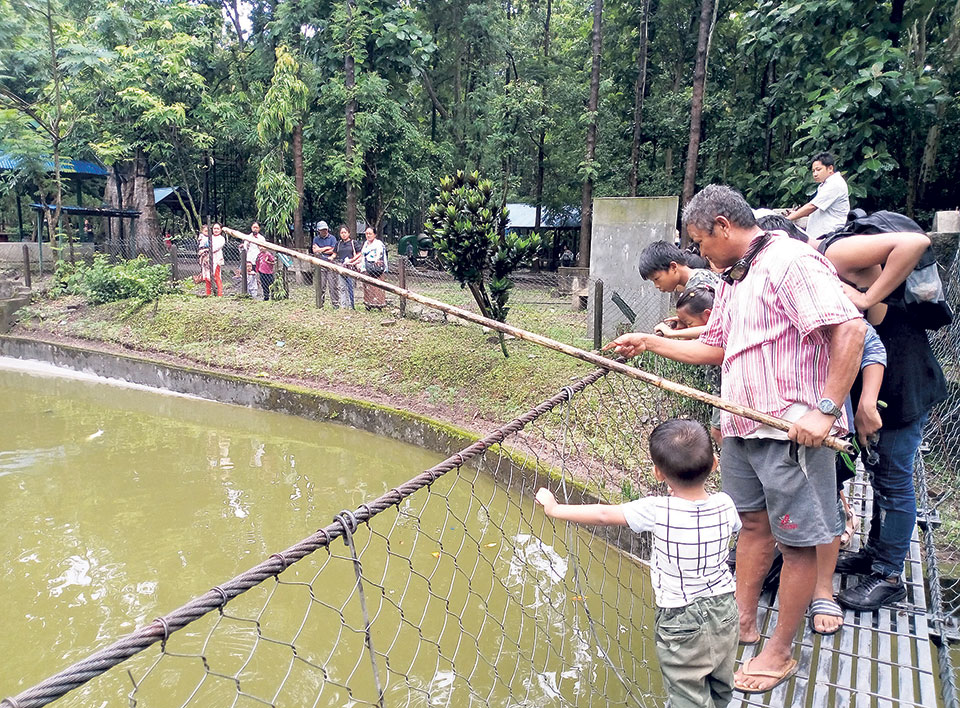
That being said, he does believe that cleanliness is a major problem which is possible to control but is quite a challenge at the same time. “It’s difficult to maintain sanitation and hygiene in an area full of so many birds and animals,” Koirala explains, “Zoo always urges the visitors to use dustbins and not to throw food, stones and sticks inside or around the enclosures.”
Plastic bags, too, are banned in the zoo and it might soon be turned into a food free zone as well. However, there’re some natural elements that remain no matter how spick and span a state one intends to attain and uphold. “Some animals give off a pungent smell when they get irritated or scared,” he says, “So, if you can sense a foul smell in zoo, it may not always be garbage or excreta.”
The zoo also controls and captures stray wild animals in and outside Kathmandu valley. They have recently rescued a red panda and a cheetah and brought them into the zoo.
Many animals are found amidst human settlements, in mortal peril, alone and confused.
“Habitat fragmentation and lack of proper food and shelter are the major reasons why they wander off into the streets,” informs Sarita Jnawali, the Zoo Project Manager, “But it’s tragic to see them bloody and beaten up by the time we reach the spot to get them back.”
Fear, she opines, causes these animals to launch violent attacks on human beings. “They are out of their homes and are scared and vulnerable,” she explains, “It’s their primal instinct to attack others and defend themselves.”
Central Zoo is a home to fauna that come from different places and are brought in through rescue, purchase or bequest. It’s a common dwelling of 800 animals and is visited by millions of visitors every year. A grand total of 116 different species live in this area of six hectares.
For many zoologists, environmentalists and students, zoo has become a way of reacquainting with nature amid the hullabaloo of the metropolis. However, according to Pramada Shah, an animal rights activist, zoos are animal prisons and it’s unwise to put them behind bars. “The current zoo is extremely overcrowded and unscientific. It could be run as a bird park or a sanctuary for smaller mammals and rescued wildlife,” she insists.
“But you can’t keep big animals inside small cages and then starve them because they’re overweight.”
Shah suggests that Gokarna and Surya Binayak could be the perfect sites for open zoos and safari parks so that the larger animals can be relocated to their natural habitats. “It would be a major attraction for the visitors. Also, the animals wouldn’t be teased and stoned inside the cages all day which could be the cause behind them getting furious and frustrated.”
Sarita Jnawali, on the other hand, focuses upon the measures that the zoo has been taking to maintain the natural habitat. She talks about the zoo officials visiting Darjeeling to overview the enclosures for red panda and reports and pictures being asked from London zoo for bears. She argues, “Our major concern is to get the zoo infrastructure as close as possible to the natural habitat. We’ve even installed air conditioners and heaters in the enclosures to achieve that.”
Animals may have their own issues due to the immediacy with humans. But the locals too share mixed sentiments regarding their proximity with a zoo.
Bhupendra Jung Shahi, a resident of Jawalakhel reminisces, “We used to visit the zoo as kids. Now, we take our children there. It certainly has a history.”
He does not deny that zoo has improved the business prospects of the vendors and restaurateurs in the vicinity. “But the same crowd is a problem to those who residents prefer a serene and quiet atmosphere,” he points out.
He also admits that he is troubled by the imaginary scenario where dangerous animals escape from the zoo. “A tiger or a cheetah is not a dog,” he shares, “I know that the chances are slim but the prospect is still scary.”
Zoo, the management assures, is a safe and sound way of observing the animals. No visitors get close enough to the enclosures where they can unfasten the lock. And the zoo officials are extremely careful about such safety measures.
Zoo is currently managed by the National Trust for Nature Conservation (NTNC). But wildlife is a chief natural resource of the country and so local participation is mandatory for its management and maintenance. The zoo management offers its take on local participation by talking about Friends of Zoo (FOZ), a membership based program. Its main objective is to create knowledge and interest from the grassroots since an early age. “Most parents are conscious and responsive,” shares Jnawali. “They would rather have their children engaged in community work than in video games.”
Central Zoo, established by the then Prime Minister Juddha SJB Rana in 1932 for his personal entertainment, is now a site of infotainment regarding animals for the public. Animal right activists and ecologists have their own ideas and perspectives regarding the validity and necessity of zoo. The zoo itself has seen its fair share of highs and lows. But it was and still is a small slice of jungle within the concrete forest that Kathmandu has turned into albeit in need of enhanced maintenance and perpetuation.
younitya@gmail.com
Related story
Forest guard fire aerial shots to disperse timber smugglers