“I have been working in the field of women’s rights since long. But a non-governmental organization working in same field didn’t entrust me with higher responsibility in its office merely because I’m a woman,” shares Chameli Pariyar, a Dalit rights activist. “The responsibility that they was supposed to hand over to me was given to a man who had no experience necessary for the post,” adds Pariyar.[break]
She further adds that she had to lose the opportunity not due to lack of capacity but due to the patriarchal mindset of treating women as weaker sex. She also informed that the NGO was reluctant to provide her the job, citing that the job needed extensive travel for which a woman employee was not fit.
Photos: Bijay Rai/The Week File Photo
The political parties themselves need to increase women’s participation in their organizations as it is the political parties which govern all the sectors.
Both men and women have equal existence and their roles in the society are not vastly different, but still biased social perspectives prevail in the case of women. Women are struggling to keep up with their men counterparts in addition to keeping up with their other social responsibilities. But society still hesitates to bank on women and invariably look askance at their capacities.
While volunteering, women are considered as perfect candidates but when they compete for employment, they are only second choices. Such biased opinion of the society comes from its patriarchal roots.
Activist Pariyar has many stories of such inequality. Being a woman, that too from a Dalit community, she has to face double domination in the society. Even as an activist, she has bitter experiences of people looking down upon her after they come to know about her caste.
It is also seen in many programs organized by different institutions that a male rarely prefers a woman employee, even though is she is working in higher post, to chair the program. They would rather accept another male to chair the program, even if he is a junior in post.
The situations of women in political parties are not the exception. Male political leaders are found at the helm of women-related programs and they are always ahead of women leaders while delivering speeches related to women’s issues. The slogans of inclusion are sounding high but no palpable changes can be seen in behavior. It is indubitable to say that women are backward due to the biased nature and opinions still pervading the political parties and various institutions. Despite enthusiasm and zeal to progress ahead in life, women are forced to be backbenchers due to the lack of opportunity to grow.
According to Kanchan Khanal, Kaski District Vice Chair of CPN-Maoist, feudal society and patriarchal mindset do not permit women to come forward in the society. She also opined that her party has given relatively greater space to women leaders, yet many principles are required to be converted into practice to empower women. She also informed that they did not feel any distinction between men and women activists in the wartime years. However, after her party came into peaceful politics following the Comprehensive Peace Agreement (CPA), the platform for women in her party is being narrowed down.
Even in national politics, women are being used just to fulfill the reservation quota. Moreover, parties tend to provide opportunities in its sister organizations to those women leaders who are easily persuaded and can be used for party politics. Almost all political parties have men in top most positions. If any woman leader goes against her party’s decision, she has to face actions for breaching the party discipline. But in the same case, if any male leader expresses his dissatisfaction over party decisions, he hardly has to face disciplinary action. Political parties do not bother to groom any woman leader, making her capable to hold greater responsibilities in the future.
Despite women’s enthusiasm, participation, and involvement in party politics, women leaders are working only in deputy posts. Women leaders in any political parties are only the fillers in the reservation quotas, devoid of any top jobs. The political parties rarely acknowledge their women leaders’ presence in the party even they come after winning the general elections.
Prabha Koirala, a woman politician affiliated to CPN-UML, dubbed such trend as patriarchal mindset of the male leaders in the party.
“The patriarchy mindset is so deep rooted in society that it may take some more time to change the perspective toward women in the society,” said Koirala.
She remembers an incident that took place in the course of an activists-orientation program two decades ago when she was barred from making a speech in the program. Another male leader, who was poorly prepared for the event, was given the chance to speak in her place. No one questioned the leader’s lack of preparation.
Many women lost their lives in the past two Jana Andolan. Women’s role in the 10-year war waged by the Maoists received accolade from many. The government also stared enlisting women in the army after learning from women involved in the Maoists army.
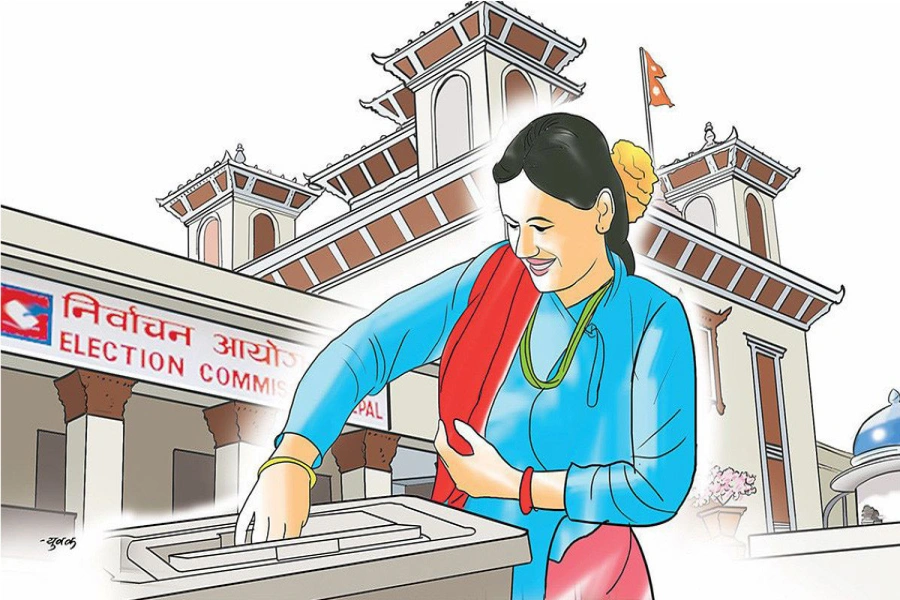
After the Jana Andolan, it was announced that 33 percent of the seats in the Legislative Parliament would be reserved for women. However, the announcement is yet to come to implementation.
Dr Govinda Thapa, researcher of violence against women and access to justice, said that such injustices toward women are the product of our tradition, upbringing, and the socializing process of the society. He said that changes are turning slower than expected due to the macho culture prevalent in our society. He also informed that women continue to suffer, despite legal provisions, due to the long held male domination in tradition and culture existing in the society. “Women are found to deliver properly if they are provided with responsibility,” he added.
The political parties themselves need to increase women’s participation in their organizations as it is the political parties which govern all the sectors. All-round efforts are needed for the policy of inclusion to be translated into actions in the coming days, ensuring women’s upliftment.
Sancharika Feature Servic
Related story
Innovative take on gender equality