KATHMANDU, March 7: Half a dozen bangles on each of her hands, she doesn’t let her pachyauri fall off her head. She isn’t literate but she can deftly copy designs and has managed to make her husband’s name in one of her bangles, with silver sequins. Pinki Das has been making bangles for seven years now, after learning this skill in one of the trainings on bangle-making in her village. Out of the two women who took this training, she’s the only one who has continued and sells her handmade bangles in her small family-run cosmetic shop in Pureshwor in Dhanusha. [break]
Women in her village aren’t allowed to go out of their houses easily.. This is Pinki Das’s first time in Kathmandu and she’s made the journey from her house in Pureshwor in Dhanusa to the city with her husband. Back home, she rarely leaves her house. Her mother-in-law brings her all the materials she requires to make bangles and even accompanies her in case she has to travel to take various trainings.

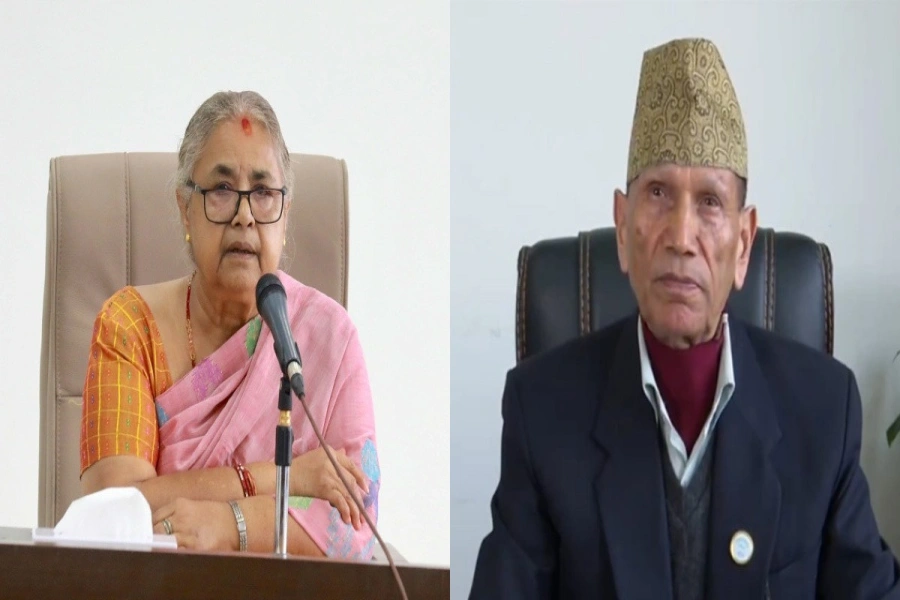
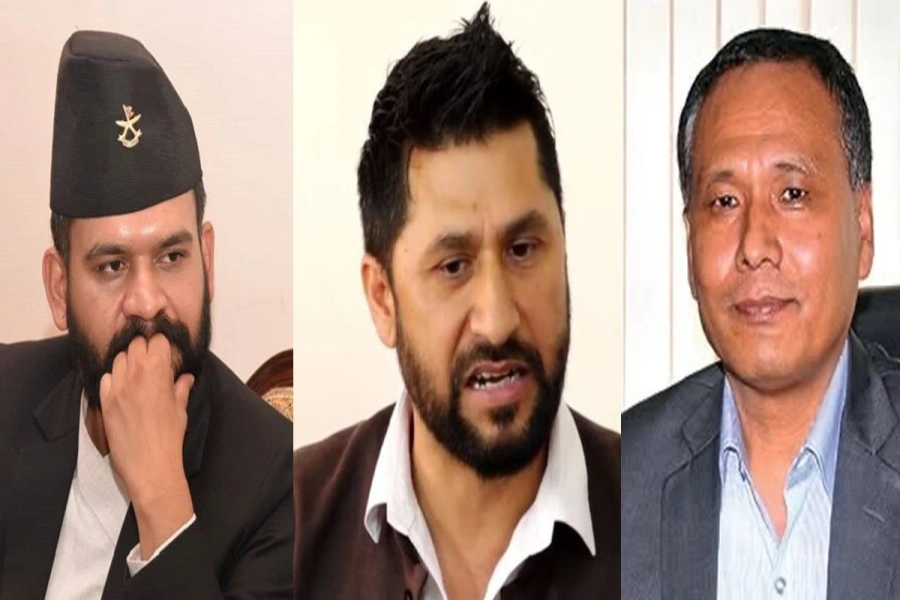
A combo picture of, from left to right, Durga Danuwar, Pinki Das and Parbati Das. (Republica)
Pinki was married off to her husband when she was 15-years-old. At that time, she hadn’t even met him. She now lives with her in-laws and has two sons. With the profit that she gets from selling her bangles, she pays for her children’s education.
She wishes to travel to different places to attend various training programs to gain more skills and make new friends. Business is good and she wants to continue but if she could afford to buy machines, work would be much easier for her. As such, she has simple goals. Nothing radical or rebellious. But you can’t misunderstand her obedience to her society’s boundaries for her naivety. Sure, she admits that were she to travel to Kathmandu alone, given the fact that she can’t read or write or speak Nepali, she’d be lost. But Pinki is very capable and highly aware of the fact that women have to be financially independent.
“A woman has to do all the household work but she’s rarely given any credit. Whereas a man, he might only be earning Rs 100 and spending half of it on alcohol, but he has a certain status in the society,” says Pinki. “All women should earn at least some money so they don’t have to always beg for money,” adds Pinki. She hopes that other women like her, also become more aware and capable to learn and do something that isn’t limited to household chores.
Surely making a name of her own and becoming an inspiration to all women is Parbati Rai from Bagaha, Udayapur. She’s strong and confident and one can tell that the struggles in her life have shaped her to become the woman she is.
Parbati believes that a person becomes an entrepreneur, either for the money or for the name. “I took up the incense making business out of dearth,” she says. After receiving training on incense-making, she took the risk and borrowed Rs 6,000 from the Srijana Women’s Group in her village, of which she was the president, and invested in making incenses. She hired women to make incense for her and took up the responsibility to market the product. Today, she employs around 23 women and makes about Rs 15,000 every month.
Life is much better for Parbati but, she recalls the times when there was no food to eat and no place to call home. She used to be an athlete and even has experience travelling to the SAARC nations, representing Nepal. But her sports career ended after she got married and had children.
She married out of her cast after falling in love with a Newar man who left her five months pregnant with their first child. She was on the verge of taking her life and was preparing to hang herself, ready to kick the stool when her unborn baby made her first movement inside her and kicked her into her proper senses. She then resolved to live for her child. With some financial help from her brother, she went on a search for her husband and was able to find him. She lived with him after that but life wasn’t easy.
It’s much better now. “I may not be able to give my two daughters expensive clothes, but I can very well afford to clothe them decently, educate them and prepare them for the future,” says Parbati. She wants her daughters to grow up to become business women while she herself wishes to expand her incense-making business.
“People should be empathetic. Women should especially understand each other’s pain and come together,” shares Parbati who has been helping other women back home. She also believes that perseverance is important and that although there are different struggles that one has to go through, one shouldn’t act out of frustration.
Frustration. This isn’t an unknown feeling for Durga Danuwar too, a resident of Jogidaha in Udayapur. Differently-abled there was times when she felt ashamed of her bad foot. But she didn’t let her resolution falter. Married to a simple, laborer man, money was never enough at home. Hence, she started making dalmot with a mere Rs 300 investment, after receiving some training on the same. From half kg to now 20 kgs per day, Durga makes about Rs 800 to900 profit on a daily basis.
Work isn’t easy. “But I’m not afraid of hard work,” she says. Her hand is full of burn marks, testimonies of her hard work, the ones she got from mistakenly landing her hand in a wok full of hot oil. Durga goes from shop to shop, sometimes even on foot, to sell her products.
She’s got a supportive family and a loving husband and she feels lucky about that. With support from her family and her continuous determination, she wants to be able to give employment to struggling women from her village. Today, she’s not only supporting her family but is also involved with training other women like her on making dalmot and has travelled from Illam to Dailekh, conducting training programs.
Durga, Parbati and Pinki are examples of the fact that a little push can go a long way. For city-businessmen and entrepreneurs born amidst opportunities and prospects, who talk millions of investment and billions of returns, what these women have been doing might not mean anything. But they’re inspiration to many women struggling with lack of education, economic deprivation and social bias.
Pinki Das, Parbati Rai and Durga are amongst the women entrepreneurs supported by the Ministry of Industry, UNDP and AusAID. They’re also featured in a documentary series ‘Sangarsha’ which will be showcased at the Russian Culture Center in Kamalpokhari to mark the International Women’s Day.
Related story
Mandatory VAT puts small enterprises like beauty parlors and ta...