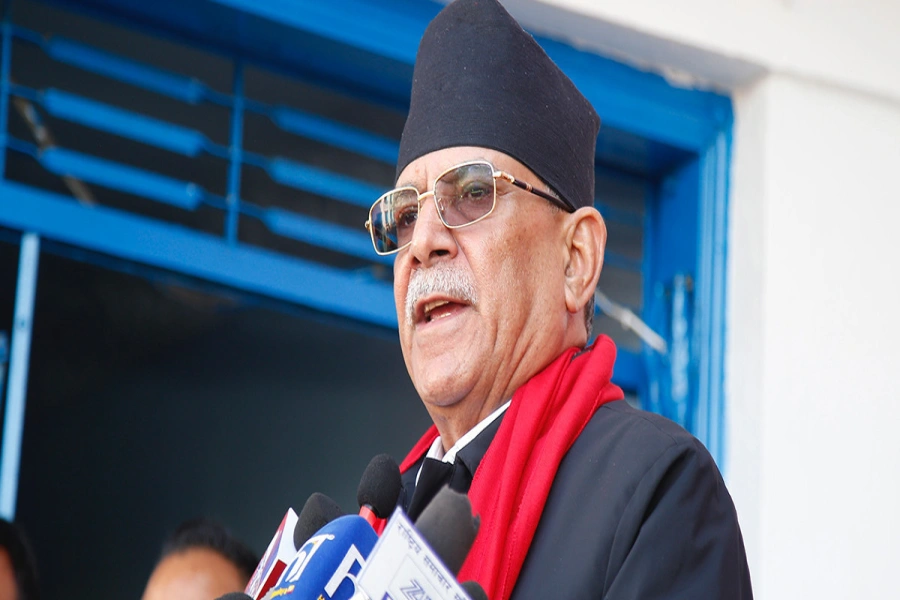
The long-predicted vertical split in UCPN-M finally materialised on June 18. The splinter party of CPN-M chaired by Mohan Baidya aims to establish ‘people’s republic’ through the line of revolt as opposed to the line of peace and constitution adopted by its mother party UCPN-M led by chairman Pushpa Kamal Dahal after entering parliamentarian politics. In a press conference following the break up, Baidya termed the establishment duo of Dahal and Baburam Bhattarai ‘neo-revisionists’ and ‘reformists’ who have failed to meet people’s aspirations by backtracking on real agendas of insurgency. CPN-M aims to revive and establish parallel local government and is preparing for a revolt. Baidya justified the split as need of the hour, much-needed to protect the true ideals of Marxism which, he claims, have been losing ground in contemporary Nepali politics.

Though Marxism primarily talks about proletarian revolution arising out of class conflict in the society, in the case of Nepal, the state-sponsored caste-based/racial discrimination has largely contributed to formation of class stratification. In Nepal, the Brahmin-Chhetri caste-hegemony has marginalised other castes and ethnicities from state institutions for centuries. The Maoists during the insurgency took up the issue as one of their main agendas that in turn helped them secure their strategic position in rural Nepal with the support and active participation of oppressed communities. The Maoist insurgency that started in February 1996 ended with the signing of Comprehensive Peace Agreement (CPA) with the Seven Party Alliance (SPA) on November 21, 2006. It should be noted that Baidya and other senior leaders close to him were still locked up in Indian prisons during that historic juncture. Their resentment against the establishment faction began to thrive following the party’s Chunbang meeting in Rolpa in 2005 that adopted the line of democratic republic, paving the way for the signing of CPA, contrary to the wishes of hardline leaders.
After the Maoists entered parliamentarian politics, chairman Dahal has time and again said that he is finding mainstream politics tougher than armed insurgency. The Maoists had to make compromises to fit in, which they did, to the hardliner faction’s disapproval. Dahal’s unprecedented show of flexibility sowed the seed of differences in the party. All the resentment that had been building but poured out leading to a split after the demise of CA, that could make no substantial political gains. Currently, the newly formed party CPN-M wants to start anew on the path of revolution, though a violent struggle might not be viable at this point. However, the disgruntled ethnic population and other minorities who had once backed the Maoists may back them up once again only if the approach of their intended revolt is non-violent and masses friendly.
Now, the challenges for the hardliner party are immense. To achieve true Marxist goals, they need to overthrow ‘capitalist’ forces, ‘reactionary’ forces, ‘foreign imperialism’ and ‘bourgeoisie domination’ to bring about rule of the proletariat on the way to establishing a classless revolutionary society. How viable is this option today? In Dahal’s calculation, as things stand, such a goal would be extremely difficult to achieve and hence he chose the easy way out of aligning with the traditional parties, which earned him sobriquets like ‘neo-revisionist,’ ‘traitor,’ ‘rightist,’ ‘reformist,’ etc from the hardliners.
Mao Zedong had drawn heavily from Marxism to develop his own political vision, in keeping with the socio-cultural, economic and political realities of China at the time. Lenin had done the same when he applied Marxism in Russia. The Nepali Maoists claim Marxism-Leninism-Maoism as their guiding principle but there has been no creative application of Marxism as per the socio-cultural, political and economic realities of the country. UCPN-M claims to be experimenting with Marxism in a new way alongside the parliamentary model of democracy, as CPN-UML has now been doing for a number of years. However, the latter seems to have quasi-rightist leanings. It is not inconceivable that UCPN (Maoist) will not suffer UML’s same fate as the once revolutionary party gains notoriety for practicing patronage politics, much like the two traditional parties. Creative application of Marxism doesn’t mean a movement towards the right. Nor does the party become reformist and revisionist by adopting changes in accordance with the country’s ground realities. Baidya should not be a fundamentalist in application of Marxism, but should rather incorporate changes in keeping with the times and context.
It is possible to end elite domination in all aspects of Nepali society through judicious application of Marxism by Maoist parties.
Notwithstanding the CA fiasco, its existence helped to outline people’s aspirations clearly. The unprecedented rise of political consciousness in recent years has made the oppressed people more assertive for their rights. In such a situation, CPN-M can act as a catalyst for social change. However, the confrontation between the cadres of UCPN-M and CPN-M that recently surfaced over the ownership of party offices in certain districts doesn’t bode well. The two Maoist forces should at least refrain from fighting even if they can’t work together. If they are true Marxists, then they should realise that the need of the hour is to work and fight together against the historical caste hegemony which lay the foundation of class disparity in Nepal.
We’re neither in a position of reverting to the constitution of 1990 nor have we been able to come up with a palatable constitution. In such a situation, the bickering between communist forces will be detrimental, not only for themselves, but for the entire country. If they really want to salvage the gains of ‘people’s war’, they should learn to tolerate opposing viewpoints, not letting their big egos come in the way of meaningful solutions. Otherwise, their collective gains so far will be undone, rendering the decade-long insurgency a complete futile. A piecemeal approach is more expedient now as opposed to going for a revolution at one fell swoop. The end of the upper-caste elites’ domination of political, cultural, social and economic spheres can be a stepping stone to shaping a larger picture of Marxism in Nepali context.
The author is currently pursuing his BA in English and Social Work at St. Xavier’s College
Related story
'Game of Thrones' creators to adapt Chinese sci-fi trilogy for...