A common generalization about Madeshi leaders, especially those in power, in Nepal is that they are opportunists driven by lust for power and money, working more for their personal gains than for public good. This may be unfair but there are some grounds behind this unpleasant “allegation.” When in power, most of the Madeshi leaders have filled up their resumes with records of corruption, irregularity, eccentric remarks, uncivil actions, irritable tantrums and buffoonery. And never has this been better-manifested than in the post-2006 politics where Madeshi parties and their leaders have had mainstay. Let me give a brief recapitulation.
The first to spark controversy was the first vice-president of the Republic of Nepal, Parmananda Jha. He made travesty of his own learning and wisdom by first taking oath in Hindi in 2008 then lying to the public, in Nepali, that he knew no Nepali and then reinstating himself, reluctantly following the Supreme Court’s verdict, by retaking oath in Maithili. As this controversy was brewing, the then CPN (Maoist) lawmaker and Minister for Forest and Soil conservation, Matrika Yadav, locked Local Development Officer (LDO) of Lalitpur inside the toilet of the latter’s office for over one and half hours. How disgusting, we said.
But more of this sort was yet to come in the succeeding governments. Education Minister Ram Chandra Kushwaha of Madhav Kumar Nepal administration sold teachers’ quotas and amassed millions. State Minister for Agriculture and Cooperatives Karima Begum smacked a CDO in Parsa for failing to provide her a lustrous car. As the then Prime Minister Madhav Kumar Nepal could not chastise her, leaders of Kushwaha and Begum tendency felt emboldened to go wayward. It is exactly from this point that people began to extrapolate Madeshi leaders as corrupt power-mongers capable of any vile.
Madeshi leaders in the Baburam Bhattarai government have kept the legacy differently. Take ousted Defense Minister Sarat Singh Bhandari. His infantile threat to “secede” 22 districts of Madesh from Nepal not only cost him his position but also helped frame Madeshi nationalists as “secessionists.” There is no denying that Bhandari committed a mistake. But the condition which he had entailed in his declaration “if the state remains to be indifferent to the sentiments and demands of Madeshis,” had to be equally taken note of. Bhandari’s remark was rather unduly overblown by Nepali Congress (NC) and CPN-UML.
Ever since the ouster of Prabhu Sah and Sarat Singh Bhandari, Madeshi leaders have not only refrained from controversy and tantrums but also been treading on politics cautiously. There have been no vitriolic and no threat to pull out from the coalition from their side.
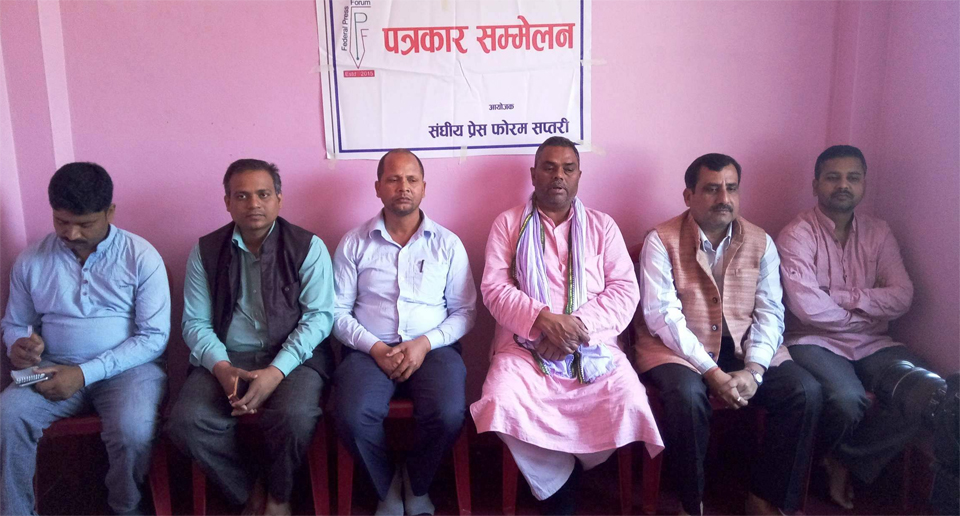
It is debatable whether Bhandari had committed treason. But if Bhandari is to be characterized a traitor, what would one say about Health Minister Rajendra Mahato? Mahato reportedly sought to bribe journalists on Dashain eve and when the latter made his nefarious scheme public, he threatened the whistleblowers—“whoever raises fingers against Madeshi leaders will have their fingers chopped off.” For me, this is as much treacherous a remark as Bhandari’s. Flaws and weaknesses fetter Deputy Minister and Home Minister Bijay Kumar Gachchhadar’s political past. He tried to hold the cabinet hostage as soon as he came to power. He had an honest secretary transferred and made a silly wish—“all earthquakes go to the West.” And, worst of all, he walks with a notorious gangster Ganesh Lama whom he has harbored as the central committee member of his party.
How powerful Lama is and has been was apparent on October 19 when he, Lama, was taming Bhandari loyalists in the premises of Madeshi Janaadhikar Forum (Democratic) party office. Once Lama intervened, all Bhandari loyalists, who were shouting slogans against Gachchhadar, meekly submitted.
Yet, there are some good things about Gachchhadar. He was more considerate to the public mood in Bhandari dispute and played a crucial role in settling it. As soon as Bhandari made a secessionist remark, he called a press meet and termed it unfortunate. Coincidentally, ever since the ouster of Prabhu Sah and Sarat Singh Bhandari, Madeshi leaders have not only refrained from controversy and tantrums but also been treading on politics cautiously. There have been no vitriolic and no threat to pull out from the coalition from their side. I take Gachchhadar’s initiative into signing the latest peace deal and his address to the parliament as a good gesture. In his address to the parliament, Gachchhadar was not only civil but was cautiously polite in requesting NC and CPN-UML to not misinterpret the four-point deal signed between some Madeshi parties and the Maoist party. On Saturday, he applauded SP Ramesh Kharel in Birgunj and promised to groom officers into Ramesh Kharels all across Nepal. Other Madeshi leaders have not committed anything untoward since October 19. This may not be a hallmark but could surely be a sign of change.
Prime Minister Dr Baburam Bhattarai’s good intentions are often critiqued on the ground that he is shouldering a bunch of corrupt politicians in his cabinet. In this month’s “prime minister with the people,” a live question-answer session, aired on Radio Nepal every month, Bhattarai was asked: You have been doing good but with stinking men in your team, how will you succeed? To the question, Bhattarai responded by taking recourse to metaphor of Ratnakar and Balmiki. Even Ratnakar had transformed into a sage, Balmiki, hopefully they will change, he said. Dr Bhattarai was tactfully referring to the corrupt ministers of his cabinet as the Ratnakar of the past and held the conviction that they would one day be Balmikis. Ratnakar and Balmiki are too overstretched metaphors. But the signs are that Madeshi leaders are changing into responsible politicians.
What has catalyzed changes in the behavior of Madeshi leaders? A part of the answer is chastisement of Sarat Singh Bhandari and Prabhu Sah. This has given a clear message to the rest of the leaders that politics is moving toward a direction where minister’s wrongdoings will not be tolerated. Another part of the answer is the personal integrity and honesty of the prime minister. With an honest head in team, it is immoral for the subordinates to continue with the waywardness. And the most important part of the answer is the political consensus. Now that the three major parties are slowly coalescing together with regard to consensus government and peace process, Madeshi leaders are losing leverage to insistently threaten to break away from the coalition if things do not go their way. A good lesson for political parties to take note of: Political consensus can settle most scores, even the unruliness of the leaders. Hopefully, with the new development, they are likely to behave well in the days ahead.
On their part, Madeshis have been unfairly dealt with by history. Until 1951, people from the Tarai region needed permit from their own government to visit Kathmandu, which in turn caused them problem of identification in psychological terms. As the nation moved to Panchayat regime, their linguistic territory was further encroached. The 1961 constitution instituted “Nepali in the Devnagari script” as the national language when Nepali was lingua franca for majority of the population. More, in 1965, Hindi news broadcast was terminated on Radio Nepal. The elimination of Hindi was sealed in the 1971 census when the census commissioners listed the Tarai regional languages as Tharu, Awadhi, Bhojpuri and Maithili. I take the occasional Hindi outbursts from the Madeshi leaders in the parliament as an avenge on Mahendra-era exclusionary politics. But it will be unfair for them to hold current leadership responsible for historical wrongs. After 1990, Nepali politics has been kind to Madeshi leaders and after 2006, it has been the most benevolent to them. Now the leaders have to pass that benevolence to their people.
There is yet another front in which Madeshi leaders have to change: Disburdening themselves from self-lacerating mentality of Madesh and hill divide. When a non-Madeshi from a hill-Brahmin origin, like this scribe, discourses against evils of Madeshi leaders, he often has to bear the indictment of being an anti-Madeshi racist and an advocate of parochial nationalism. Worse, he is even taken to the level of having nurtured what some postcolonial and subaltern theorists call “disgust complex” or behaving like a home-grown
Orientalist. Madeshi leaders should break the shackle of this mis/understanding. This may be an ambitious demand. But considering the events unfolding since October 19, and fair play by the leaders in the national politics, this is a little thing one can ask for. Madeshi leaders are changing. With confidence, I give them the benefit of doubt.
Related story
Previously companions, now competitors