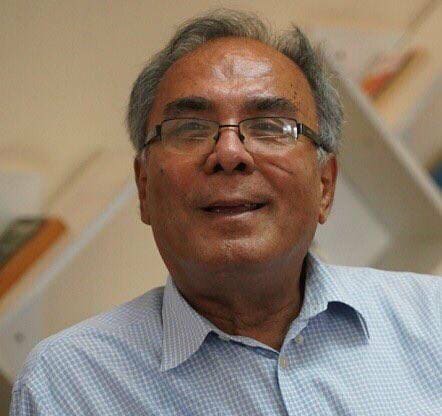
Krishna Prasad Sigdyal, with his commonsense approach, has made just such an attempt in Sana Kura. [break]
This fair-sized tome is a compilation of what journalist Krishna Prasad Sigdyal said in his weekly “Kurakani” broadcasts over Radio Sagarmatha FM from 2063 BS four years ago and onwards. It comprises 129 broadcast articles on his musings on various matters concerning national life and public affairs. Not originally meant for the print media, it has been published in response to encouragement from listeners. Since the articles were prepared for broadcasts, the language and presentation reflect this.
The articles cover eight broad topics, including 1) Constituent Assembly, 2) Nepali politics, 3) international relations, 4) water resources and energy, 5) industry and commerce, 6) environment and our behavior, 7) administrative system, and 8) society and community.
 Though titled “Sana Kura” or Small Matters, the wide range of topics covered by the book indicates an attempt to address the entire gamut of issues affecting our national life. Views have thus been put forth on problems of political, economic and social natures, on where the country is headed and how it is faring, its boundless potential and the obstacles to tapping this, the existing administrative system and the rot that has set in, the difficulties in our relations with India and China and our diplomatic floundering, the uncertainties of the transition period, the political parties that find themselves at a loss, and more.
The clear-cut analyses and views contained in the book are based on informed observation. The author gets across his deep concern over the failure in Nepal to do what should be done and over the things that end up getting done that should not be done.
He makes no claim to originality in what he has to say, nor any bones about the fact that his book is not based on any serious research. It is a journalist reacting to the developments of the day. His aim has been more to present a living picture of the country through an admixture of his own experience and the research and thinking of scholars. He says, “This collection has been published with the sole intention of better informing a lay public. It has nothing to offer that can be quoted in the research reports of experts.”
Within the constraints of a broadcast format, the author has tried to draw the attention of the general public as well as of particular circles to the many issues he has taken up. Written in simple prose, even a reader with just a basic education can profit from it and draw some conclusions about the topics addressed. This kind of book format can be taken as something of a novelty in Nepali writing. It holds up a kaleidoscopic mirror to society.
Sana Kura stands as a record of contemporary events, of the aspirations and angst of the present generation. It is also indicative of how the spin-off from national politics impacts on daily life, and what difference this can make to the progress of the nation. It exemplifies how an observant citizen has reacted to what is happening around him and to the way things are headed. At another level, the book represents a flashback to the months and years of political transition.
With its commonsensical approach, the book gives some insight into what the masses think of our leaders and decision makers. For them, a glance at this book is a must. He says, “Nepali politics is like a skit put on by raw actors who have not been trained nor have practiced their craft. Somehow or other, it seems out of sync. It feels like it is neither here nor quite there.” This assessment is borne out by the actual politics.
Sigdyal comes across particularly strong and lucid when he deals with Nepal’s difficult geography and the way this has translated into the challenges it faces in foreign relations. The author delves into the untoward aspects of relations with India against a historical background of the giant southern neighbor forever trying to nudge Nepal into a tight corner. The same analytical approach based on ground realities has been brought to bear on relations with northern neighbor China, the rising force in the global economy. In dealing with these two neighbors, he indicates the need for a balanced perspective that is both firm and steady as Nepal goes.
He makes the observation that Nepalis tend not to be preoccupied with minor matters, with mundane things. From economists to politicians, it is the grand topics that figure in their conversation, blissfully ignoring the fact that in life, as in legal documents, the devil is in the detail. Even people who barely manage to make ends meet from day to day tend to wax eloquent at the neighborhood teashop about Barack Obama’s economic strategy or the carnage in Iraq. This book is an attempt to help bring such folks back on track.
As a concerned citizen, Sigdyal worries that the country will eventually go under, lag behind further, the economy will founder, the administrative machinery will be overwhelmed by uncertainty and confusion, politics will lose all sight of morality, and leadership will fail to rise to the occasion. His is an attempt to see things big and small against the broader picture of national progress, to seek out the positive even in what is patently grim and disappointing. Suggestions on offer range from how political and diplomatic maturity can better address the country’s strategic situation to how we can become proud members of a civilized society.
On negative notes, the book does belabor certain topics and scatters them about rather widely. As media commentary prepared for a particular point in time, the topicality of what is said may have lost some of its edge. But the reader can nevertheless come away with something.
Sigdyal also puts forth a somewhat frightening scenario, something that does not get the focus it deserves in present political discourses and media commentaries. Outside the country, there could well be a convergence between those who say that monarchy must be restored in Nepal and those who are for taking advantage of these times of our national weakness to get treaties or agreements that suit their own interests signed and sealed. It was under such circumstances that Rana Prime Minister Mohan Shumsher signed, among other things, the treaty of 1950 between Nepal and India. Might history not repeat itself?
The author is fed up with politicians who keep swearing by the New Nepal. He asks, “What is this new Nepal?” Are the next ten or twenty years to be used up simply harping on this three-word mantra of federal democratic republic? It is a question that has occurred to many.
Related story
Song titled ‘Pradesh’ from the movie 'Hijo Aaja Ka Kura' releas...