Had a female student leader such as Ram Kumari Jhankri not won the election for president of the UML-affiliated All Nepal National Free Student Union (ANNFSU), young female leaders would still have not caught the eye of the media. [break]
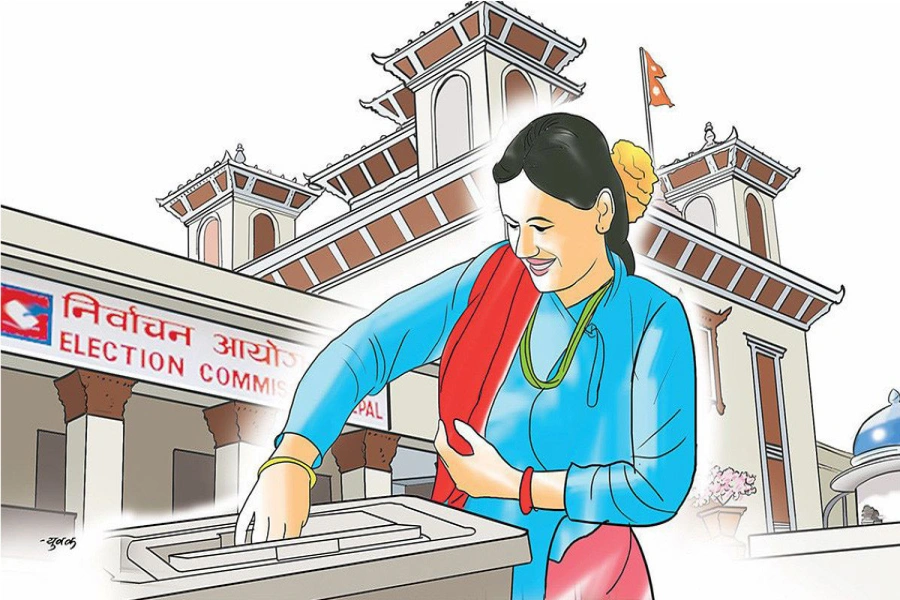
On the threshold of the Free Student Union election three young female leaders from different student unions affiliated to political parties were interviewed.
 Urmila Thapaliya, a central committee member of Nepal Student Union (NSU), is studying Political Science at Tribhuvan University (TU).
Manushi Yami Bhattarai, a district-level member of All Nepal National Independent Student Union-Revolutionary (ANNISU-R), is a Political Science student at TU.
Narayani Devkota, a central committee member of UML-affiliated All Nepal National Free Student Union (ANNFSU), is doing her Bachelor of Arts from Padma Kanya Campus.
Urmila is the most experienced of the three, having devoted 15 years to the union. Audacity defines her the most. She talks the talk of a strong leader and is determined to establish herself in politics.
Manushi has been a member of the Unified CPN (Maoist) for the past seven years and is currently with ANNISU-R. When one sees her for the first time, one is struck by her very young face but the surprise increases when she starts talking. She speaks the language of the common people, not words and ideas that student or political leaders prefer.
Ambitious and candid Narayani has a lot to say when it comes to politics and her own life. It has been five years since Narayani Devkota was affiliated with ANNISU.
Why Politics?
In her own words, Manushi is in politics as it is one medium for bringing positive change in society and it’s at the head of everything.
Narayani has a different story to share. During the Magh 19, 2061 protest against the monarchical system, she was arrested and jailed for two days along with some friends. She realized then that politics touches everyone.
Urmila had recited a poem to welcome Girija Prasad Koirala when he was in Dhading for a conference. Impressed by the girl’s aptitude Koirala shared some words of wisdom with her. This attracted Urmila towards politics at the tender age of 12.

Women leaders in FSU election
Women have been marginalized in terms of quality and quantity in every sphere of life. But times are gradually changing, opines Manushi. She adds that her organization, ANNISU(R), has even come up with a policy of including at least two women in the five top posts in the organization.
The chances of women student leaders standing for president at ANNFSU or elsewhere are waning, says Narayani. She adds, the reason for this is lack of ability of women leaders to put together gangs and mobilize them for the various activities of the student union. Narayani feels that other than in physical ability women are equal to men in every aspect.
To date no woman has been able to secure a vital post in the FSU, informs Urmila. She further adds that this time there are only a few women leaders who have been nominated to run for president, something which has minimized the chances of women winning the vital post.
Problems faced by women in politics
 Unlike women, men have plenty of time to devote to politics. At Tribhuvan Universtiy many women students are married. Therefore time constrains them from devoting themselves to politics as they have to look after their families also, says Manushi.
Narayani adds, biological problems further constrain women from entering politics as it involves traveling a lot. And it is also weakness on the part of women not to be able to share with colleagues problems like their monthly period.
Urmila on the other hand presents a whole new answer. She says that if a woman wants to enter politics she has to fight against three forces - family, society and the state. Family members most of the time discourage women, and especially students, from entangling themselves in politics. Then there is society that gives them a number of names. Finally the state enervates women by treating them as second class citizens.
Beside the above, a common problem faced by women leaders is being threatened with kidnap and even rape.
Why should students participate in politics?
Narayani: For their rights. If one wants to lead and contribute to the country and society one has to understand politics right from the student years.
Manushi: To raise issues relating to students and bring about positive change.
Urmila: Politics is the responsibility of every citizen and students are no exception.
One issue that has always bothered them after they entered politics
Urmila still feels sad when she reminisces how women from her own village accused her of eloping when she came to Kathmandu for further studies and joined politics so that she could contribute to the empowerment of women.
Whenever a woman joins a political party or union, she is taken as being representative of women rather than everyone in general, remarks Manushi.
Narayani is annoyed by flattery by some of her friends, which contradicts their talk about her.
Despite the different backgrounds, all of them share an equal fervor for politics and have the vim to bring positive change in the mentality of people regarding the ability of women.
Related story
FSU Election: Things to Consider