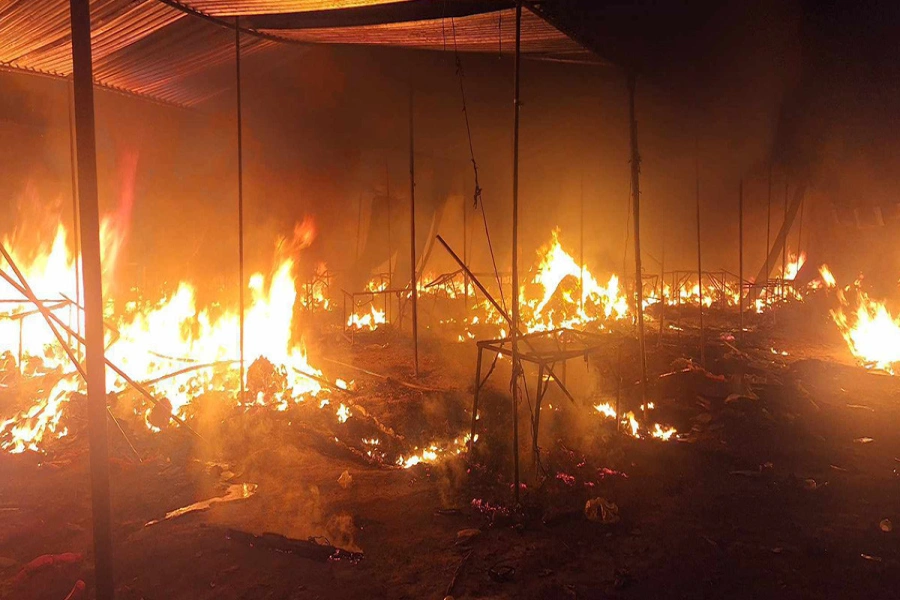
During Jan Andodan II against the royal-military regime of the last Shah king Gyanendra, Ashmina was holding street exhibitions of installation art to raise awareness against excesses of the government machinery.[break]
Born in a traditional family of Kathmandu in 1966, her artiste father Kiran Ranjit did not want her daughter to follow in his footsteps. Ashmina herself wanted to fly, but destiny would have her chase spiritual freedom through arts. To give shape to her dreams, she enrolled at Lalit Kala Campus in Kathmandu and completed BFA (Painting, Sculpture & Art History) from Tribhuwan University. She obtained another BFA (Printmaking, Painting & Art Theory) from the University of Tasmania, Australia, in 1999 and finally finished her MFA (New Genre, Visual arts) as a Fulbright scholar from Columbia University, New York, NY, USA in 2006.
Does she need any more degrees?
“Why not? There’s no end to learning,” is her retort.

She compares the process of her creation with that of a mother giving birth to a child. In her opinion, the combination of pain and pleasure is impossible to describe. It can only be experienced, never understood. She is a mother, and we have no reason to doubt her comparison of physical and emotional processes of pregnancy and childbirth. She believes art and life cannot be separated.
But they are not the same, are they?
She pauses, and responds that differences are in perception rather than reality.
For Ashmina, audience is an integral part of her art, a participant rather than just an observer. She has presented these concepts with the room as a womb, or moods of women through hair warps, to bewildered and then becalmed audience of Kathmandu.
Ashmina likes to call herself an interdisciplinary visual artist who can use her training as a painter, a printmaker, a sculptor, and an innovator for installation, live art performance along with video presentation, painting, drawing and sound. She prefers to work on social and political issues that advocate change. She has traveled and exhibited widely in Asia, Europe, Australia, and the USA, including the Dhaka Biennale, Fukuoka Triennial, and the Third Guangzhou Triennial. Her installations, performances, and films have been included in solo and group exhibitions around the world. She has participated in several artist-in-residence programs in Asia and Europe.
It is difficult to generalize about Ashmina’s oeuvre: they are too varied to fit a simple definition. However, most of her work meets conditions set by philosopher and art critic Arthur Danto. Her works have a subject, usually topical, but also of enduring nature. Her style is distinctive. They engage the audience. However, she probably deviates from art’s historical contextual condition of Danto’s institutional definition. She experiments and expects her work to be self-explanatory.
What next, Ashmina?
“Gender, democracy, and issues of common concerns,” is her quick response.
Well, whatever Ashmina says, she can and will do.
Related story
‘Silence No Longer: Artivism of Ashmina’ launched