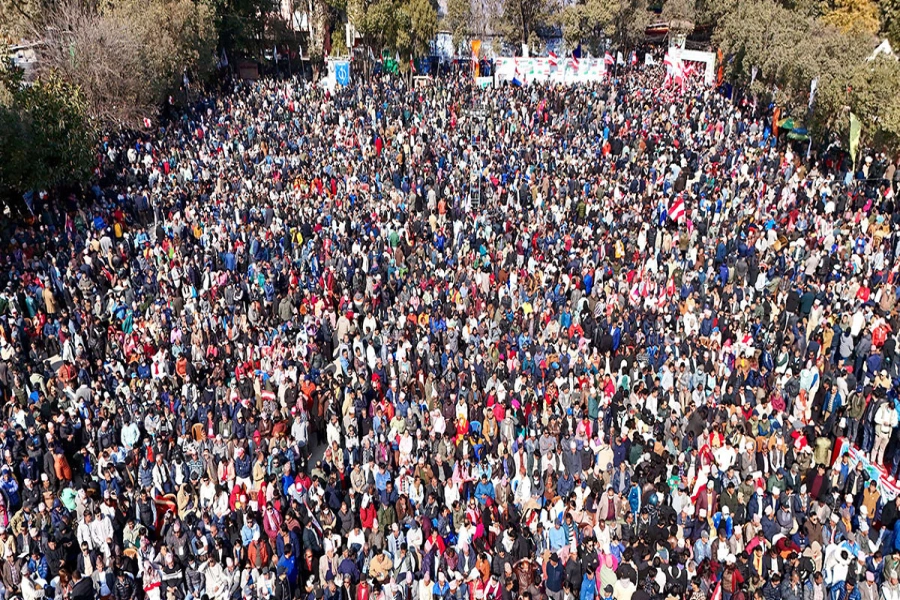
The outpouring of grief was also a recognition to the void created by his death, at a time when there is no single person in sight who could offer a decisive leadership to complete the unfinished tasks of the peace process and drafting of a democratic constitution that could lay the proper foundation for a peaceful, democratic and economically prosperous Nepal.
BOLD AND ADVENTUROUS
He was a man of steely determination who liked to live dangerously. He never hesitated to take decisions fraught with grave risks. Once he made up his mind about something, he would not retract come what may. He often said: “I have habit of only looking forward, not behind.” His decision to marry a widow with a son some six decades ago must be considered a revolutionary step, given the Nepali conservative social values of that period — a fact made possible no less by the liberal modern values imbibed by the Koirala family. He never remarried after the untimely death of his young wife. His decision to slip into the then East Pakistan under martial law in 1971 with truckloads of arms to support the Bangladesh liberation movement, speaks volumes about the courage of the man. It was B P Koirala’s decision to divert the arms in possession of Nepali Congress meant for anti-Panchayat insurgency to support the Muktibahini. B P was convinced that the democratic movement of Nepal would receive a serious jolt “if the light is extinguished from Bangladesh”. Girija Babu himself volunteered for this adventurous task.
Girija Babu was not a puritan stickler of proper means, when he believed in the rightness of the end. Knowing that B P would not agree to the plan to high jack the RA plane in 1971 carrying three million rupees from Biratnagar to fund the cash starved party in exile, he kept the plan secret from BP until the last days when all preparations for this adventure were completed. That helped the party tide over the financial crisis for some time. He has more than once said, upon being goaded by some friends in exile, he had even tried to make fake notes when desperately in need of cash for the party.
ON THE MOVE UNDETERRED
GPK never worried about the risks to his personal life. This becomes evident in a long saga of his career starting from the days of raising arms against the rule. He launched various insurgency missions from exile against the Panchayat regime. Inside the country, he traveled far and wide mostly on foot for party organization without proper security — a quality which endeared him with the party workers that lasted throughout his political career and represented the bedrock of his support base. He was undeterred from the likes of Surajpura incident where the royal regime planned violent attack on his life. Even after the restoration of democracy in 1990, many times he faced hostile opposition crowds with black flags pelting brickbats and stones. But he always remained undeterred and on the move.
His open fight with the towering personality of Ganesh Man Singh, the Supreme Commander of the 1990 Public Uprising who was rightly hailed as the Father of Democracy shows his ability to take grave risk in matter he considered right. Some of his political actions and fights with party giants have been controversial. He has been blamed for sidelining and undermining his peers. History will judge how much he was responsible and whether he could have prevented the infightings and power struggle that plagued the Nepali Congress (NC)for a long time and caused its split, and led to Ganesh Manji’s disassociation and Kishunji’s retirement from party politics. The decision to dissolve the parliament and announce midterm election in 1994 and the open defiance of CIAAA’s politically motivated summons were other bold and stormy actions. The former act proved costly for the party; on the other he was vindicated in the end.
METAMORPHOSIS
Girijababu was a communist in his student days in India and M N Roy was his hero. The turning point came when during India’s Quit India movement, B P Koirala enquired from him the whereabouts of M N Roy. GPK realized that M N Roy was in Europe while Gandhi was in British prison. He was subsequently disenchanted with the Indian communists for their role in the freedom movement.
The metamorphosis soon followed.
He was vehemently opposed to the Maoist insurgency and its ruthless character. His government had directed security forces to crush it. But the royal takeover and subsequent actions convinced him of the threat of continued royal autocracy. His attempts to preserve the institution of ceremonial monarchy as a source of national unity and stability did not find favor from the ambitious monarch. His subsequent acts of establishing contacts and negotiating with the Maoist leadership whom the regime had declared terrorists and placed in the red corner notice globally were serious personal and political risks. He was convinced that this was the right time to bring the Maoists to peaceful politics, since their insurgency had already reached its peak and showing signs of tapering, and that Maoists were looking for safe landing. He staked his political career in this mission. The gamble worked and he succeeded. The failure could have cost him dearly.
DEATH DID NOT WORRY HIM
I had had air travel opportunities with him many times, when we encountered scary moments during bumpy flights in turbulent weather. But Girijababu would remain unruffled — not a trace of anxiety in his face or body posture. Death did not worry him. The Nepali press was generally critical of him during his lifetime. After death he has received profuse admiration. The media probably waited until his death to make proper appraisal. The gap in communication also led to many criticisms. He was also a misunderstood person. He never bothered to defend his actions publicly, nor did he use any PRO and other means. Like a genuine Karmayogi, he believed in action he considered right.
Related story
Prime Life, Union Life and Gurans Life ink a merger agreement