KATHMANDU, Dec 4: The World Bank (WB) has expressed concern over increasing financial risk for low and middle income countries, including Nepal, due to soaring public debt.
Unveiling the International Debt Report 2025 on Wednesday, the multilateral lending institution said about US $741 billion more flowed out of the developing economies in debt repayments and interest than the amount they received in the form of new financing between 2022 and 2024. It was the largest debt-related outflow in more than 50 years.
The WB’s report has come at a time when Nepal has been facing an increasing burden of public debt. For the current year, the government has allocated Rs 15.57 billion for interest payment on foreign loans. This includes an interest amount of Rs 11.71 billion on multilateral loans and Rs 3.86 billion on bilateral loans. Likewise, the budget has set aside a total of Rs 51.88 billion for principal repayments on foreign loans.
Public debt hits Rs 2.8 trillion mark
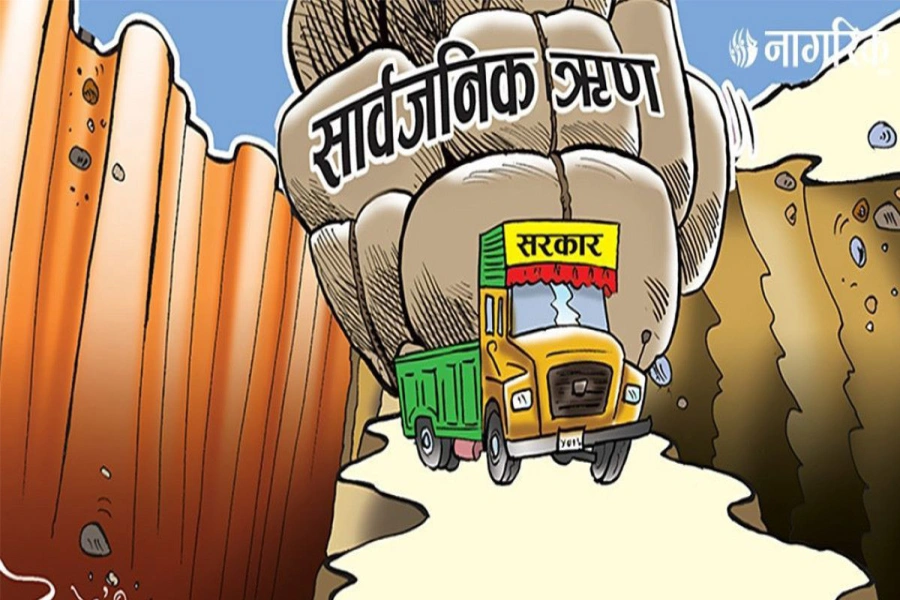
The report shows that in 2024, the total external debt stock of low- and middle-income countries (LMIC) hit a new record of US $8.9 trillion. These countries paid a record US $415 billion in interest alone, according to the WB report.
External debt stocks comprise public and publicly guaranteed long-term external debt, private nonguaranteed long-term external debt, use of International Monetary Fund credit and special drawing rights allocation, and short-term external debt.
In the case of Nepal, its total external debt stocks reached $10.15 billion in 2024. The amount under the heading stood at 234 percent of its export earnings, while it was 20 percent of the country’s gross national income. Nepal faced net financial outflows of $480 million due to the external debt.
China, the largest debtor country among LMICs, accounted for 30.1 percent of LMICs’ interest payments on total debt stock. In 2024, the country’s interest cost on short-term debt stock increased marginally by 1.4 percent to US $82.9 billion, whereas interest payments on long-term debt obligations decreased substantially by 21.3 percent, to US $41.9 billion.
Excluding China, total interest costs of other LMICs increased 7.1 percent, to US $290.6 billion. Interest payments from this group of countries on short-term debt remained almost unchanged, at US $52.4 billion, whereas interest payments on long-term debt increased 8.9 percent to US $238.2 billion.
As per the WB, the mismanagement of debt by the LMICs has been creating hurdles on economic development of these countries. “In addition, the situation has been pushing these countries with poor bargain powers leading to borrowing at high cost from foreign bondholders or stifling the domestic private sector by soaking up the assets of domestic commercial banks.”